

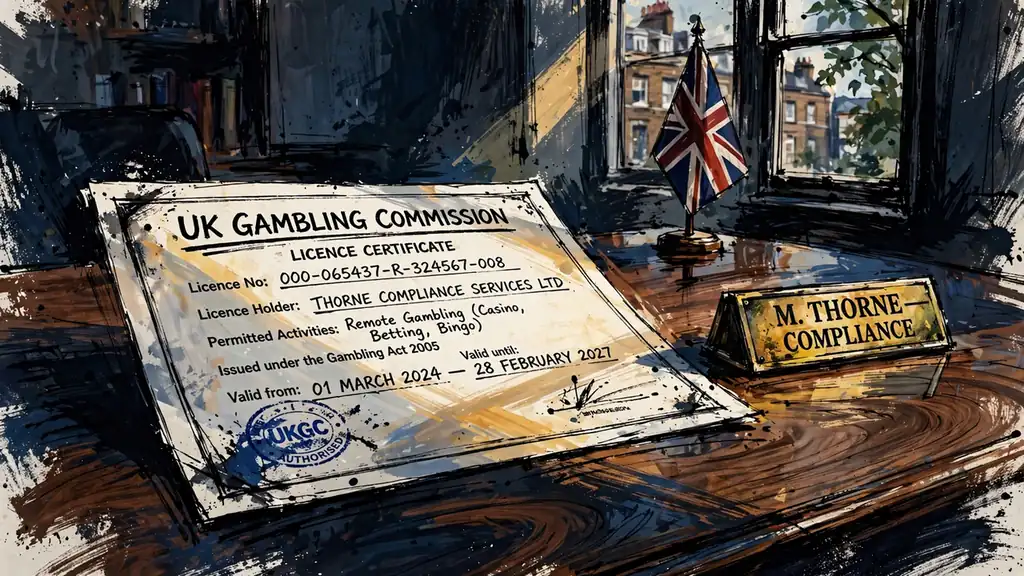
The guide connects licensing with identity checks, app safeguards, bonus terms, games and payment rules, and payout verification.
What a UK Casino Licence Actually Covers
A UK casino licence is not a decorative badge attached to a website. It is the legal permission that allows an operator to offer remote gambling to people in Great Britain. The decisive point is not where the company is incorporated, where its servers sit, or which country appears in its corporate address. The decisive point is where the gambling is being offered.
For a remote operator, serving consumers in England, Scotland or Wales brings the business within the remit of the UK Gambling Commission. That remains true when the company itself is based abroad. A business located outside Britain cannot treat geography as a curtain behind which its British-facing gambling service disappears. If it provides facilities for real-money gambling to customers in Great Britain, it needs the relevant UK Gambling Commission licence.
This is the first boundary worth keeping in view when assessing a trusted casino UK. A polished brand, a familiar payment page or a list of popular games does not establish that the operator has permission to serve the British market. The licence is the legal threshold. Without it, the site is not a licensed UK online casino, however British its language or currency may appear.
Merkur Casino Online UK: Slots and Bonus Terms
What “Great Britain” means here
The phrase “Great Britain” is narrower than “the United Kingdom”. It covers England, Scotland and Wales. Northern Ireland is part of the United Kingdom, but it is not within the Gambling Commission’s jurisdiction under the Gambling Act 2005 in the same way.
That distinction is more than a cartographer’s footnote. It determines which regulatory system is relevant to the service being offered. The UK Gambling Commission regulates remote gambling directed at consumers in Great Britain. Its role should not automatically be extended across the whole United Kingdom simply because the word “UK” appears in a company description or in the name of a casino page.
The Gambling Act 2005 governs gambling in England, Wales and Scotland. Northern Ireland sits outside that framework for these purposes, with its own legal arrangement. A statement that an operator holds a UKGC Licence therefore establishes a particular fact about its authority in Great Britain. It does not, by itself, describe the whole constitutional and regulatory position of Northern Ireland.
Casinos not on GamStop UK: trust and limits
The distinction can feel ungainly because commercial language prefers a single market. Websites often speak broadly of the United Kingdom; regulators must work with actual jurisdiction. The result is a small but important mismatch between the language of advertising and the geography of public law.
The location of the company is not the test
A common mistake is to treat an overseas corporate address as evidence that British licensing rules do not apply. That reverses the question. The relevant issue is not whether the operator has left Britain, but whether its gambling service has entered the British market.
Remote gambling makes this especially important. A casino can be operated from another country while still offering its facilities to consumers in England, Scotland and Wales. The UK Gambling Commission’s licensing threshold follows that activity. A foreign headquarters does not remove the requirement for a UKGC Licence when the operator is serving Great Britain.
This is also why a trusted online casino in Britain must be considered through its regulatory position rather than through appearance alone. A site may present itself as an international business, but a British-facing real-money service still has to meet the local licensing requirement. The rule is attached to the market being served.
The arrangement reflects a wider idea about regulation: a state does not surrender responsibility merely because commerce has become digital or because a company has chosen a distant address. The screen may be borderless. The permission is not.
What the licence tells the public
A relevant UK Gambling Commission licence indicates that the operator is authorised to offer the regulated remote gambling service to consumers in Great Britain. It places that activity within the Commission’s regulatory system and separates a licensed British-facing casino from an offshore operation with no UKGC Licence.
That does not turn the word “trusted” into a guarantee of every commercial promise or every future decision by an operator. Trust, in the regulatory sense, begins with whether the required permission exists. It is a question of legal accountability before it becomes a question of presentation, reputation or convenience.
For gambling offered to England, Scotland and Wales, the operator needs the relevant UK Gambling Commission licence. Northern Ireland is not covered by the same Gambling Commission remit.
The practical vocabulary can therefore be kept simple. For gambling offered to England, Scotland and Wales, the operator needs the relevant UK Gambling Commission licence. The Commission regulates that Great Britain-facing remote activity. Northern Ireland is not covered by the same Gambling Commission remit. A company’s country of registration does not cancel the British requirement.
Those are the ground rules behind claims about safe, legitimate and licensed online casinos in Britain. Before a site can be considered in any more personal or commercial terms, its place in that regulatory geography has to be clear. A licence is not the whole story. It is the door.
A Casino Site’s Name Is Not Its Licence
A casino’s public name is the part designed for recognition. The licence belongs to a legal entity. Those two names may coincide, but they do not have to, and treating them as interchangeable makes the most important line of a review disappear: who is responsible for the gambling service?
Anjouan Casino Licence in the UK: What It Means
This distinction matters whenever a site presents itself as one of many trusted UK casino sites. A polished domain, a familiar logo and a page full of casino bonuses do not identify the operator authorised to provide the service. The trail has to be followed from the consumer-facing address to the regulatory record.
The UK Gambling Commission’s public register is built for that purpose. Rather than searching only for a brand, the check can begin with the domain itself. A domain is the address used by the public; an operator account is the regulatory identity behind it. Where the register connects the two, the relationship becomes visible instead of being left to advertising language or the wording of a casino review.
The entry for 333casino.com provides a concrete example. The register links that domain to Grace Media (Gibraltar) Limited, under operator account 57869. It identifies 333casino.com as a White Label domain. In practical terms, the brand name shown on the site is not the same thing as the company named in the register. The brand is the public-facing label; Grace Media (Gibraltar) Limited is the licensed operator associated with the listed domain.
Understanding White Labels
A White Label domain means the brand name shown on the site is not the same as the company named in the register. The brand is the public-facing label, while a different company acts as the licensed operator.
That is a small piece of information with a large effect. It changes the question from “Does this casino look established?” to “Which legal entity stands behind this address?” The first question invites impressions. The second can be tested against an official record.
A White Label description is especially important because it warns against reading the brand as the whole corporate structure. A site may have its own visual identity and commercial voice while appearing in the register under another company’s account. The label does not turn the public brand into a separate licence holder. Nor does a brand name, by itself, establish that it possesses an operating licence in its own name.
For that reason, a careful assessment of trusted online casino sites in Britain has two separate stages:
- Identify the exact domain being offered to customers.
- Check which operator and account the UK Gambling Commission associates with it.
The spelling of the domain matters. A register entry for one address should not casually be extended to another address with a similar name. A casino brand can be surrounded by mobile versions, regional pages, promotional landing pages or addresses that differ by a single character. The register check belongs to the precise domain, not to the general impression created by the brand.
The same discipline applies to lists described as the most trusted casino sites in the UK, or to articles presenting new casino sites as though newness itself were evidence. A list can be useful as a starting point, but it does not replace tracing the operator. Nor does a favourable description of trusted slots, trusted casino bonuses or a broad game selection answer the legal question of who provides the service. Product language is not corporate identification.
A specialist affiliate review has reported the 333casino.com connection in the register, but a review remains an interpretation or presentation made by a third party. The decisive detail is the relationship recorded in the UK Gambling Commission’s public register: the domain, the company name and the operator account appear together. That is why the register is more useful than a badge placed on a homepage or a sentence claiming that a site belongs among trusted casino sites in 2026.
The operator account number, 57869, adds another layer of precision. Company names can resemble brands, brands can be redesigned, and websites can change their presentation. An account number gives the record a fixed reference within the register at the time it is checked. It does not make a brand and an operator identical; it helps distinguish one regulatory record from another.
Choosing a Casino: UK Options and Key Considerations
This is also why a casino review should name both sides of the relationship when the register provides them: the domain visible to the public and the company responsible behind it. Naming only “333 Casino” leaves the essential connection unstated. Naming only Grace Media (Gibraltar) Limited makes the consumer-facing service harder to identify. Trust, if the word is used at all, rests on the trace between the two.
The exercise is less glamorous than choosing a homepage. It is also more revealing. A casino’s name is marketing; its register entry is accountability.
Trust Is Tested When the Regulator Acts
A casino’s public image is assembled from familiar materials: polished design, a recognisable name, reassuring language and the quiet suggestion that everything behind the screen is in order. None of those things, by themselves, establish how an operator behaves when a customer has asked to be excluded or has withheld permission for marketing. Trust becomes less decorative when the regulator opens a case.
That is what makes the action against Grace Media significant. On 26 June 2025, the UK Gambling Commission required the company to pay a financial penalty of £60,000. The breaches concerned two matters that sit close to the practical boundary between gambling promotion and customer protection: self-exclusion, and consent for direct electronic marketing.
The point is not the size of the number as a piece of publicity. A penalty is a regulatory finding, not a review score. It records that the Commission identified failures serious enough to warrant formal enforcement. That gives the event a different weight from a complaint on a forum, a low rating, or a reviewer’s impression that a casino feels well run. Presentation is opinion. Enforcement is an institutional response.
Regulatory Enforcement
Regulatory penalties, such as the £60,000 fine issued to Grace Media, are formal institutional responses to serious failures in areas like self-exclusion and marketing consent.
When exclusion is not merely a button
Self-exclusion is often presented through the language of personal control: an account feature, a setting, perhaps a button hidden among the other tools of a gambling site. Yet the protection only has meaning if the operator’s conduct respects the decision once it has been made. A customer who has chosen exclusion is not simply changing a marketing preference. They are asking for gambling access and related contact to be treated differently.
The Grace Media case places that responsibility at the centre of the company’s dealings with customers. The Commission’s action establishes that failures connected with self-exclusion were not treated as a harmless administrative blemish. They formed part of the conduct for which the operator was penalised.
That distinction matters when the question is whether an online casino deserves to be called trusted. A site may appear orderly while the important test occurs elsewhere: in the systems that connect account status, exclusion requests and subsequent contact. Those systems do not appear in a banner or a welcome page. They reveal themselves when a customer’s expressed boundary has to be honoured.
A boundary is only real when observed.
Permission is not atmosphere
The second part of the enforcement action concerned consent for direct electronic marketing. Promotional messages can make a casino feel active, attentive and eager to maintain a relationship. But a message arriving in an inbox is not evidence of good service merely because it carries a personalised tone. The relevant question is whether the operator had the necessary permission to send it.
USA Casinos for UK Players: Licensing and Risks
The Commission’s finding therefore reaches beyond the surface language of advertising. It concerns the conditions under which a commercial relationship may continue through electronic contact. Consent is not the same thing as silence, and it is not created by a colourful offer or a familiar brand name. In the Grace Media case, shortcomings in this area were treated alongside the self-exclusion failures in the penalty imposed by the regulator.
That combination is revealing. One issue concerns a customer’s attempt to step away from gambling; the other concerns the operator’s authority to continue reaching out. Together, they show why trust cannot be reduced to whether a casino looks established or whether its promotions are attractively worded. The underlying question is whether the operator recognises limits set by customers and respects the conditions attached to communication.
What enforcement can and cannot show
The penalty does not turn every casino connected with Grace Media into a simple label, nor does it provide a permanent verdict on every future action by the company. Regulatory decisions are tied to the conduct examined and the date on which the decision was made. They should not be inflated into a complete portrait of an organisation.
They do, however, establish something concrete about the conduct that led to the action. Grace Media faced a £60,000 financial penalty from the UK Gambling Commission in June 2025 for breaches involving self-exclusion and consent for direct electronic marketing. That is more substantial than a vague warning to “be careful” and more useful than a reputation built from appearance alone.
Enforcement Insights
- Regulatory decisions are tied to specific conduct and dates.
- Enforcement history shows where official scrutiny has found a failure.
- A penalty is a formal finding rather than just a consumer opinion.
For anyone comparing a trusted online casino in Britain, enforcement history belongs in the assessment because it shows where official scrutiny has found a failure. It does not recommend a brand, certify a perfect record or replace attention to the regulator’s published information. It changes the question. Instead of asking which casino looks most trustworthy, the sharper question is what the operator has done when customer protection and commercial interest pulled in opposite directions.
That is where the gloss tends to come off.
Real-Money Play Begins With Verification
A real-money casino account is not simply a doorway marked “sign up”. In Britain, it is also an identity record. Before a customer can deposit funds or play, the operator must complete the checks required under UK rules. The order matters: verification is not an administrative epilogue after the first wager, but a condition of entering real-money play.
That requirement serves several purposes at once. It confirms that the account belongs to a real person, establishes the customer’s age and helps prevent gambling accounts from being opened under someone else’s details. A polished website, a welcome bonus or a large catalogue of slots cannot replace that work. Trust, in this narrow sense, begins with the unglamorous question of who is behind the username.
Non-UK-Regulated Casinos: Rules for British Players
Age is central to the arrangement. Operators must verify a customer’s age before allowing money to be deposited into a gambling account. The rule removes a familiar temptation from the digital world: treating a tick box as proof. A declaration supplied during registration is not the same thing as evidence checked by the operator. Real-money play therefore depends on the casino being able to connect the account with an eligible individual before the account is funded or used for gambling.
The documents behind the account
Identity checks commonly require an image of a passport or driving licence. These documents provide a photograph and personal details against which the account information can be examined. A recent utility bill may also be requested as evidence of address. The purpose is not decorative bureaucracy. The operator is checking that the person named on the account can be linked to the identity and residence details supplied.
That distinction is important when comparing sites described as trusted real-money casinos in the UK. The meaningful point is not that a casino uses reassuring language, but that it applies the controls expected of a licensed operator. The same applies to descriptions of trusted online casinos with welcome bonuses: a promotion does not suspend identity or age requirements. A welcome offer remains secondary to the account checks that permit real-money gambling in the first place.
Documents also need to be usable. A photograph that does not show the relevant details clearly cannot do the work of identification, while an address document that is too old may no longer establish where the account holder lives. The required evidence is therefore part of the practical terms of opening and using an account, even when the registration form itself appears brief.
Do
- Verify identity and age before allowing deposits.
- Provide valid photo ID and recent proof of address.
- Ensure all account verification is complete before funding.
Don’t
- Treat a registration tick box as sufficient proof of age.
- Assume a welcome bonus bypasses identity requirements.
- Delay essential verification until after real-money play begins.
LeoVegas and the first withdrawal
LeoVegas states that identity verification is generally requested at the first withdrawal. Its stated evidence includes photo identification and proof of address dated within three months. That timing describes the operator’s account procedure, not a relaxation of the British rule governing deposits and play. Age checks must still be completed before a customer can deposit or gamble; the later request for documents can represent a further identity or payment-ownership examination when money is being taken out.
This is why a first withdrawal can feel like a second doorway. The account may have been opened and used only after the necessary initial controls, yet the operator can still require documentary evidence before releasing funds. A photo ID document establishes identity; a recent proof-of-address document supplies a separate piece of the picture. Neither should be treated as an optional courtesy attached to a bonus.
For anyone comparing the most trusted real-money casino options, the practical test is consequently less glamorous than a ranking badge. It is whether the account’s identity and age controls are visible, intelligible and applied before real-money activity. The same standard applies to trusted slots for real money: the slot does not alter the status of the account or the checks attached to it. Nor does a crypto payment label create a separate route around them. Payment technology changes; the obligation to establish who is playing does not.
Verification can make the beginning of play slower than the advertising suggests. That is not a flaw in the principle. A casino that accepts deposits first and asks basic questions later would be reversing the order required for lawful real-money gambling in Britain. The quiet upload window, with its passport or driving licence and recent utility bill, is where the promise of a trusted online casino meets an actual safeguard.
Casino Without a Swedish Licence: UK Rules Explained
Less sparkle, more paperwork.
The Casino App Still Answers to the Same Safeguards
A casino app does not create a separate regulatory world. It is another way of reaching an online gambling service, so the operator behind it remains subject to the safeguards attached to the Great Britain regime. The polished interface, push notifications and small-screen convenience do not alter that basic responsibility.
One of the clearest examples is GAMSTOP. The Gambling Commission requires online operators serving consumers in Great Britain to participate in this self-exclusion service. Participation became compulsory on 31 March 2020. That requirement applies to the operator, not merely to a particular website layout. An app therefore cannot be treated as a side door around the self-exclusion framework.
This matters when a brand presents separate routes into its service: a browser site, a downloadable application or a mobile-optimised page. The technology may differ, but the regulatory obligation follows the gambling operation. A person who has chosen self-exclusion is not dealing with a different set of rules simply because the account is opened or accessed through an app.
The distinction is easy to miss because apps are designed to feel self-contained. They store a shortcut on the phone, send information directly to the screen and make the operator seem almost like an ordinary software publisher. That appearance is misleading. Behind the icon is still a remote gambling business operating within the Great Britain licensing system, with participation in GAMSTOP required.
Mobile Safeguards
Casino apps must participate in the compulsory GAMSTOP self-exclusion service, just like browser-based websites. The regulatory obligation follows the gambling operation regardless of the device used.
This is also why the word “trusted” needs more substance than a neat design or a familiar brand. An app’s appearance can be copied, refreshed or replaced. Its connection to the responsible operator and the applicable protections is the more meaningful question. For self-exclusion, the relevant safeguard is not whether an app advertises a responsible-gambling menu attractively, but whether the online operator is part of the compulsory GAMSTOP arrangement.
The rule is deliberately indifferent to the device. Laptop, browser or phone: the route changes, the obligation does not.
Reading a Casino Review Against the Register
A casino review can describe a site as established, licensed or connected with a particular company. Those descriptions are useful only when they can be matched to an independent record. The public register is where a brand name becomes a traceable domain and an operator account, rather than a polished paragraph on a review page.
LeoVegas provides a clear example. A specialist review identifies leovegas.co.uk as the relevant UK-facing website. The UK Gambling Commission’s domain register records that domain against operator account 39198. The Commission’s operator listing identifies the business behind that account as LeoVegas Gaming PLC.
That three-part match matters:
- the domain is
leovegas.co.uk; - the operator account is 39198;
- the registered operator is LeoVegas Gaming PLC.
A review making that specific claim can therefore be checked against the regulator’s records. The point is not that a review becomes an official document. It is that its factual statement about the site has an external reference point. Trust, in this narrow sense, is not a mood created by a familiar logo. It is the ability to follow the thread.
What to compare
Reviews often compress several different ideas into the single word “licensed”. A more careful comparison separates the consumer-facing domain from the legal entity operating it. The domain register addresses the first question: which web address is associated with the account? The operator register addresses the second: which company is named under that account?
The spelling must also be exact. A near match, an altered domain or a brand name without an operator entry does not reproduce the same evidence. Nor does a review’s statement, by itself, establish that every related website belongs to the same account.
This is why a review of trusted UK casinos is best read as a set of claims to test, not as a substitute for the register. In the LeoVegas example, the domain and company meet at one account number. That is a modest detail, but regulation is built from such details. No fireworks required.
The Fine Print Behind a Casino’s Promises
A casino’s offer is not only the amount displayed beside a banner. It also includes the permissions attached to that offer: which promotions may be sent, where they may appear, and how much control remains with the customer once the account is open. These details sit in the less theatrical part of gambling regulation, where trust is measured by settings rather than slogans.
Casinos must give customers more control over the types of promotions they receive and the channels through which those promotions arrive. That distinction matters. Promotional communication may take different forms, and accepting one kind does not have to mean accepting every kind. An account’s preferences therefore become part of the practical terms of the relationship between operator and customer.
Account Control Mechanisms
Casinos must allow customers to manage promotional preferences and set financial limits. These controls include the ability to receive different types of communication and the application of cooling-off periods for increasing limits.
A site that makes these choices visible is easier to assess than one that treats every marketing message as an unavoidable companion to the account. The useful question is not whether a casino has promotions; commercial gambling is unlikely to apologise for having them. It is whether the customer can determine what is received and where it is delivered.
The same attention belongs on financial limits. Limits are not decorative settings placed in an account menu for the sake of appearing responsible. They alter what can happen next. A reduction takes effect immediately, so the lower boundary applies without a waiting period. An increase is handled differently: it is subject to the standard cooling-off delay.
That asymmetry has a clear purpose. Lowering exposure should not be made difficult at the moment it matters, while raising it should not be an instant reaction to excitement, frustration or a persuasive promotion. A cooling-off period inserts time between the decision and its effect. In gambling, time is an unfashionable but useful form of friction.
This is one way to examine whether an online casino deserves to be treated as trusted. The licence remains the foundation, but the account’s practical controls show how that foundation is experienced. Clear promotional preferences and limits that respond differently to reductions and increases reveal a system designed to temper impulse rather than merely decorate it.
The fine print is doing the serious work.
VPN-Friendly Casinos in the UK: Access and Rules
Games and Payments Under British Rules
A casino’s games do not all treat bonus wagering alike. A specialist review says that slots are generally counted in full towards a wagering requirement, whereas live table games and blackjack can receive a reduced contribution or none at all. The distinction matters because the displayed value of a promotion is not the same as the progress it creates. A table game may look like a straightforward alternative to a slot, yet its contribution rules can leave the requirement largely untouched.
British rules also place a stake ceiling on online slots. For customers aged 25 and over, one game cycle cannot exceed £5; for those aged 18 to 24, the limit is £2. The lower threshold is not a suggestion dressed up as responsible gambling. It is part of the operating conditions. Autoplay is prohibited, and a slot spin must last at least 2.5 seconds. Even the most frictionless interface therefore has boundaries imposed from outside the screen.
Payments carry their own rules. UK-licensed casinos cannot accept credit cards for gambling, including credit-card funding routed through a money service business. A digital wallet cannot be used where it permits credit-card money to fund gambling either. This is a small but important distinction: the payment logo alone does not explain whether a transaction is permitted. The source of the money matters.
Remote operators must also ask new customers to set a financial limit before the first deposit and make account-level limit controls accessible afterwards. Deposits and withdrawals are separate arrangements, so the presence of one payment route does not establish that the same route is available for taking money out. Bank transfers may also carry a £2–£5 charge, depending on the bank’s policy, as reported by a specialist review. That cost belongs to the payment channel rather than to the game.
Stake Ceilings
For customers aged 25+, one cycle cannot exceed £5. For those aged 18-24, the limit is £2.
Game Contributions
Slots are generally counted in full towards wagering, while live table games and blackjack may have reduced or no contribution.
Payment Restrictions
UK-licensed casinos cannot accept credit cards for gambling or use digital wallets that permit credit-card funding.
The result is a rather British compromise: choice is left visible, but the rails beneath it are not optional. Game contribution, stake size, funding source and account limits all shape what “play” can mean before chance gets its turn.
Free Spins, Wagering and the Short Life of a Bonus
A bonus is not simply money placed beside a balance. Its wagering condition turns the advertised amount into a calculation. A £20 bonus carrying 10x wagering requires £200 in total stakes before the relevant condition is met. That figure describes turnover, not a guaranteed loss or a guaranteed withdrawal. Whether the balance survives depends on the games permitted, their contribution rates and the rest of the promotion’s terms.
This is where free spins become less decorative. They may be attached to a particular game, credited in stages or subject to their own wagering rules. The phrase “wager-free spins” has a precise appeal, but it should not be assumed from the word “free” alone. The promotion must say whether the resulting winnings can be withdrawn immediately or become bonus funds with conditions attached.
A specialist review describes welcome offers as commonly restricted to new customers and limited to one offer per household. It also notes that some payment methods, including e-wallets, may be excluded. That is not a minor footnote: a deposit made through an excluded method may fail to qualify, even where the amount deposited otherwise meets the promotion’s wording. Eligibility is therefore tied not only to the account, but also to the route by which funds arrive.
The same review describes bonus funds and free spins as expiring after a stated period, with periods ranging from seven to thirty days. The expiry is part of the offer, not an administrative detail added afterwards. A bonus can therefore be mathematically generous and practically brief.
Casino sites not registered with GamStop: what it means
The sensible reading is mechanical rather than celebratory: identify the qualifying payment method, check who may claim the offer, calculate the required stakes, and mark the expiry date. “Trusted” is not a substitute for arithmetic.
Fast Payouts Have a Verification Stage
A quick withdrawal is not necessarily a quick arrival. The clock can have two parts: the operator’s review of the request and the payment provider’s own processing time. That distinction matters when judging claims about trusted online casinos with fast payouts in the UK. “Fast” may describe only the final transfer, not the checks that come before it.
The first withdrawal often receives closer attention than later requests. A specialist review reports that document checks can add 12–24 hours to an initial withdrawal. This is not an extra payment method or a hidden route to quicker funds; it is an identity or payment-ownership question arising at the point when money leaves the account. Until that stage is complete, a quoted payment window should not be read as a promise that the funds are already on their way.
PayPal provides a more precise illustration of the second part of the process. A specialist review gives a weekday clearance range of 4–6 hours for PayPal withdrawals. From Friday to Sunday, the stated range extends to 8–10 hours. These are processing estimates for that payment route, not a universal timetable for every withdrawal and every operator.
The calendar therefore matters, as does the customer’s history with the account. A new withdrawal can carry the additional document-check period, while a later request may be measured mainly by the payment provider’s window. The two stages are easy to collapse into one neat claim, but the neat claim is where expectations become unreliable.
A sensible description of a trusted online casino for UK players should separate approval from clearance. The first concerns whether the operator can release the money; the second concerns how PayPal handles the approved transfer. One queue precedes another. Not quite instant.
Which casino payment methods are generally quickest?
PayPal withdrawals are typically quickest, clearing in roughly 4–6 hours on weekdays and 8–10 hours from Friday to Sunday. Debit card withdrawals usually take 2–3 banking days after the operator’s review.
Is 333 Casino licensed for Great Britain?
The Gambling Commission register links 333casino.com to Grace Media (Gibraltar) Limited, account 57869, as a White Label domain. Grace Media was fined £60,000 in June 2025 for breaches involving self-exclusion and direct-marketing consent.
What are the deposit limits and safer betting tools?
Operators in Great Britain must participate in GAMSTOP, and you can reduce your limits immediately; increases are subject to a cooling-off delay. UK rules also cap stakes at £5 per spin for players aged 25 and over and £2 for those aged 18 to 24.