

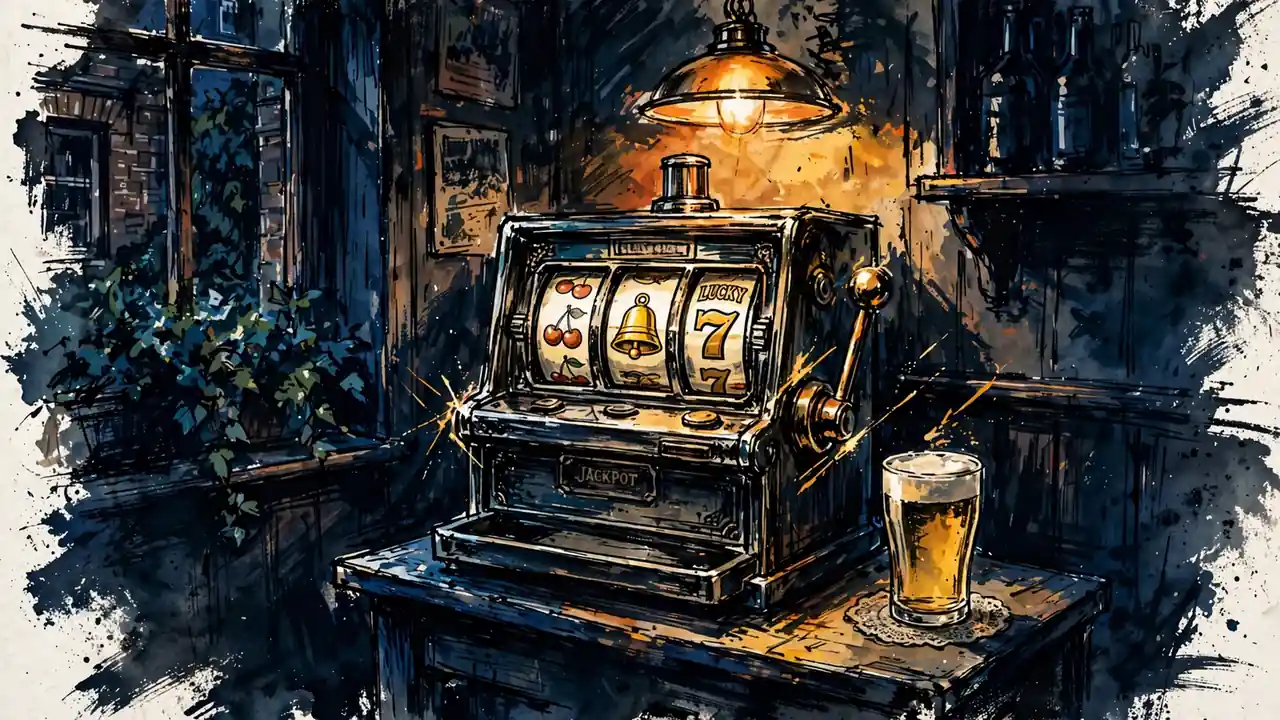
A clear guide to reel layouts, symbol lines, free-play versions and the practical limits of playing classic slots online.
The Old Machine, Recast for a Screen
A classic slot begins with a small piece of visual theatre: reels turn, symbols pass the window, and the result is read from the arrangement that finally stops in view. The design is spare compared with the crowded interfaces of many modern casino games. Fruit, bells, bars, lucky sevens and other familiar emblems do much of the work. They are not decoration placed around the game; they are the language in which the game states its result.
The essential idea has survived the move from a cabinet on a betting-shop floor to a browser or app. A player selects a stake, starts a spin and waits for the reels to settle. If the symbols line up in a paying arrangement, the game awards a win according to its rules. The value of that win depends on the symbols involved and the arrangement in which they appear. A cherry is not merely a cherry, and a row of symbols is not merely a row. Each has a defined meaning within that particular classic slot.
Crash Casino Games in the UK: How They Work
This simplicity explains much of the format’s persistence. Classic slots do not need an elaborate narrative to make their point. Their stories are compressed into repeated images and familiar sounds: a bright sign, a mechanical rhythm translated into animation, a brief pause before the outcome. The older machine offered a compact ritual that could be understood almost at a glance. The online version keeps the ritual while removing the physical casing, handle and visible machinery.
That change matters, but not because the underlying premise has become mysterious. A screen can give the game more room for presentation, yet the central act remains the same: symbols appear in a sequence, and the final arrangement is assessed under the game’s rules. The label “classic” usually signals this directness. It points towards a recognisable reel-based style rather than promising a particular theme, provider or outcome.
The phrase “3 reel classic slots” describes one familiar expression of that style. Three reels create a compact visual field, often associated with the early fruit-machine tradition. They can make the result feel immediate because fewer moving parts are presented to the eye. Yet the number of reels alone does not establish what a game pays or how its symbols behave. Those details belong to the individual title. A classic slot is a form, not a guarantee of identical rules across every game wearing the label.
UK Casino Sites and Slots: How the Rules Work
Online play also places this old visual language inside a modern regulatory structure. In Great Britain, remote gambling offered to consumers is regulated by the UK Gambling Commission, regardless of where the equipment running the service is located. The Commission is the sole regulator for commercial gambling in Great Britain. That distinction is easy to overlook when the game itself appears to be nowhere in particular: the reels may be drawn on a phone in one place while the operator’s technical systems are maintained somewhere else. Regulation follows the service offered to the market.
The Commission’s remit includes online casinos. Businesses operating in Great Britain require operating licences, while individuals involved in operating gambling businesses may require personal licences. These are different forms of permission: one concerns the business providing the gambling service, and the other concerns relevant people working within the regulated operation. The arrangement reflects an institutional preference for responsibility that can be assigned, examined and, where necessary, challenged.
French Roulette Online Casinos in the UK: How Zero Works
The wider legal framework is the Gambling Act 2005, which governs gambling in England, Wales and Scotland. Northern Ireland has a separate legal position. For online casino play, the practical point is that a service offered legally to the British market belongs within the Gambling Commission’s licensing system. A polished interface does not itself establish that status, and an old-fashioned appearance does not remove the operator from it. A fruit-themed screen remains a regulated gambling service when it accepts play online.
The outcome of a spin is not decided by the mood of the machine, the hour of the day or the player’s sense that a particular symbol is overdue. Licensed sites use Random Number Generators, generally shortened to RNGs, so that each spin is independent and unpredictable. The technology is less theatrical than the tumbling reels it controls, but it is central to the modern version of the format. The animation shows an event; the regulated system determines the random result behind it.
That separation between appearance and mechanism is characteristic of online classic slots. The screen borrows the gestures of an older machine, while the regulated digital service supplies the structure beneath them. Familiar symbols, moving reels and a plainly stated result remain enough to carry the form across decades. The cabinet has disappeared. The little drama has not.
Online classic slots use Random Number Generators (RNGs) to ensure that every spin is independent and unpredictable.
Three Reels, Lines and the Free-Play Version
A classic slot machine is legible before it is exciting. Its central object is a row of reels, each carrying a succession of symbols. When the reels stop, the visible arrangement is read across a line selected by the game. The drama is modest in architecture: symbols pass, movement ends, and one particular pattern is left facing the player.
That simplicity explains the continued appeal of classic slot machine games. There is little need to learn a story, a map or a collection of invented characters before the mechanism becomes clear. A classic three-reel slot machine presents its small theatre almost immediately. The reels are the scenery, the line is the stage mark, and the symbols provide the vocabulary.
The screen version preserves this arrangement while removing much of the old cabinet. There is no metal casing to pull, no glass window glowing above a physical control panel, and no pocketful of coins waiting to be fed into a slot. Yet the visual grammar remains familiar. Reels occupy the centre; a payline or set of paylines indicates where the result is read; controls sit around the display. The machine has been reduced to an image of itself, but not quite to an abstraction.
What the reels actually show
A reel is not a separate game. It is one vertical column in the display, carrying symbols that move past the viewing window. In a simple layout, several reels stand side by side. The player sees only part of each reel at once, while the software determines which symbols settle into view when the movement ends.
Progressive Slots Online in the UK: How Jackpots Work
This is where the phrase “classic slot” can be misleading if it is treated as a strict technical category. Some online versions imitate the compact appearance of an older machine without reproducing every detail of a particular physical model. Others use more elaborate displays while keeping the same basic idea: a small number of reels, a familiar line of symbols and a result read from their relationship.
The important point is not whether the cabinet once existed in a seaside arcade. It is whether the game asks the eye to follow a straightforward reel-and-line arrangement rather than a crowded system of layers. The screen may carry decorative polish, but the underlying picture remains economical.
A line gives that picture direction. It tells the game which positions should be considered together. On the most restrained layouts, the line runs through the middle of the visible reels. Other designs allow lines to travel in different shapes across the display. Their purpose is still the same: to define the route along which the symbols are read.
Some slots allow the number of active lines to be changed manually. That control alters how much of the layout is involved in a spin. A smaller selection leaves some possible routes inactive; a broader selection brings more lines into play. The interface may present this as a simple adjustment beside the reels, but it changes the relationship between the player and the machine. The line is no longer merely painted decoration. It becomes part of the chosen structure of the game.
This is one reason the old machines were easier to understand than many modern interfaces. Their visible arrangement made the question of “where is the result?” almost unavoidable. Even online, the line remains a useful piece of typography: it organises movement into something that can be read.
DO
- Check the operator’s UKGC licence on the public register
- Verify age and identity before making a deposit
- Set financial limits before your first deposit
DON’T
- Rely on a website’s logo or language as proof of authorisation
- Use credit cards for gambling transactions
- Assume a game is “due” after a run of losses
Three reels are an idea, not a promise
The expression “three reels” suggests a particular compact format, and many classic slots are built around that image. It should not be taken as a promise that every game described as classic will use exactly the same arrangement. Online casinos may group together games that share a visual period or a stripped-back style while differing in their number of reels, lines and controls.
The useful distinction is between the appearance of the machine and the logic of the display. A game can look like an old fruit-machine game while giving the screen more room for symbols. Another can use a narrow, traditional layout but allow several active lines. The family resemblance lies in the emphasis on reels and visible combinations, not in one universal template.
The line also prevents the symbols from becoming a random collage. Their positions matter because the game reads them through the selected route. Winnings depend on which symbols are lined up, so a symbol sitting just outside an active line may be visually close while belonging to another part of the display. The eye sees a whole screen; the machine reads an arrangement.
That small difference is characteristic of gambling interfaces. They appear to offer a picture, yet they operate through a set of defined relationships inside it. A painted line can therefore carry more weight than its humble appearance suggests.
The free version beside the wager
A demo version presents the same basic layout without making the result part of a real-money wager. It allows the reels, lines and controls to be examined as a working arrangement rather than as a static picture. This makes free classic slot games useful when the aim is to understand how a particular title is organised.
Fastest payout online casinos in the UK: what claims mean
The distinction matters because “free” can describe two different things in casual conversation. It may mean a practice version that does not involve wagering, or it may be used loosely for a promotional offer attached to an account. Those are not the same arrangement. A demo is a mode of play for learning the game’s layout and features before wagering; it is not a hidden form of real-money play and does not turn practice results into withdrawable funds.
Free online classic slot games are therefore best understood as rehearsals of the interface. They show where the reels sit, how the active lines are displayed and what the controls do. They can also reveal whether the visual style feels genuinely spare or merely wears the costume of an older machine.
Once money enters the picture, the meaning of the spin changes, even if the screen looks identical. The reels may occupy the same space and the lines may be marked in the same colours, but the player is no longer only learning the arrangement. Deposit and time limits are recommended before wagering, because a familiar-looking machine can make the boundary between practice and gambling feel thinner than it is.
The old cabinet had a physical edge. The screen has a button. The distinction needs a clearer one.
Choosing a Casino Without Promising a Winners’ List
The phrase “best classic slots casino” sounds as though a settled table exists somewhere: one operator at the top, another beneath it, and a reassuring bronze medal for the site that almost made sense. Gambling does not produce such a table. A casino can be compared for its licensing, terms, payment conditions and choice of classic slots, but none of those qualities turns it into a source of better outcomes.
Comparing Casinos
- Check for valid UKGC authorisation on the public register
- Review clarity of deposit and withdrawal processes
- Confirm game availability for British customers
- Ensure responsive web versions are provided
- Check visibility of game and bonus terms
- Verify available responsible-gambling controls
For a UK player, the first comparison is not decorative. It is legal. A casino taking real-money bets from customers in Great Britain must be authorised by the UK Gambling Commission, even when the company’s important equipment or corporate address is elsewhere. The Gambling Commission is the regulator responsible for commercial gambling in Great Britain, and it grants operating permissions to businesses as well as personal licences to relevant individuals.
The licence should be checked on the Commission’s public register rather than inferred from a badge, a logo or a confident sentence on a homepage. Offshore casinos sit outside the UKGC system and do not possess a UKGC licence. That distinction matters when a site presents itself as international, displays several regulatory emblems or uses polished language about security. A familiar-looking website is not evidence of British authorisation.
The legal framework also gives the comparison a clear boundary. Online gambling is available in the UK to people aged 18 and over where the operator holds the required UKGC licence. Operators must establish a customer’s age and identity when an account is opened, and age verification must take place before a deposit can be made. A request to upload documents may feel like an interruption to the grand ceremony of the spinning reel, but it is part of the market’s operating rules.
What can sensibly be compared
A useful comparison of classic slots sites can examine the following:
- whether the operator holds the appropriate UKGC authorisation;
- how clearly the site explains deposits, withdrawals and account checks;
- whether classic slots are actually available to British customers;
- whether a responsive web version is provided for different screens;
- whether game and bonus terms are visible before money is committed;
- what responsible-gambling controls are available at account level;
- how complaints are handled if the operator and customer disagree.
This is a comparison of conditions, not a ranking of luck. A larger lobby does not make a particular reel combination more likely to pay, and a familiar provider name is not a guarantee of a favourable session. Availability can also change: a game shown in a lobby is not automatically eligible for a particular promotion, nor does its presence prove that it can be played with every payment method or stake setting.
Payment rules deserve more attention than the usual promise of speed. UK-licensed casinos cannot accept credit cards for gambling, including arrangements in which a money-service business routes credit-card funds into the account. A digital wallet cannot be used for gambling where its balance is funded by a credit card. These restrictions can make a site appear less flexible than an offshore alternative, but the difference reflects the British regulatory position rather than a missing feature.
Operators must offer a complaints procedure of their own and access to an approved Alternative Dispute Resolution service. Responsible-gambling tools, including self-exclusion, must also be available at UKGC-licensed casinos. New customers must be prompted to set a financial limit before making their first deposit, while account controls should make it possible to manage limits afterwards. These details tell more about an operator’s practical standards than a banner announcing a “premium” or “trusted” experience.
Promotions are terms, not evidence
Promotional language is particularly poor material for a winners’ list. “Extra spins”, “welcome rewards” and similar offers describe an incentive, not the quality of the underlying classic slots. Some bonuses carry wagering requirements, meaning that bonus funds or winnings connected with the offer may need to be played through before a withdrawal is permitted. The condition belongs to the offer’s terms, not to the title’s mathematical identity.
Attention Always read the specific terms of a promotion, as they may exclude certain games or include wagering requirements.
A promotion may also exclude particular games, restrict the amount that counts towards a requirement or impose conditions on eligibility. That is why a slot should not be recommended merely because it appears beside a banner. The current rules for the specific offer need to be read first. A site that explains these conditions plainly is easier to assess than one that puts the attractive figure in large type and leaves the important qualifications in a footnote.
The same restraint applies to lists of “best classic slots to play online”. Without a shared measure that covers regulation, design, terms and personal preference, such a list is usually an editorial judgement wearing a laboratory coat. One person may value a sparse three-reel presentation; another may prefer the extra mechanics found in newer fruit machine games. Neither preference proves that a title is superior for real-money play.
Free classic slots with no download can be useful when the aim is to inspect a game’s presentation without installing software, but free access should not be confused with a casino’s real-money conditions. The two modes may sit next to each other while serving different purposes. A casino can therefore be assessed for whether it explains that distinction, rather than praised for making a promise about what a paid spin will deliver.
The honest shortlist is consequently less glamorous: licensed operator, visible terms, workable limits, lawful payments and a game catalogue that genuinely includes the desired style. No winners’ list required.
Fruit-Machine Habits in a Digital Game
The appeal of a classic fruit machine was never limited to its reels. Around the symbols sat a small theatre of decisions: a reel could be held, a nudge could shift it into place, and a near-result could acquire the dramatic importance of a little mechanical crisis. Online games inherit many of these habits, though they translate them into buttons, prompts and animated effects rather than lamps, levers and the firm clack of a cabinet.
Fast-Payout Online Casinos in the UK: Keno Explained
That translation matters. A digital game can reproduce the vocabulary of the arcade while quietly changing its grammar. A hold may be offered on one title but absent on another. A nudge may be available on every spin, only after a particular result, or not at all. The familiar appearance of a classic fruit slot game therefore tells little about the exact mechanics beneath it.
Holds and nudges
A hold temporarily fixes a reel or symbol while the remaining reels spin. In the physical fruit-machine tradition, this gave the player a modest choice inside an otherwise automatic process. The decision was simple but not entirely empty: preserve what looks promising, or release everything and allow the whole arrangement to change.
Online versions can make the same gesture more visibly explicit. A button may appear beneath an eligible reel, or the game may pause and present the choice as part of a bonus sequence. Some titles can offer several holds or nudges during one spin, while others provide them only under particular conditions. The difference belongs to the individual game, not to the category as a whole.
A nudge moves a reel by a position, often bringing a neighbouring symbol into the payline. In a cabinet, the movement had a physical finality: one could hear the reel advance and see the result settle. On screen, the animation may be smoother, but the underlying idea remains recognisable. The player is not choosing any symbol from the reel; the available movement is constrained by the game’s design.
This is where the old vocabulary becomes slightly mischievous. “Skill” can sound too grand for a choice whose permitted outcomes are already built into the software. A hold or nudge is an option within a random game, not a route by which the player takes control of its underlying probabilities.
Common Features
Digital versions of classic games often include mechanics such as holds, nudges, and wild symbols. While these add variety, they are built into the software and do not change the underlying random nature of the game.
The extras around the reels
Classic casino slot games may also add features that were not part of the most stripped-back three-reel format. Wild symbols can substitute for other symbols in an eligible combination, according to the rules of the particular title. Their visual role is usually easy to recognise, but the exact conditions attached to them are not universal. A wild may be restricted to certain reels, excluded from another feature, or used in a bonus arrangement rather than everywhere.
Free spins create another layer. Instead of treating every result as an isolated ordinary spin, the game can award a sequence in which the player watches several outcomes unfold under a special feature. The sequence may include altered symbols, additional nudges or other conditions. “Free” describes the absence of a fresh stake for those spins; it does not turn the game into a separate kind of probability.
Pick-style mini-games borrow a different piece of arcade theatre. After a qualifying result, the screen may present several objects or symbols and invite a selection. The choice can reveal an award, another step in the feature, or an end to the sequence. It is a familiar pattern in digital gambling: a simple act of selection placed between the ordinary spins, giving the pause a little ceremony.
Such additions can make a compact game feel more eventful without changing its basic identity. The fruit symbols remain; the bells and bars remain in spirit; the surrounding machinery has simply acquired more rooms.
A modern screen, an older mood
The online version can also supply quick-spin options and other controls that alter how the interface behaves. These controls are not the same as a hold or nudge. They concern the presentation and pace of the game rather than offering a choice about a particular reel. In Britain, however, online slot autoplay is banned, so a service aimed at this market cannot treat automatic repeated spins as an ordinary permitted feature.
Keno Casinos in the UK: Draws, Payouts and Checks
Mobile compatibility has helped preserve the compactness associated with fruit-machine play. A responsive web version can arrange reels, buttons and pay information for a smaller screen without requiring a cabinet in a pub or arcade. The game may travel in a pocket, but its visual language still looks backwards: fruit, bells, bars and bright signs standing in for a period when amusement was expected to be immediate and legible.
That legibility is part of the attraction. A classic fruit slot game often communicates its theme with unusually little explanation. The symbols are large, the actions are familiar, and a hold or nudge is usually presented as a plainly marked possibility rather than buried in a long narrative. The format was born in places where a passer-by had to understand the machine quickly. Screens have inherited that impatience.
Yet a title’s appearance should not be mistaken for a complete specification. One game may offer holds, nudges and a pick feature; another may retain only the fruit imagery and the reels. A third may place its extra mechanics behind a particular result. The label “classic” describes a style and lineage, not a guaranteed inventory of features.
Free versions and feature inspection
Versions available without wagering can be useful for observing these habits in operation. A free-play mode may show whether a game includes holds, how a nudge is presented, when wild symbols appear, and what a free-spin or pick sequence looks like. This is a way of learning the game’s layout and features before wagering, not a substitute for real-money play.
Understanding Demo Play
Free-play modes are tools for observing a game’s layout and mechanics rather than a substitute for real-money play.
The distinction is especially useful when a title has several layers of rules. A player may understand the visible reels but miss the conditions that activate a secondary feature. Watching the interface work can reveal which buttons are persistent, which appear only after a result, and which are merely decorative. The screen is less mysterious once its small rituals have been seen in sequence.
Free play does not make the outcomes predictive. It shows the arrangement of the game, not what a later wagered spin will produce. Nor does familiarity with one fruit-themed title transfer neatly to another. The traditions are shared; the software is not.
Why the old features survive
Holds and nudges endure because they give a player something to notice between the beginning and end of a spin. Wilds and free spins add a change of colour to a repeated action. Pick features provide a moment of selection. Even quick-spin controls acknowledge that repetition can become tedious, while the responsive web version makes the whole ritual available beyond the old physical cabinet.
These mechanics are small acts of staging. They make chance feel inhabited by decisions, pauses and interruptions, although the permitted choices remain bounded by the title’s rules. That tension is central to the charm of classic slots online: the machine looks more conversational than it really is.
A digital fruit machine is therefore neither a museum piece nor a wholly new invention. It preserves the gestures of the older cabinet, trims away some of its weight and adds features that belong unmistakably to software. The result is a game where a hold can feel like prudence, a nudge like rescue, and a free-spin sequence like a small excursion from the ordinary rhythm. Sometimes it is simply a brighter form of waiting.
Live Baccarat Online Casinos in the UK: What to Know
A Spin Has Its Own Clock
A classic slot once belonged to a particular place: a row of machines under bright lights, a counter nearby, and the small ritual of deciding whether to stay for another spin. Online, that setting falls away. Classic slots can be opened at convenient times, without travelling to a venue, and the available choice is broader than any single physical cabinet could offer. Different titles appear at different stakes, so the rhythm of play is no longer dictated by one machine standing in one room.
That convenience changes the atmosphere more than the mathematics. A screen is always ready to display the next result, while the surrounding world supplies fewer natural pauses. The machine does not need to be approached, fed or left behind; access becomes part of the ordinary day. A useful boundary is therefore not a promise about winning, but a deliberate interruption: a deposit limit, a time limit or simply a decision to stop before the next spin becomes automatic.
Each spin remains a separate event. On regulated online games, random outcomes are produced so that the result of one spin does not determine the result of the next. A win does not make another win more likely, and a run of losses does not build towards a correction. The machine has no memory in the human sense, however persuasive a sequence may feel.
This is where familiar gambling language becomes misleading. A player may speak of a “lucky” machine after several favourable results, or call one “due” after a barren stretch. Neither description changes the probability of the following spin. Past wins and losses belong to the record of what has happened, not to the calculation of what must happen next.
Random Number Generator
The technology used in licensed sites to ensure that each spin is independent and unpredictable.
Nor does the timing of a decision give a spin a better chance. Playing quickly or slowly does not alter a random outcome, and changing the betting size does not make the symbols more likely to land in a desired arrangement. The clock belongs to the player’s experience, not to the underlying chance. It measures attention, pauses and duration; it does not negotiate with the random generator.
That distinction matters particularly online, where several titles and stake options can sit within easy reach. Variety can make the session feel active and exploratory, but movement between games is not a strategy for changing chance. One spin finishes. Another begins. The past stays behind.
Real Money, Real Limits
Real-money classic slots in the UK sit at the boundary between a familiar pastime and a regulated financial activity. A stake is not merely a token placed beside a reel display: it is a gambling transaction, subject to rules about who may take part and how much can be risked.
A specialist review reports a £5 maximum stake per game cycle for online slots in Great Britain for customers aged 25 and over. That figure belongs to the regulatory setting described by the review, rather than serving as a universal promise about every product or account. The relevant category is the online slot game cycle, not a general casino limit. Roulette and blackjack are outside this particular slot-stake restriction.
Age also changes the position. Online gambling is available only to adults, and operators must verify age before allowing a customer to deposit funds into a gambling account. The distinction matters because real-money access begins with eligibility, not with the appearance of a spin button. Identity checks and account controls are part of the same threshold.
Penny Slot Machines in the UK: How Stakes Work
The other important boundary is mathematical. On a regulated game using a random generator, each spin is independent. A win does not make another win more likely; a run of losses does not make a payout “due”. The machine has no memory in the human sense, however vividly a sequence may suggest one. It does not become generous after a barren stretch, nor vindictive after a sizeable result.
Timing cannot alter that outcome, and changing the stake cannot persuade the random process to favour a particular symbol. A faster rhythm may make the session feel more urgent, while a larger wager may make each result feel more consequential, but neither changes the probability attached to the next spin.
That separation—money on one side, chance on the other—is easy to blur in the bright language of classic slots. The stake is real. The prediction is not.
The UK Market in Perspective
Classic slots sit within a much larger online-slots market. Their visual language may recall the fruit machine in a local pub, but the commercial setting is now digital, national and measured through the performance of remote operators. The old symbols have travelled further than the old cabinets.
A specialist market report citing UK Gambling Commission operator data recorded £773 million in gross gambling yield from online slots for January–March 2026 in the reported market data. Gross gambling yield describes the operator-side gambling revenue measure used in that reporting context; it is not the total amount staked and should not be read as the profit from any individual title.
That figure belongs to online slots as a broad category, rather than to classic slots alone. It therefore cannot show how much activity came from three-reel designs, fruit machine games, branded releases or newer video slots. Nor does it establish that one style is more popular than another. A search for classic slots in the UK can lead into a substantial market without making the classic format a separate statistical category.
Market Data
In the period of January–March 2026, the gross gambling yield from online slots in the UK market was recorded at £773 million.
The distinction matters because familiar design is easy to mistake for a measured trend. A game with cherries, bars and a simple reel display may look like a small surviving corner of gambling history, while its online distribution places it inside the same wider commercial system as more elaborate titles. The number gives scale, not a verdict on taste.
For the period covered, then, the useful perspective is modest: classic slots are part of a sizeable online-slots economy, but the reported figure does not isolate their contribution. The cabinet has disappeared. The accounting has not.
Free Play as a Rehearsal
A free classic slot is best understood as a rehearsal room rather than a smaller version of gambling. It gives the game’s appearance and operating sequence a chance to become familiar without placing a wager. The distinction matters: practice may explain how a title behaves, but it does not turn a simulated session into real-money play.
The value of demo play lies in observation. A player can see where the stake controls sit, how a result is displayed, what information accompanies a spin and how the game signals any special feature. The layout becomes less mysterious when there is no pressure to make an immediate financial decision. This is particularly useful when several controls, menus or stages are presented on the same screen.
A demo can also reveal whether the pace and presentation suit the person using it. A responsive web version may arrange controls differently from a desktop display, while a smaller screen can make the practical shape of the game more apparent. None of this says anything about future results. It is simply an opportunity to learn the interface.
That rehearsal should remain separate from decisions about wagering. Before moving from free play to real-money gambling, setting deposit or time limits is recommended. Such limits create a boundary around the activity before money enters the account, rather than relying on a decision made in the middle of play.
Live Blackjack Online Casinos in the UK
The language of “trying a game” can blur this boundary. A free session may resemble the paid version visually, yet it carries no financial stake and cannot reproduce the consequences of losing one. Its proper role is modest: learn the layout, notice the features, and decide whether the format is understandable before wagering. Practice, not prophecy.
Symbols and the Meaning of a Line
Classic slot machine symbols are the small vocabulary from which a result is formed. Fruit, bells, bars and lucky sevens belong to the visual language of the old arcade machine, while newer titles may replace them with themed pictures, letters or character icons. The decoration changes; the basic act of reading the reels remains familiar.
A line is the route across the visible symbols that is checked for a result. When the reels stop, the symbols sitting along that route are read together. A winning combination depends on which symbols have been lined up, not simply on an attractive picture appearing somewhere on the screen. A cherry outside the relevant line may therefore have a different significance from the same cherry placed on it.
This is why the screen can look busy while the logic stays narrow. Several symbols may be visible on each reel, but the meaningful arrangement is the one connected by the active line. The line gives the eye a path: left to right, across a row, or along another marked route established by the game. The symbols provide the content; the line supplies the order.
Some classic slots keep that relationship stark. A few reels, recognisable pictures and a plainly marked route leave little to interpret. Others dress the same principle in elaborate artwork, but a result still comes down to the symbols occupying the relevant positions. The old machine’s visual grammar survives because it is immediately legible.
That clarity has a social history. Fruit and bells made a machine readable at a glance, even in a noisy amusement room where attention was brief and the rules were mostly visual. Online, the same shorthand is polished and enlarged, yet it still asks for the same modest act of interpretation: identify the line, then see what it contains. Picture first, meaning second.
Can I play fruit machine games for free?
Yes. Demo versions let you explore a game’s layout and features before wagering.
Are online fruit machine games fair?
Licensed sites use Random Number Generators (RNGs), making each spin independent and unpredictable. Previous wins or losses, timing and bet size do not affect the next result.
What controls help manage my play?
You can set deposit or time limits. Trying a demo version before wagering can also help you learn a game’s features.
How do I know if a site is trustworthy?
Check that the operator holds a UK Gambling Commission operating licence to serve customers in Great Britain.
Are there age restrictions to play online fruit machines?
Yes. You must be at least 18 to gamble online, and operators verify customers’ age and identity when they open an account.
What are the online slot stake limits in Great Britain?
For customers aged 25 and over, online slots are capped at £5 per game cycle. This limit does not apply to roulette or blackjack.