

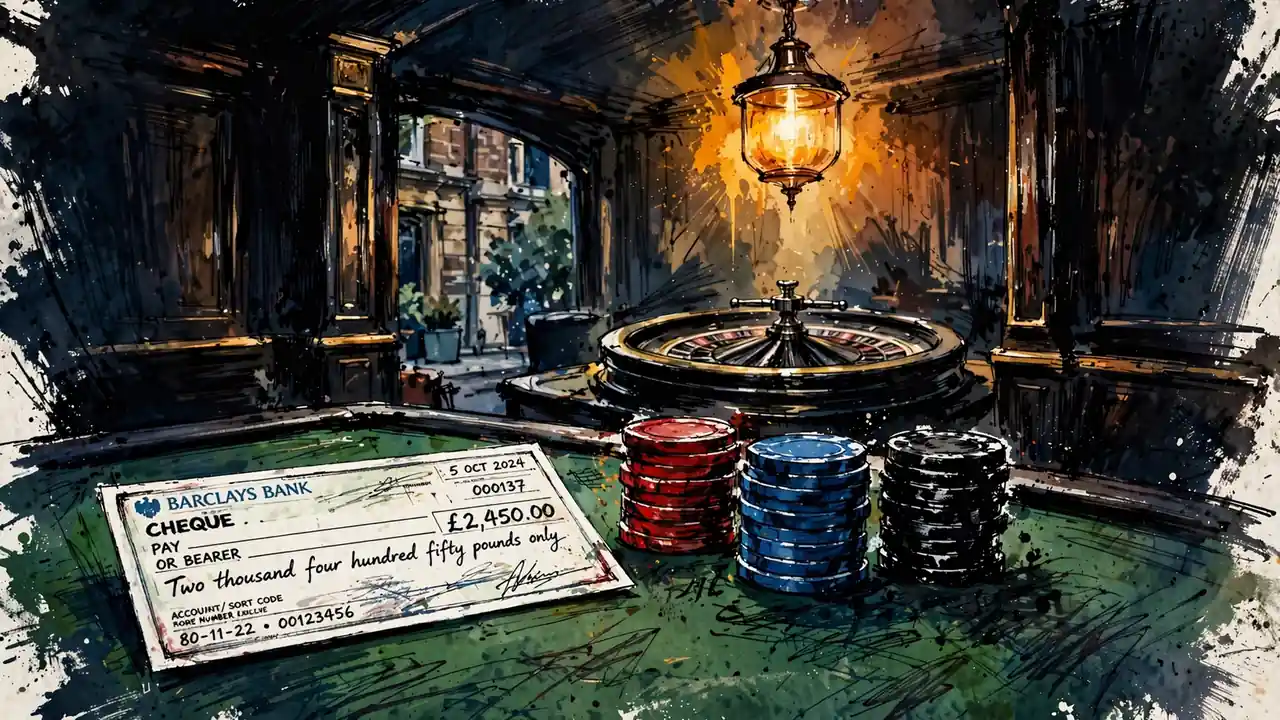
Availability depends on the account-specific cashier, while deposit and withdrawal routes, costs and limits need separate checking.
What UK Casino Payment Pages Can—and Cannot—Confirm
A payment page is a practical checkpoint, not a catalogue of every method that has ever appeared in a casino’s promotional material. Its most useful information is tied to a particular account, location, currency and moment. That is why a page describing an e-cheque facility in general terms cannot, by itself, establish that an e-cheque is available to a UK customer in 2026.
The question is narrower and more useful: what does the cashier show after the account has been created, the relevant location has been recognised and the payment section has been opened?
That distinction matters for anyone looking for casinos accepting e-cheques in the UK. A search for an e-cheque casino can produce old references, international payment descriptions or pages assembled before a provider changed its service. None of those things proves that an e-cheque option is active for a particular British account. The cashier is where a claim becomes testable.
Start with the account-specific cashier
Payment methods are not necessarily presented identically to every customer. A remote gambling licensee may display a different set of options according to the customer’s country, account currency, verification status, payment-provider rules or the product available in that market. A method visible in a general payment guide may therefore fail to appear after login.
The sensible check has several parts:
- Open the casino’s payment or cashier area from the account itself.
- Select the deposit section rather than relying on a general help page.
- Inspect the complete list of available methods and the labels attached to them.
- Check whether the account is recognised as being in the United Kingdom.
- Confirm the currency shown for the account before selecting a method.
- Read any method-specific instructions before entering payment details.
An e-cheque should be treated as available only if the logged-in cashier clearly presents it as an option for that account and explains how it is used. A mention elsewhere is weaker evidence. It may describe a service that has been withdrawn, a method restricted to another country or a product that is no longer supported by the payment provider.
This is not pedantry. Payment brands have changed names, withdrawn products and altered the countries in which they operate. A familiar label can survive on a page long after the underlying service has disappeared. The internet is remarkably good at preserving ghosts.
The same principle applies to pages describing online casinos that accept e-cheque deposits. The word “deposit” must refer to a live, selectable route in the account’s cashier, not merely to a sentence in a review or a logo in a payment strip. A logo can indicate a commercial relationship, a historical option or nothing more than an untidy page. It does not replace the account-level check.
What the cashier can establish
A functioning payment page can answer practical questions that a broad description cannot.
It can show whether a payment method is currently offered to the account. It can also reveal whether the method is available for the intended transaction type, whether the account currency is supported and whether extra instructions apply before the transaction can proceed. These details belong to the actual payment route, rather than to a general ranking of casino sites.
Casinos That Accept EntroPay in the UK
For card users, Visa and Mastercard may appear among the listed methods. That does not mean every card bearing one of those brands is eligible. The card product, issuer and funding arrangement still matter. Current UK availability and the eligibility of a particular card must be checked in the cashier, where the casino’s live payment controls can be compared with the card being used.
A debit card is not simply defined by its logo. The account holder, issuer and type of card may affect whether a transaction is accepted. UK-licensed casinos cannot accept credit-card payments for gambling, and credit-card funding routed through a money service business is also prohibited. A payment screen that accepts a card number is not an invitation to use any card that happens to be in a wallet. The funding source has to fit the UK rules as well as the casino’s own controls.
The cashier may also identify a method as deposit-only. That label is significant, but it does not turn a deposit method into a complete payment solution. A method shown for adding funds should not automatically be treated as a route for every later transaction. The practical availability check therefore has to preserve the distinction between what the page allows at that moment and what the account’s wider payment arrangements may require.
DO
- Open the casino’s payment or cashier area from the account itself.
- Select the deposit section rather than relying on a general help page.
- Confirm the currency shown for the account before selecting a method.
- Check whether the account is recognised as being in the United Kingdom.
- Read any method-specific instructions before entering payment details.
DON’T
- Rely on general help pages or marketing descriptions.
- Assume a method is available because it is mentioned in a review or a logo.
- Assume a method works for all countries or accounts.
- Trust a payment symbol without checking the active cashier.
That distinction is especially important when an e-cheque is being considered. The fact that a casino accepts another electronic payment product says nothing about e-cheque acceptance. Visa, Mastercard, bank transfer, e-wallets, vouchers and other payment products are separate arrangements, with separate provider relationships and separate eligibility rules. Substituting one for another because both are described as “online payments” is a category error dressed as convenience.
Currency is part of availability
A payment method can appear available while the account currency creates a separate issue. Pages describing UK casino payments state that GBP is supported, but the account currency still needs confirmation before the first transaction. This is not a decorative setting. It can affect whether the amount is handled directly in pounds or passed through a conversion process.
The currency displayed in the account and the currency shown in the cashier should therefore be read together. A British location does not, by itself, prove that every account has been configured in GBP. Account settings, registration details and the selected payment route may all have a bearing on what is displayed.
For a person seeking an e-cheque facility, the useful question is not merely whether the word “GBP” appears somewhere on the site. It is whether the logged-in account shows the intended currency alongside the payment method. If an e-cheque option were presented without clear currency information, that ambiguity would need to be resolved before the transaction was started.
Currency confirmation also helps distinguish a real account-specific option from a generic page. A broad page may list GBP among supported currencies, while the cashier presents another currency for the individual account. The latter is the more immediate record of what the account is prepared to process.
A payment logo is not proof of a live route
Payment pages often compress complicated arrangements into small icons and short labels. A method may be named in a footer, a review, a frequently asked questions page or a banner while being absent from the active cashier. Those appearances should not be given equal weight.
Casinos That Accept Bank Cheques in the UK
A live cashier normally provides more useful evidence because it connects the method with an account action. It may offer a button, a selection field or instructions that lead to the provider’s payment process. Even then, the displayed option should be read carefully. A name without usable instructions may indicate a technical placeholder or a route requiring a separate eligibility check.
The wording matters too. “Supported payments” can describe a broad commercial category. “Available for this account” is more specific. “Deposit-only” is narrower again. The page may also distinguish between cards, wallets, bank-based services and vouchers. Such distinctions prevent a convenient but misleading assumption that every named method can perform the same task.
This is why a list of “best e-cheque casinos” cannot be constructed merely from payment icons or broad claims about fast payments. A site can be attractive for other reasons and still have no e-cheque route in the relevant cashier. Conversely, a payment option can appear in a cashier without establishing that the casino is suitable in every other respect. Availability is one factual question, not a complete verdict on the operator.
Keep the check tied to the UK account
The phrase “UK casino” can conceal several different realities. A site may be accessible from Britain, describe British customers in its terms or publish a page aimed at the UK market. The payment experience still has to be checked in the account used for that market.
Remote gambling operators selling into the British market must hold a Gambling Commission licence. Licensed online gambling is legal in the UK for customers aged 18 and over, and the operator must verify age before allowing funds to be deposited. These are not payment-brand details, but they shape the account in which a payment option can legitimately be assessed.
A general international page cannot substitute for the British cashier. The relevant question is whether the remote gambling licensee serving the British market presents the payment method within the account governed by its UK-facing arrangements. A method visible to customers elsewhere does not become a UK method through repetition.
Casinos That Accept Ethereum in the UK
The same care is needed with e-cheque terminology. “E-cheque” may be used loosely for different electronic services, bank-based transfers or older payment products. The name alone does not identify the provider, transaction structure or account eligibility. The cashier’s instructions should make clear what service is actually being offered. If the label is vague, the label has not done enough work.
What a payment page cannot confirm
Even a clear cashier has boundaries. It can show an available route, but it cannot turn an unverified claim into a guarantee that the method will remain available. Payment providers can change their arrangements, and account status can alter what is displayed.
Nor can a payment page establish that every customer will see the same option. The visible list belongs to the account in front of it. Another account may have different currency settings, verification requirements or provider eligibility.
A payment page also cannot prove that a method mentioned in a review remains active. A specialist review may report that a casino offered a particular payment product at the time it was checked, but that statement is not a permanent record of the current cashier. The only safe use of such material is as a prompt to inspect the live account page, not as confirmation of present availability.
Finally, a cashier cannot be used to blur the difference between an e-cheque and other electronic methods. A bank transfer is not an e-cheque because both involve banks. A debit card is not an e-cheque because both can be used online. A wallet is not an e-cheque because it may connect to a bank account. Each route has its own provider, rules and account controls.
A short evidence standard
For a UK account, the strongest practical indication of current e-cheque availability would be:
- the method is named in the logged-in cashier;
- it appears in the deposit area for the relevant account;
- the page identifies the service clearly rather than using a vague category;
- the account’s currency is visible and suitable for the intended transaction;
- the instructions explain what information or verification is required; and
- the route is presented as available to the account rather than merely described in general terms.
If those details are not aligned, the payment method should remain unconfirmed. That is not a refusal to recognise technological change. It is a refusal to mistake an old logo for a live payment route.
The practical task at this stage is therefore limited but important: establish what the account’s cashier currently offers, check that the UK-facing account and currency are the ones being assessed, and distinguish a genuine selectable method from a general description. Questions about the movement of funds after a transaction, or about account-level controls before depositing, belong to separate parts of the payment process. Here the cashier has one job: show what is available now, for this account, in this market.
Comparing Casino Options Without a Verified E-Cheque Shortlist
The phrase “best e-cheque casinos UK” sounds as though it should lead to a neat table of operators, payment limits and approval times. That appearance is misleading. Those are not the same thing.
That distinction matters because payment branding is unusually fluid. A casino may describe its cashier broadly as supporting bank payments, cards or electronic wallets while the actual options shown to a particular account differ. A payment service may also alter its availability, eligibility or function without changing the wording used in an older review. A page can therefore sound precise while remaining poor evidence of current e-cheque support.
The sensible comparison is wider: which payment routes are documented for UK-facing casinos, and what can those descriptions genuinely establish? That does not make any named method an e-cheque substitute. It simply places the narrow question in the payment landscape that surrounds it.
Casinos That Accept Tether in the UK: What to Check
Why a ranked e-cheque list would be unreliable
A list called “top e-cheque casinos” promises more than a collection of casino names. It implies that each listed site accepts e-cheques, that the method is available to British customers, and that the services can be compared on meaningful terms. None of those implications should be smuggled in through a heading.
An old review, a promotional page or a general payment banner may mention a method without showing whether it remains active. Even where a casino has once supported a particular route, the method may not appear for every account. Currency, identity checks, account status and the provider’s own rules can affect what the cashier presents. A name alone proves very little.
The same problem applies to mobile searches. A casino site may work on a phone while its payment options remain controlled by the account cashier rather than by the device. “Mobile e-cheque casinos” is therefore not a distinct, verified category merely because a payment page can be opened on a mobile screen. The device is one question; the payment rail is another.
Nor does the word “best” solve the problem. A best-list comparison needs a common basis: confirmed availability, compatible account conditions and a like-for-like view of the service. Without those, rankings encourage a false precision. Payment pages are not beauty contests.
It should separate confirmed descriptions of wider payment methods from an e-cheque claim that has not been established.
What the wider UK payment picture does show
A specialist affiliate review describes the analysed UK-facing websites as mentioning Visa, Mastercard, bank transfer, e-wallets and several cryptocurrencies. This is useful as a map of the vocabulary found around casino cashiers, not as proof that every operator offers every method. Nor does that description establish e-cheque acceptance.
Casinos That Accept MuchBetter in the UK
Debit cards are a more clearly documented part of the UK casino payment environment. UK casinos commonly accept debit cards issued by Visa and Mastercard. That statement still requires careful reading. It concerns debit cards, not credit-card payments for gambling, and it does not turn a card logo into evidence that a particular account can use the card at a particular moment.
Bank payments occupy a different place in the comparison. An affiliate review reports that open banking and bank transfers can offer instant deposits and fast withdrawals at many sites. The wording belongs to that type of review and should remain qualified: it is not a timeless rule for every casino, every bank or every account. It also says nothing about e-cheques. A bank transfer and an e-cheque may both sound like bank-linked instruments in casual conversation, but similarity of language is not interchangeability of payment method.
E-wallets add another layer. A cashier may display wallets alongside cards and bank routes, yet the presence of a wallet category does not establish that an e-cheque is accepted. It also does not establish identical treatment for deposits and withdrawals. The comparison must stay with the method actually named and the function actually described.
Cryptocurrency references should be treated in the same restrained way. The review material mentions several cryptocurrencies among the payment methods shown by the analysed websites. That observation records what those sites mention; it does not confirm universal availability, and it certainly does not make cryptocurrency an e-cheque route. A long menu is not necessarily a flexible menu.
Comparing payment routes without confusing their labels
A payment method has at least three separate identities:
- The label shown in the cashier.
- The account conditions attached to that label.
- The transaction function available through it.
The first is visible language. The second may depend on the account. The third concerns what the method can actually do. Confusion begins when the first is treated as proof of the other two.
This is why “e-cheque deposit casinos” needs more than a reference to electronic payments. An e-cheque would need to be identified as an available route in the cashier, rather than inferred from a general mention of bank transfer or e-wallets. A bank transfer description does not certify an e-cheque facility. A card logo does not certify one either. Nor does a casino’s ability to accept payments through a mobile site.
For comparison purposes, a method should be considered only when its name and role are clear. A route described as deposit-only should not be presented as a complete payment solution. A route described as supporting transfers should not be relabelled as an e-cheque. Precision is less glamorous than a list, but it survives contact with the cashier.
The difference is especially important when operators use payment providers whose branding changes. EcoPayz, for instance, became Payz in 2022. A historical reference to the former name may therefore identify the same family of service rather than a separate current option. That example shows why old lists need interpretation before they are used for a current comparison. Names age; account controls age with them.
What can fairly be compared
A useful comparison of UK casino payment options can examine whether a method is described as a card, bank route, wallet or cryptocurrency service. It can distinguish a general operator statement from a more specific cashier display. It can also ask whether the method is presented for British customers and whether the account is permitted to use it.
The comparison should not award an e-cheque badge merely because a payment service sounds electronic. “Electronic” is a broad adjective, not a product name. A debit card payment is electronic. So is a bank transfer. So is a wallet transaction. These routes may have different ownership checks, processing arrangements and restrictions.
Attention UK remote gambling operators cannot accept credit-card payments for gambling, including funding routed through a money service business.
The identity of the funding source matters as well. UK remote gambling operators cannot accept credit-card payments for gambling, including credit-card funding routed through a money service business. A wallet cannot be used to evade that rule where the wallet permits credit-card funds to be used for gambling. This places a boundary around any comparison of wallets and bank-linked methods: the route must be considered in light of how its funds are supplied.
A clean comparison also keeps account ownership in view. Using payment details and casino account information belonging to the same customer reduces the prospect of avoidable friction over basic ownership. That principle does not prove that any e-cheque service is accepted; it explains why a method’s name alone is not enough to assess its practical suitability.
The legal setting supplies another boundary. Remote gambling operators serving the British market must hold the relevant Gambling Commission licence, wherever the operator is based. Online gambling is legal in the UK at licensed and regulated sites, and a legal online casino serving UK players must hold a current operating licence. An e-cheque label does not replace that licence requirement. Payment convenience is not a legal category.
The role of named payment methods
Visa and Mastercard can be named as payment brands documented in the wider UK casino landscape, but their presence should not be stretched into a promise about e-cheques. The same caution applies to bank transfer, open banking, e-wallets and cryptocurrencies. Each belongs to its own payment family.
A specialist affiliate review’s account of these methods is best read as a snapshot of what analysed websites mention. It does not establish that every named casino accepts every route. Nor does it justify naming an operator as one of the “best casino sites that accept e-cheques”. That title requires a specific, current connection between the operator and the e-cheque method.
Casinos That Accept Neteller in the UK: How It Works
The temptation to build a list from familiar casino brands is understandable. Familiarity feels like evidence because it reduces uncertainty. Yet a well-known operator may still change its cashier, restrict a method by account or use a provider only for a limited function. A list built from reputation would therefore answer a different question: which operators are familiar, not which accept e-cheques.
The distinction also protects the meaning of “UK”. A site may be accessible to people in Britain without offering every payment route to British accounts. The relevant comparison is not whether a website opens, but whether its remote gambling licence and cashier arrangements support the claimed service for the account in question.
Reading “best” as a set of tests
When people look for the best e-cheque online casinos in the UK, the word “best” often conceals several different wishes. One person may mean that the method is available for a deposit. Another may mean that it works on mobile. Another may care about whether the same route can be used for a payout, while someone else may be concerned with account verification or payment compatibility.
Those are separate tests, not one ranking. A site that displays an electronic payment option may not display the same option for every account. A route that appears on a desktop page may not become a special mobile service. A method described in a review may not be active when the account is opened. Without separating the tests, “best” becomes a decorative word.
The more defensible comparison is therefore modest:
- Availability: is the named method displayed for the relevant account?
- Identity: is it actually an e-cheque, rather than a card, bank transfer or wallet?
- Eligibility: does the casino permit that method for the account and customer?
- Function: is the method described for the transaction purpose being considered?
- Currency: is the account set up in a compatible currency?
- Ownership: do the payment details and casino account belong to the same customer?
They prevent other payment labels from being quietly substituted for it.
Mobile access is not a separate payment guarantee
The mobile wording deserves particular care because it can make an ordinary cashier sound like a special product. A mobile casino may provide a responsive website or an application through which the account and cashier can be opened. That says something about access to the site, not about the presence of an e-cheque option.
The same named payment method may be shown, hidden or restricted according to account conditions rather than screen size. Nothing about a mobile interface converts a bank transfer into an e-cheque, or a wallet into one. A phone can display a payment label; it cannot settle the question of what that label legally or technically represents.
This is one reason a “mobile e-cheque casino” list would need unusually careful evidence. It would have to establish both the payment method and its availability through the mobile account experience. A general statement that a casino works on mobile would not be enough.
A more honest way to describe the market
The UK payment landscape can be described without pretending that every narrow search category has a confirmed roster. Debit cards, including Visa and Mastercard, are commonly accepted at UK casinos. A specialist affiliate review also records references to bank transfer, open banking, e-wallets and several cryptocurrencies across the websites it analysed. Those are meaningful features of the wider market, but they are not an e-cheque certification.
That wording may seem less satisfying than a page headed by ten casino names. It is also less likely to confuse a payment family with a specific product. The history of financial technology is full of names that sounded interchangeable until money had to move. Then the distinctions became expensive.
Casinos That Accept Boku in the UK: What to Know
For an e-cheque comparison, the necessary standard remains simple: the method must be identified as an e-cheque and shown as available to the relevant UK casino account. Wider payment information can still explain the alternatives and the vocabulary of casino cashiers, but it must remain labelled as wider payment information.
That is not an empty comparison. It is a refusal to turn a familiar payment word into a false shortlist.
Deposits and Withdrawals: The Route Matters
An e-cheque can look like a payment method in the same broad sense as a card, bank transfer or electronic wallet. That appearance conceals the important distinction between putting money into a gambling account and taking money out of it. A deposit is accepted by the cashier when the remote gambling licensee can identify the payment route, match it to the account and approve the transaction. A withdrawal is a separate process, governed by ownership checks, internal review and the rules attached to the original funding source.
That distinction matters when considering casinos associated with e-cheque payments in Britain. A payment symbol, a reference on an old review page or a method mentioned in general terms does not establish that the same route is available for both directions. An e-cheque deposit, if shown in an account cashier, would not by itself demonstrate that an e-cheque withdrawal is possible. Nor would the existence of a withdrawal route prove that the method can fund a new account. Money has a habit of acquiring more rules on the way out.
Withdrawals are governed by ownership checks, internal review and the rules attached to the original funding source.
A deposit is the beginning, not the whole transaction
The deposit stage concerns the movement of funds into the casino balance. The cashier presents the methods enabled for that particular account, and the transaction is then handled through the selected payment route. With an unfamiliar method, the practical question is not simply whether the name appears somewhere on a casino page. The relevant question is whether the account can actually use it at the point of payment, and under what transaction direction.
This is especially important for a method described as an e-cheque. The label may refer to a particular payment service, a bank-supported process or an older description that no longer corresponds to the live cashier. Payment products change, disappear, acquire new branding or become restricted to certain customers. A statement that a casino once accepted an e-cheque therefore says little about a current account.
The deposit itself may be credited before the wider account review has finished. That does not mean the balance is immediately free from every control. A remote gambling licensee may still need to establish who owns the account, whether the payment instrument belongs to the same customer and whether further information is required before a payout can be released. The balance can be visible while the route remains subject to scrutiny.
A consistent identity is therefore more than tidy administration. Using one named account and a payment route belonging to the same customer reduces the chance that basic ownership details will create avoidable friction. A mismatch between account holder and payment source can turn an apparently simple transaction into a request for explanations or supporting evidence.
Casinos That Accept USDC in the UK: Payment Checks
A payout follows a different logic
A withdrawal is an instruction to send money away from the gambling account. It is not merely a deposit in reverse. The casino must review the request, apply its account controls and determine how the funds can be returned. UK anti-money laundering controls generally point towards sending the payout back to the original payment source. This is part of the wider effort to prevent gambling accounts from becoming convenient passageways for money belonging to someone else.
That principle is often described as a closed-loop arrangement: money enters through an identified route and, where possible, returns through that route. The cleanest version is one named account used consistently for both deposit and withdrawal. Where the original route cannot receive the payout, an alternative may be considered, but additional verification can be required. The change is not necessarily a refusal; it is a point at which the operator must establish that the destination belongs to the same customer and that the transaction remains legitimate.
For an e-cheque deposit, this creates a practical issue that cannot be solved by the word “accepted”. The relevant terms would need to show whether the method is deposit-only or can also receive funds. If the route cannot handle a payout, the casino may direct the withdrawal elsewhere under its closed-loop and anti-money laundering controls. That alternative route should not be assumed in advance, and neither should the availability of an e-cheque deposit be treated as evidence of a matching withdrawal facility.
The distinction is simple, though payment pages rarely make it feel simple.
Verifying availability
The most reliable way to confirm a payment method is to check the live cashier within your specific UK account.
Why a withdrawal can take longer
The time attached to a payout includes the casino’s own approval stage. A specialist review reports that first withdrawals may take longer while verification is completed. That is a description of a reported practice, not a fixed timetable for every account or payment route. The delay may arise before the payment provider receives the instruction, because the casino has not yet authorised the release of funds.
First-time withdrawals tend to attract particular attention because they can bring the account’s identity and payment history into sharper focus. The operator may need to confirm the customer’s details, examine the relationship between the gambling account and the payment source, and resolve any difference between the name on the account and the name attached to the funds. Until those checks are complete, a withdrawal request may remain pending even when the balance itself is displayed as available.
The payment route then has its own part to play. A casino can approve a payout without the money appearing immediately in the destination account. The operator’s internal decision and the provider’s delivery process are separate stages. Treating them as one event creates the familiar but mistaken expectation that a request marked “approved” must already be spendable.
A first withdrawal through an e-cheque-related route would therefore need to be considered on two levels. First comes the casino’s approval and any account verification. Then comes the ability of the payment service or bank route to receive the funds. If either side does not support the required direction, the transaction may be redirected, delayed or subject to further checks.
Reading the route as a chain
The safest way to understand a payment method is to follow the entire chain: whose name funds the account, which route receives the deposit, what the cashier permits for withdrawal and whether the destination can be matched to the same customer. The deposit and payout should not be treated as interchangeable labels.
This is why descriptions of “e-cheque casino sites” can be misleading when they discuss only the first movement of money. A site may mention an e-cheque deposit without promising an e-cheque payout; another may show a method only to selected accounts. The meaningful evidence lies in the live transaction route and the conditions attached to it.
Casinos That Accept Interac in the UK: What to Check
For British customers, the practical issue is not whether an old list once used the right terminology. It is whether the current account recognises the payment source, whether ownership can be established and whether the intended route works in the direction required. Depositing and withdrawing are two halves of the same financial journey, but they are not the same road.
Payment Costs and Limits, Before the First Transaction
The price of a casino deposit is not necessarily confined to a figure displayed beside the payment button. A specialist review identifies several possible contributors: a charge from the casino, a payment-provider fee, an issuer or bank charge, an exchange-rate spread and, where relevant, a network cost. These may sit at different points in the transaction, so a route that appears inexpensive at first glance can produce a different total once the account statement is settled.
Currency deserves particular attention when considering an e-cheque casino payment in the UK. A visible flat charge is easy to notice; the exchange rate is less theatrical. Yet a conversion spread can cost more than that stated fee. The account currency should therefore be checked before money is deposited.
The amount permitted is controlled by more than the casino’s headline payment page. A specialist review places minimum deposits in the £10–£20 range, depending on the method selected. Maximum deposits can be set per transaction, day or month, and may change with both the payment method and the status of the account. An e-cheque option, where displayed, should therefore be assessed through the cashier’s own figures rather than through a generic payment-method description.
Account controls form part of the budgeting picture. UKGC requirements mean that a new customer must be prompted to set a financial limit before making the first deposit, with accessible controls available at account level. That limit is separate from a payment provider’s transaction cap and from any casino-imposed minimum or maximum.
The sensible calculation is the amount leaving the bank account, not merely the number printed on the deposit screen. Fees have a habit of arriving in company.
What is the fastest withdrawal method for UK casinos?
PayPal, open banking services and debit cards linked to fast payout systems are generally among the quickest options. The casino’s approval process and your verification status also affect how quickly a withdrawal arrives.
Why must withdrawals return to the deposit method?
Returning funds to the original payment source is a common anti-fraud and anti-money-laundering control. Using another route may require additional verification.
Why can a fast payout casino still delay my withdrawal?
A casino must process and approve the withdrawal before the payment provider sends it. Approval can take longer if your account is not fully verified, particularly for a first withdrawal.
Can I deposit in GBP?
Yes, GBP is supported at the casinos covered here. Check the currency shown in your account and cashier before depositing to avoid an unwanted conversion.