

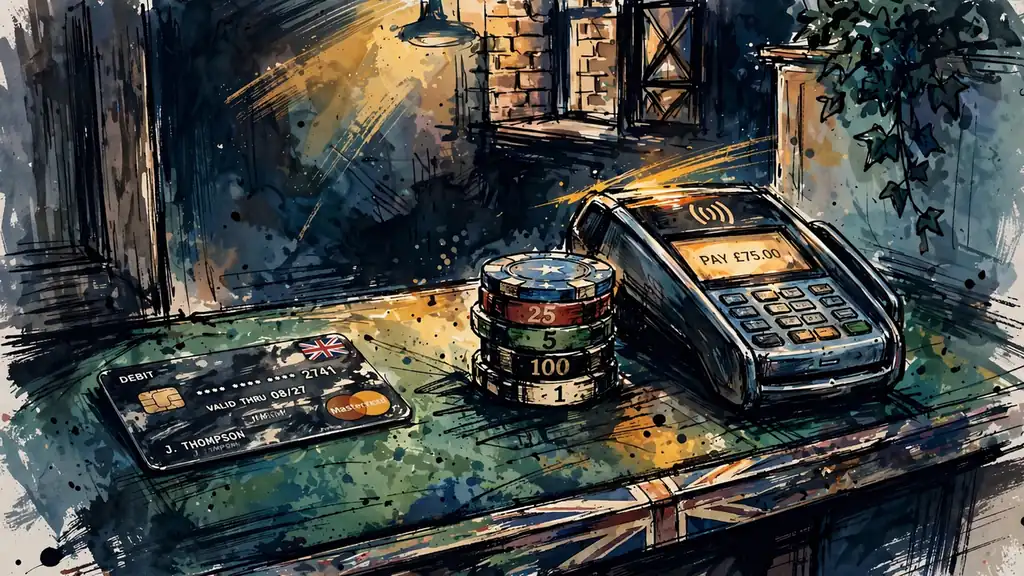
A listed payment method is not proof of current UK availability; the cashier is the relevant check.
Wirecard Acceptance Is a Cashier Question, Not a Guarantee
A casino payment logo is not a promise carved into stone. It is closer to a notice in a shop window: useful, perhaps current, but not enough to establish what will happen at the till. For anyone looking for casinos that accept Wirecard in the UK, the decisive evidence is the payment cashier shown by the relevant casino at the time of registration or deposit.
That distinction matters because payment pages age badly. A casino may change its banking provider, remove a card brand, alter the countries served by a payment product, or display different methods to different account holders. An old review can remain online long after the cashier has changed. A directory can repeat the same outdated detail until it acquires the appearance of consensus. Repetition is not confirmation.
The word “Wirecard” creates a particular trap. It may appear in a page title, an archived payment list or a discussion that once described a card as accepted. None of those references demonstrates that the method is available now, for a UK account, at the specific casino being considered. The relevant question is narrower: does the live cashier present a compatible Wirecard payment route to that account?
That is why lists described as the best Wirecard casinos, new Wirecard casinos or casinos with Wirecard bonuses should be treated carefully. A ranking can compare only what has been checked, and payment availability is not a permanent characteristic of an operator. It can depend on the casino’s current payment arrangement and on the particular card product. A name appearing in a list is therefore a lead for checking, not a certificate of acceptance.
A specialist affiliate review has listed Visa and Mastercard among the payment brands found at the sites it examined. That observation is useful only within its limits. It does not establish that every Visa or Mastercard product will work, that the same options remain visible, or that a Wirecard-branded product will be treated in the same way as another card issued on one of those networks. The cashier remains the place where the general label meets the actual account.
Zimpler at UK Casinos: Checking Cashier Availability
UK casinos commonly accept debit cards, including Visa and Mastercard. Yet “debit card accepted” is a broad statement, not a verdict on every card carrying those marks. Card products differ, and a payment network’s presence does not by itself settle whether a particular issuer, product or account is eligible. The practical language of the cashier is more precise than the language of a promotional page: a method is either displayed as available for the account, or it is not.
This also explains why the phrase “all Wirecard casinos in the UK” promises more than any responsible list can deliver. No static catalogue can prove completeness when operators alter their cashier pages and when availability may be checked only after an account is opened. A short list may be out of date; a long list may merely be confident. Neither deserves automatic authority.
The same caution applies to Android casinos. An Android phone changes the device used to reach the casino, not the payment methods offered by its cashier. A mobile site or app can display games on a smaller screen while presenting the same account-specific payment choices—or different ones, depending on how the operator has built its interface. The presence of a mobile version says nothing, by itself, about Wirecard acceptance. That question still belongs to the cashier.
Casinos That Accept eChecks in the UK: What to Check
A sensible check has several simple parts. The casino must be serving the British market through the appropriate legal framework, and its payment page must be current. The account should be opened using accurate ownership details, because payment compatibility is not only a matter of familiar logos. Then the cashier should be examined for the exact method shown, rather than for a nearby brand or a remembered description. If Wirecard is absent, a search result cannot turn that absence into acceptance.
The order is important. First comes the live account page; commentary comes afterwards. A payment method printed in an article may describe yesterday’s arrangement. A logo in a general footer may describe the operator’s wider market rather than the UK cashier. A forum post may record one player’s experience without proving that the same product is eligible today. The cashier is less glamorous than a “best sites” table, but it has the advantage of being attached to the transaction in question.
Recognition vs Compatibility
A casino may recognise Visa or Mastercard as card networks while rejecting a particular card product. It may display a method in general information while withholding it from a particular jurisdiction or account. These distinctions are easy to lose in a headline and difficult to ignore at the point of payment.
There is also a difference between recognition and compatibility. A casino may recognise Visa or Mastercard as card networks while rejecting a particular card product. It may display a method in general information while withholding it from a particular jurisdiction or account. It may offer one card route and not another that sounds similar. These distinctions are easy to lose in a headline and difficult to ignore at the point of payment.
So the answer to whether Wirecard casinos are still available in the UK cannot be responsibly supplied as a timeless catalogue. Availability must be established casino by casino, account by account, through the current cashier. The search for a “best” site begins there, not with the adjective.
The cashier has the last word.
If Wirecard Is Unavailable, Other Routes Have Different Trade-offs
When Wirecard is not displayed in a casino cashier, the practical question is not which operator has the most convincing old payment page. It is which available route fits the movement of money in both directions, the account holder’s circumstances and the casino’s current rules. Payment brands have long lives in articles and short lives in cashiers. The cashier remains the less romantic, more useful document.
The alternatives used in the British market fall into three broad families: bank-linked payments, e-wallets and prepaid vouchers. They do not solve the same problem.
Bank-linked payments
Open banking connects the gambling account with a bank account through a payment service. A bank transfer takes a more traditional route, moving funds from the account rather than passing through a card or stored-value wallet. A specialist review of UK casino payments describes open banking and bank transfers as routes that can offer instant deposits and fast withdrawals at many sites. That wording matters: availability and speed belong to the individual cashier, not to the label alone.
Casinos That Accept Debit Cards in the UK
The appeal is straightforward. Bank-linked payments use an account already associated with the customer, so the path from funding account to casino account is relatively clear. This can make the method feel less like buying a voucher and more like moving money between named accounts. It also avoids the question of whether a particular card product is compatible with the cashier.
The trade-off is that a bank transfer is not a single, uniform experience. The casino may provide its own bank details or use a banking service, and the route can involve its own processing stages. Bank transfers can also be affected by cut-off times, weekends and currency conversion. “Bank” sounds solid; it does not mean every transaction obeys the same clock.
Open banking and ordinary bank transfer should therefore not be treated as interchangeable merely because both touch a bank account. The cashier may show one and not the other. It may also distinguish between deposit and withdrawal availability. A payment route that can put money into a gambling account is not automatically a route for taking winnings out.
E-wallets
Skrill and Neteller occupy a different position. They are electronic wallets rather than direct bank instructions, and a specialist review of casino payment methods reports that they are available at some sites. The wallet can provide a separate layer between the bank account and the casino account, which some customers value for organisation and control over payments.
E-wallet Separation
E-wallets like Skrill and Neteller provide a separate layer between the bank account and the casino account, which can offer organisation and control over payments.
That separation also creates another account to maintain. The name, ownership details and verification status held by the wallet need to fit the casino account. A mismatch can turn a simple transaction into an administrative exchange, with documents and explanations replacing the imagined instant click.
Skrill remains one of the most common deposit methods mentioned by specialist reviews of UK-friendly casino sites in 2026, while Jeton is reported in that type of review as available at a handful of UK online casinos in the same year. These descriptions are snapshots, not permanent directories. They show that e-wallet availability is uneven and time-sensitive, particularly for less widespread services.
E-wallets also carry a promotional complication. A specialist review states that Skrill and Neteller are often excluded from promotions. That is not a judgement on their payment performance; it is a reminder that a deposit method and a promotional deposit are separate matters. The cashier may accept the wallet while the offer’s terms treat that funding route differently. Payment choice first, bonus interpretation second.
Prepaid vouchers
Paysafecard is the clearest example of a prepaid route. It is a voucher used for deposits only. That single characteristic changes the calculation: it may provide a way to fund the casino account, but it does not form a complete deposit-and-withdrawal arrangement.
A deposit-only method can suit someone who wants to separate the gambling payment from a bank card or account. It can also impose a hard boundary around the transaction: the voucher enters the casino account, while any return of funds has to follow another approved process. That process may involve extra checks because the casino must establish where money can properly be sent.
The distinction is easy to miss when payment logos are presented in a neat row. A logo means that a route may be offered; it does not explain whether the route handles deposits, withdrawals or both. Paysafecard’s role is narrower by definition.
Casinos That Accept Upaycard in the UK
What an alternative actually replaces
Wirecard searches often treat every payment method as though it were a substitute for every other one. They are not. A bank-linked method may prioritise a direct relationship with the bank. An e-wallet may prioritise separation and speed where the cashier supports it. A prepaid voucher may prioritise deposit control while giving up withdrawal functionality.
The clean comparison is therefore not “which method is best?” but “which part of the transaction needs replacing?” If the missing feature is a card-like deposit, an e-wallet may not behave in the same way. If the important feature is a route back out, Paysafecard cannot provide it as a deposit-only voucher. If the attraction is a quick bank connection, a conventional transfer may involve different timing conditions.
There is also no sensible basis for calling a casino a Wirecard casino merely because it accepts one of these alternatives. A site offering Visa, Mastercard, a bank route, an e-wallet or a voucher has disclosed those methods—not a continuing relationship with Wirecard. Payment names are not family trees.
The sound approach is to read the cashier as a live map: identify the methods currently displayed, distinguish deposit from withdrawal, and then consider the method’s own trade-offs. The alternative is not a consolation prize. It is a different arrangement, with a different path for money and a different set of conditions.
Deposits, Promotions and the Small Print
A payment method appearing in a casino cashier answers one question only: whether the operator is prepared to process that type of deposit. It does not answer whether the same deposit qualifies for a welcome offer, free spins or another promotion. Those are separate decisions, governed by the terms attached to the offer.
Attention A payment method appearing in a casino cashier does not guarantee that the same deposit qualifies for a welcome offer, free spins, or another promotion.
That distinction matters particularly when searching for casinos accepting Wirecard debit cards in the UK. A page may describe a card route, while the live promotion terms exclude it. Conversely, an offer may be available to customers who deposit by a particular method without that method being available to every account. The cashier and the promotion page perform different jobs; neither should be treated as a substitute for the other.
Deposit acceptance is not bonus eligibility
Promotional wording normally specifies the qualifying payment routes, the type of deposit required and any exclusions. A card or wallet can therefore be accepted for ordinary funding while being left outside the bonus. The presence of a deposit button is not a promise of free spins, a no-wagering bonus or any other reward.
PayPal illustrates the awkwardness. A specialist review describes it as popular for speed and convenience, while also noting that deposits made through it may be excluded from bonus eligibility. That is not a permanent rule for every operator, but it is a useful warning about the gap between a functioning payment route and a qualifying promotional deposit.
The same care applies to Skrill and Neteller. A specialist review reports that they are available at some sites and are often excluded from promotions. “Available” in that sentence concerns the payment facility; “excluded” concerns the offer conditions. Collapsing the two produces a very attractive misunderstanding.
The word “deposit” can also conceal different requirements. A promotion may require a qualifying payment rather than simply any account credit. It may restrict eligibility to a first deposit, a named method or a particular offer period. The relevant conditions belong to the individual promotion, not to the payment brand in the abstract.
Deposit-only means exactly that
Paysafecard is a prepaid voucher used for deposits only. Its role ends at putting funds into the gambling account; it is not a withdrawal route. That makes it especially important to separate payment availability from promotional eligibility. A casino may accept the voucher for a deposit, yet the bonus terms may exclude prepaid methods or require another qualifying route.
Prepaid Voucher Limits
Paysafecard is a voucher used for deposits only. It can fund the casino account, but it does not form a complete deposit-and-withdrawal arrangement.
The same principle prevents a common leap in searches for “no minimum deposit” or “no deposit bonus”. A payment method being listed does not establish that an offer requires no deposit. Nor does an offer described as “no deposit” establish that a particular card, voucher or wallet can be used with it. The promotional label and the cashier option must each be read for what they actually say.
Claims about Wirecard casinos offering no-deposit bonuses, no-wagering free spins or real-money play without a deposit therefore need unusually careful wording. A historic mention of Wirecard, a general payment-method page and a current offer are not interchangeable evidence. Promotional availability can change independently of the cashier, while a search result can outlive the arrangement it once described. Marketing has a long memory; payment systems do not.
What the terms should settle
Before treating a deposit as promotional, the small print should identify:
- the payment methods that count as qualifying deposits;
- whether prepaid vouchers or e-wallets are excluded;
- whether the offer is a welcome promotion or another type of bonus;
- whether the advertised free spins or bonus funds require a deposit at all;
- any conditions attached to claiming or using the reward.
No universal Wirecard bonus follows from the card’s name appearing beside a casino. “Casinos that accept Wirecard” and “casinos offering a Wirecard-qualifying promotion” are different descriptions, and the second requires its own current terms. The cashier confirms the transaction route; the offer rules determine the reward. Two small print boxes, two separate answers.
Mobile Slots Do Not Make a Payment Method More Available
A phone changes the screen, not the cashier. A slot that opens in a mobile browser or inside a casino app is still connected to the operator’s payment system, and that system decides which funding methods are available. The fact that a game works neatly on a small display says nothing about whether Wirecard can be used to fund the account.
This distinction matters because mobile gambling pages often place several ideas close together: the game catalogue, the sign-up button and the deposit menu. They belong to different parts of the service. Mobile compatibility concerns whether the software can run on a phone or tablet. Payment compatibility concerns whether the cashier recognises a particular card, account or payment route for a UK customer. One does not prove the other.
The same applies to online slots played through a desktop browser. A casino may offer an identical catalogue across desktop and mobile versions while showing different payment choices after login, depending on the account, location or card product. A page describing “Wirecard slots” may therefore be using the name as a label for the intended payment route rather than confirming that the route is available at the point of deposit. A label is not a cashier.
Casinos that accept Giropay in the UK
Free play is a separate case
Free or demonstration slots require no payment method at all. Their availability cannot establish that Wirecard is supported for deposits, nor can it show that a particular casino accepts the card for any transaction. The game may be available before an account is opened, while payment options appear only after registration and the relevant checks.
That is why “free Wirecard slots” can be a misleading description. The slot may be free to play, but Wirecard is not doing anything in that version of the game. The two words have simply been placed side by side. Marketing has always enjoyed this small sleight of hand.
For mobile and desktop play alike, the meaningful point of comparison is the live cashier. A specialist review may list Visa and Mastercard among the payment methods associated with the sites it examines, but such a list is not a permanent statement about every UK customer or every card product. Current availability and card eligibility still have to be checked in the cashier attached to the account.
A branded card name is not enough, either. The payment screen may distinguish between card networks, issuing products or available transaction types. It may also display one set of options on a mobile device and another after the account has been opened. The device is only the window; the cashier is the decision-maker.
Consequently, “online slots with Wirecard” should be understood as a request to combine two separate conditions: mobile or browser access to the games, and current acceptance of the payment method. Finding the first condition does not establish the second. A slot remains a slot, whatever the screen.
The Live Cashier
The device you use is only the window; the cashier is the decision-maker for payment availability.
Real-Money Play and the Limits That Come First
Real-money slot play is not defined by the name of the payment method. A card, wallet or other route may appear attractive in a search for casinos that take Wirecard, yet the important question remains whether the transaction can lawfully fund a gambling account and whether the account is ready to accept it. The machine, the app and the payment route belong to different parts of the arrangement. Confusing them produces a very polished kind of error.
For UK-licensed remote gambling operators, the first deposit is preceded by a financial-limit prompt. This is not an optional message hidden somewhere in the account menu. New customers must be asked to set a limit before depositing, and the account must retain accessible controls for managing that limit afterwards. The rule places a pause before money enters the gambling balance, when the decision still has some distance from the momentum of play.
That matters for searches framed around playing slots for real money with Wirecard. Even if a payment option is displayed, it does not remove the account-control step. A real-money balance is not created merely because a payment brand appears beside a deposit button. Age verification also has to take place before an operator allows funds to be deposited into a gambling account. The cashier is therefore part payment interface, part compliance checkpoint, and part reminder that an online slot is still gambling.
Credit cards are not an exception
Credit-card payments for gambling are prohibited in the UK. The regulator introduced the ban on 14 April 2020, and it has not been relaxed. That prohibition covers the familiar direct route and does not become irrelevant because the payment is presented through a digital service or another financial arrangement. A method that permits credit-card funds to be used for gambling cannot be treated as an acceptable workaround.
Casinos That Accept Interac in the UK: What to Check
This is especially important where a Wirecard-related search is really asking whether a card can be used to fund slots. The brand name alone does not establish the funding source, the product’s current status or its eligibility for gambling transactions. Real-money play requires the payment route to fit the UK rules, not merely to function technically.
The same distinction applies to phrases such as “free slots” and “no deposit”. They describe a possible promotional or play arrangement, not a relaxation of account controls. A no-deposit claim cannot cancel the operator’s duties, while a free-play mode does not demonstrate that the same site accepts a particular payment method for cash gambling. Different labels, different questions.
The sensible order is therefore rather unglamorous: establish that the account may legally accept deposits, complete the required age and account checks, set the financial limit when prompted, and only then consider the available way to fund play. The limit comes first.
Deposits May Be Instant; Withdrawals Follow Another Clock
A fast deposit says very little about the speed of a payout. Card payments can be authorised almost immediately because the transaction is being sent into the casino account. A withdrawal reverses the direction of the money and brings additional checks with it. A specialist review describes the contrast plainly: a card deposit may be instant, while the corresponding payout can take several business days.
That distinction matters when assessing casinos associated with Wirecard, whether the product is described as a card, a banking service or a route for funding slot play. The payment label does not create a direct withdrawal promise. The cashier must show how withdrawals are handled, and the account may need to pass checks before funds leave the operator.
Withdrawal Timelines
A card deposit may be instant, while the corresponding payout can take several business days.
Why the original payment source matters
UK anti-money-laundering rules generally require gambling payouts to be returned to the original payment source. This is part of the closed-loop approach to handling customer funds, not a special privilege attached to a particular card brand. Where the original route cannot receive the money, the casino may request another method or further information before completing the payment.
Using account details and a payment route belonging to the same customer helps avoid basic ownership discrepancies. A mismatch can turn a routine withdrawal into a request for clarification. The cleanest arrangement is therefore one named account used consistently for depositing and withdrawing, subject to the casino’s own cashier rules.
Alternative payout routes may involve additional verification. That does not mean a withdrawal has failed; it means the operator must establish where the money is going and who controls the receiving account. Financial controls are rarely impressed by convenience.
The casino’s approval comes first
The displayed withdrawal status is not necessarily the moment at which funds are sent. The casino must review the request internally, and the first withdrawal can take longer while KYC is completed. A specialist review identifies internal approval and account verification as factors that affect the time before payment is released.
This creates several separate stages: the withdrawal request, the casino’s checks, approval, and delivery through the payment provider. A quick deposit completes only the first side of the relationship. It does not remove the operator’s approval process or the need to confirm account information.
For that reason, claims about instant banking or fast card withdrawals should be read as descriptions of a payment route, not as guarantees for a Wirecard-funded account. The live cashier and the casino’s withdrawal terms determine whether the method supports both directions of payment. A deposit may arrive at once; the return journey has its own clock.
A Welcome Offer Is Not a Payment Feature
A casino can display a payment method in its cashier and still treat that method differently when a welcome offer is involved. The two questions sit beside each other but are not the same:
- Can the account be funded through this route?
- Will that deposit count towards the advertised promotion?
That distinction matters for searches about Wirecard casinos, real-money slots and welcome bonuses in the UK. A payment logo does not turn a deposit into a qualifying bonus transaction, and a bonus banner does not prove that the named payment route is available.
No Wirecard-specific welcome offer, no-deposit promotion or bonus code should be assumed from a general payment reference. The presence of Wirecard in a description, directory entry or older review cannot establish that a current promotion accepts it. Promotional terms belong to the offer and may change independently of the cashier.
The detail is easy to miss because welcome offers are written as invitations, while payment pages are written as instructions. One says what might be awarded; the other says how money may enter the account. Their overlap is governed by the promotion’s own conditions. A deposit can therefore be accepted without producing the bonus that attracted the deposit in the first place.
Do
- Check the live cashier for current methods
- Read the specific promotion terms
- Verify if a method allows both deposits and withdrawals
Don’t
- Assume a logo guarantees acceptance
- Treat payment availability as a permanent characteristic
- Conflate deposit methods with bonus eligibility
Payment routes can be excluded from bonuses
A specialist affiliate review reports that PayPal is valued for speed and convenience but may be left out of bonus eligibility. That is a statement about the terms attached to an offer, not proof that PayPal is unavailable as a payment method. The distinction is small in wording and large in consequence.
The same type of specialist review reports that Skrill and Neteller are available at some casino sites while often being excluded from promotions. Availability is therefore not enough to establish eligibility. The relevant offer must identify which deposits qualify and whether a particular payment route is excluded.
This is especially important when a promotion is described with loose phrases such as “slots bonus”, “welcome bonus” or “no-deposit bonus”. Those labels describe the reward structure, not the cashier’s compatibility with Wirecard. A bonus code, where one exists, does not alter that principle: entering it cannot make an otherwise excluded payment method promotional.
The clean separation is simple: payment acceptance concerns the transaction; bonus eligibility concerns the terms attached to the offer. Treating them as interchangeable is how a plausible headline becomes an expensive misunderstanding.
Minimum Deposits, Limits and the Cost of Moving Money
The minimum deposit is set by the casino, the payment method, or both. A specialist review places the starting point for many UK casino deposits in the £10–£20 range, with the exact threshold depending on the route selected. That matters when a search is framed around a £5 Wirecard deposit: a low figure in a title or comparison table does not establish that the cashier will accept it, or that Wirecard is available at all.
Casinos That Accept Litecoin in the UK: What to Check
The live cashier remains the practical measure. It may show a different minimum for a card, bank-linked service, wallet or voucher, even where the casino’s general payment page lists all of them together. The amount displayed before confirmation is the operative one. Payment labels are not contracts; they are closer to weather forecasts.
Limits work in the same untidy fashion. A specialist review notes that maximum deposit amounts can vary by payment method and by account status, and may be set per transaction, per day or per month. A newly opened or incompletely checked account may therefore encounter a different ceiling from an established account. The cashier and account controls matter more than a static claim that a particular route supports a certain amount.
The same caution applies to Wirecard-related wording. “Wirecard minimum deposit casinos” describes an intended payment route, not a guaranteed price or acceptance policy. Even when a method appears in an old article, its minimum, availability and permitted transaction direction need current confirmation. A deposit option should not be treated as interchangeable with a withdrawal option.
Cost is broader than the number entered in the deposit box. A specialist review identifies several possible layers: a casino charge, a payment-provider fee, an issuer or bank fee, an exchange-rate spread and a network fee. Not every transaction carries every cost, but the visible deposit amount alone cannot settle the question. The account currency also deserves attention. Specialist pages state that GBP is supported, while still advising confirmation of the account currency before the first transaction, since conversion can otherwise enter the calculation.
For a UK account, the clean comparison is therefore the displayed minimum plus every stated charge in the same currency. A small minimum is not necessarily a small-cost transaction, and an apparently familiar payment name does not remove the need to inspect the cashier.
Total Transaction Cost
The real cost includes casino charges, payment provider fees, issuer or bank fees, exchange-rate spreads, and network fees.
Choosing an Alternative Without Assuming It Is Cheapest
Replacing Wirecard is not a matter of finding one payment button with a lower-looking charge. The real cost can be distributed across several stages: a casino fee, a payment-provider fee, an issuer or bank charge, an exchange-rate spread, or a network cost. A route that appears free in the cashier may therefore be less economical once the full transaction is considered.
A specialist review has noted that the conversion spread can exceed a clearly displayed flat fee. That is easy to overlook because a spread is often folded into the exchange rate rather than shown as a separate deduction. The amount leaving the bank account and the amount reaching the casino may tell a different story from the headline fee.
Compare the whole transaction
The sensible comparison is between like-for-like payments in the same currency and for the actual amount intended for the casino account. A payment method with no casino charge can still involve a provider cost or currency conversion. A bank-linked route can have a different cost structure from an e-wallet, while a prepaid option may make the charge appear in the purchase price rather than in the casino cashier.
A specialist review also concludes that no payment method is the universal lowest-fee choice. That conclusion is less glamorous than a “best alternative” label, but it reflects how payment costs work: they depend on the casino, the provider, the account currency and the transaction itself.
The comparison should therefore record:
- any charge stated by the casino;
- any fee imposed by the payment provider;
- possible bank or card-issuer charges;
- the exchange rate used when currencies differ;
- any network cost attached to the transfer.
The same principle applies when looking for casinos associated with Wirecard-style deposits. A site’s payment branding does not establish the cheapest route, and a visible fee does not reveal the entire price. The relevant question is not which alternative sounds best, but which one leaves the intended amount in the gambling account at the lowest total cost, without mistaking a hidden conversion margin for a free service.
Cheap-looking is not cheap.
Payment Compatibility Does Not Establish GamStop Status
A payment method and a self-exclusion scheme answer different questions. The cashier concerns how funds may be deposited or returned. GamStop concerns whether a person’s self-exclusion applies to a participating gambling service. One cannot be used as a shortcut for the other.
That distinction matters when a casino is described as accepting Wirecard. The appearance of a card logo, a reference on an old payment page, or a payment option shown by a third party says nothing reliable about the operator’s relationship with GamStop. It does not establish that the casino participates in the scheme, nor that it does not. Payment compatibility is not a membership certificate.
Casinos That Accept Klarna in the UK: Payment Guide
The same caution applies to phrases such as “Wirecard slots not on GamStop” or “non-GamStop casinos accepting Wirecard”. They combine two separate claims into one attractive label. The first concerns self-exclusion status; the second concerns a cashier arrangement that can change. Treating the combination as a fixed category makes the wording sound more definite than the underlying information.
UK regulatory status is another separate matter. Remote gambling licensees selling into Great Britain must hold the relevant Gambling Commission licence, while offshore casinos operate outside the UKGC system. A payment route cannot reveal which of these situations applies. That requires checking the operator’s current licensing information and the public register, rather than inferring status from a deposit screen.
Nor should the presence of a self-exclusion statement be treated as proof that a particular payment method is supported. Account controls, self-exclusion arrangements and transaction options belong to different parts of the operator’s compliance structure. They may appear on the same website, but they do not validate one another.
There is a social reason for keeping these categories apart. Self-exclusion exists to create distance from gambling; payment branding exists to reduce distance between an account and money. Confusing the two turns a safety mechanism into a marketing description.
Different questions. Different checks.
What is the fastest withdrawal method for UK casinos?
PayPal, open banking services and debit cards linked to fast payout systems are generally among the quickest options. The casino’s approval process and your verification status also affect how quickly a withdrawal arrives.
Is Skrill available?
Yes, Skrill is available at some UK-friendly casino sites and is a common deposit method. It is often excluded from promotions.
Can I deposit in GBP?
Yes, GBP is supported at the sites described. Check your account currency before depositing to avoid conversion.