

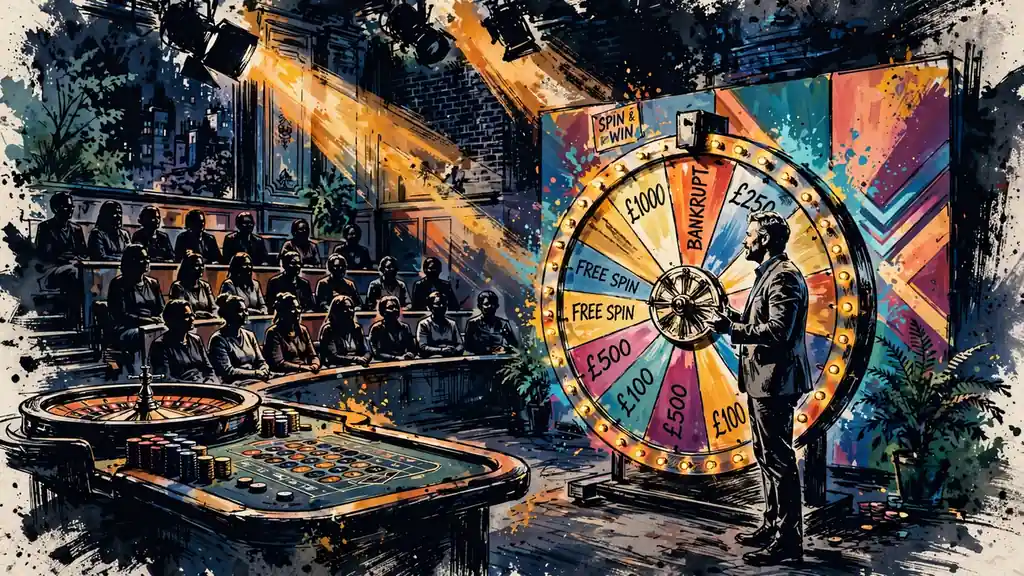
Hosts, sets, cameras and shared presentation turn a digital wager into a more theatrical event.
How Live Casino Game Shows Turn Gambling into Spectacle
A live casino game show begins with a change of emphasis. The gambling does not disappear, but it is no longer the only thing placed before the audience. Alongside the wager comes a visible setting, a host, a rhythm of presentation and the faint theatrical promise that something is about to happen in public.
That distinction matters. A conventional digital casino game can be approached as a compact machine: a screen, a stake, an outcome. A live game show borrows from television and studio entertainment. It gives the event a face and a room, even when both arrive through a browser. The result belongs neither entirely to broadcasting nor entirely to gambling. It is a hybrid, and hybrids are rarely tidy.
The appeal of live casino game shows lies in that meeting point. The player is not simply watching a programme, because participation is connected to a gambling decision. Nor is the player merely pressing a button in isolation, because the action is framed as an occasion. There may be a presenter, a set, a camera, graphic overlays, sound cues and a shared flow of attention. These elements turn a private digital transaction into something that resembles a small public performance.
From game to occasion
The word “show” does important work. It tells the audience that the experience is meant to be staged rather than merely displayed. A game show has an entrance, a centre and an ending, even when the individual rounds are brief. It creates anticipation through sequence: the announcement, the pause, the reveal, the reaction, the reset.
That sequence is familiar from television. The studio is not an accidental background but part of the product. Lighting suggests significance. Music marks transitions. On-screen graphics clarify what is happening and keep the eye occupied between decisive moments. A host supplies continuity, giving separate rounds the character of one ongoing event.
None of this changes the underlying fact that the activity is gambling. Presentation cannot turn chance into skill, and a cheerful studio cannot make an uncertain result certain. Yet presentation changes how the activity is perceived. The player encounters not only an outcome but also a setting in which the outcome occurs. A plain result becomes a beat in a performance.
Slot Providers: UK Casinos by Developer
This is the central transformation: gambling is given a social and visual surface. The surface may be elaborate or restrained, but its purpose is similar. It makes the event feel less like an isolated exchange with software and more like participation in a programme.
That is the theatre.
The presenter as a human point of contact
The presenter occupies an unusual position. In ordinary television, a host guides an audience through entertainment. In a live casino setting, the same figure may also explain the stage of the round, maintain its tempo and respond to what is happening on screen. The presenter therefore acts as both master of ceremonies and interpreter.
This human presence can make an unfamiliar format easier to follow. A sequence that might seem abstract when represented only by symbols acquires an audible and visible explanation. The host’s language supplies order: what is happening now, what comes next and when attention should turn to the result.
There is also an emotional function. A presenter can create suspense without changing the mathematical character of the game. A pause may feel longer when it is shared with a voice and a face. A result may appear more eventful when someone acknowledges it. The atmosphere is not a guarantee of excitement; it is a way of arranging attention.
Barcrest Online Casinos UK: Amatic Games Explained
The distinction is worth keeping clear. The host is part of the presentation, not a source of control over chance. Charm, confidence and polished delivery can make a studio feel welcoming, but they do not make an outcome more favourable. The performer can shape the mood. The performer cannot shape the laws of probability merely by smiling at them.
Why the studio matters
A studio gives the online experience a physical imagination. Even when the audience sees only a carefully selected camera angle, the set implies a larger place beyond the frame. There is a desk, a background, lighting equipment and a production environment. The viewer is invited to feel that the event exists somewhere, at a particular moment, rather than being generated nowhere in particular.
This sense of place separates live game shows from many forms of automated casino entertainment. A digital game may have a theme, but a live show presents an environment. The difference is not necessarily technical; it is perceptual. One format asks the eye to read a designed interface. The other asks it to recognise a room.
The studio environment is a designed setting, including lighting, music, and graphics, intended to create a sense of occasion around the gambling event.
Sets also establish identity. Colour, architecture, music and costume can suggest luxury, playfulness, glamour or informality. These choices are not neutral. They tell the audience what kind of evening the programme wishes to imitate. A bright studio may make the activity feel festive; a darker, more polished room may borrow from the language of late-night entertainment. The casino has always understood decoration. The live game show simply places decoration in motion.
The risk is that style can become louder than substance. A visually persuasive presentation may encourage the impression that an ordinary gambling event is a major occasion. The more accomplished the production, the easier it is to forget that the central result remains uncertain and that the stakes remain real. Spectacle attracts attention. It does not remove responsibility.
The television grammar of gambling
Live casino game shows borrow a grammar developed long before online gambling. Television teaches viewers how to read a countdown, a dramatic pause, a reaction shot and a change in music. These devices organise time. They tell an audience when to expect a decision and when to experience its consequences.
In a browser-based setting, that grammar serves several purposes at once. It can make the interface easier to understand by dividing activity into recognisable moments. It can keep the experience moving by preventing every stage from feeling like a technical interruption. It can also turn waiting into part of the entertainment rather than an empty interval.
That final function is especially revealing. In many digital products, waiting is treated as friction to be eliminated. A live show treats it as material. The pause before an outcome is not necessarily a defect; it may be the very point at which suspense is produced. The audience is given time to anticipate, observe and react.
Online Casinos With No Limits: What the Claim Means
Such pacing creates a stronger emotional contour than an entirely mechanical sequence. There are rises and falls, moments of noise and moments of silence. The show can feel memorable even when its underlying actions are simple. This is one reason live game shows belong to the wider history of popular entertainment: they understand that people do not consume events only for their practical result. They also consume the manner in which the result arrives.
Participation without physical presence
The curious promise of online live entertainment is presence at a distance. The player remains outside the studio, yet the format is designed to suggest inclusion. The camera faces outward. The host speaks towards an unseen audience. The interface places the remote participant at the edge of the scene, close enough to observe and connected enough to act.
This is not the same as being in a theatre or television audience. The remote participant may not be visible to the presenter, and the surrounding crowd may be made up of digital indicators rather than people in the same room. Still, the form borrows the emotional vocabulary of collective viewing. A round is presented as something that happens now, not merely something retrieved from storage.
That “now” has cultural weight. Live broadcasting has long promised access to an unfolding event. It can make an ordinary evening feel attached to a wider present. Online casino game shows apply the same promise to gambling entertainment. The appeal is not only the result but the sense of catching an event as it occurs.
At the same time, the feeling of shared presence can be misleading if it is mistaken for genuine community. A lively interface does not necessarily mean that participants know one another or influence one another. Atmosphere can be designed. The appearance of a crowd can be part of the production language. A crowd may be present, but the player’s financial decision remains personal.
Visual Spectacle
An elaborate production or a lively atmosphere does not change the mathematical character of the game or the certainty of the result.
A room full of noise is still a room in which restraint may be needed.
The border between entertainment and gambling
The category is interesting because it makes the border between gambling and entertainment unusually visible. Traditional casino design often tries to make the wager feel smooth and immediate. Live game shows make the surrounding entertainment more obvious. They announce that the activity has been packaged, styled and performed.
This openness can be refreshing. It allows the format to be judged as entertainment rather than as a mysterious technical process. Viewers can consider the quality of the host, the clarity of the presentation and the atmosphere of the studio. The show has a cultural identity, not just a functional one.
But entertainment also carries its own persuasive force. A polished production can soften the seriousness of a financial decision. Humour can make a pause feel harmless. Music can turn loss into a passing beat in a cheerful sequence. The format does not need to deceive in order to influence mood; it only needs to make participation feel easy and socially familiar.
That is why the spectacle should be understood as framing, not evidence. It frames the activity as an event, but it does not prove anything about the fairness of a particular outcome, the value of a wager or the wisdom of continued play. Those questions exist outside the studio’s lighting.
The show may be entertaining. The gambling remains gambling.
Why the format feels contemporary
Live game shows belong to a period in which online services increasingly imitate physical environments. Video calls reproduce the meeting room. Streaming reproduces the television schedule. Virtual events reproduce the conference hall. The casino game show follows the same instinct: it gives an online activity a recognisable social shape.
Amatic Online Casinos UK: Games, Terms and Licensing
This does not mean that the format is simply a digital copy of television. The online setting changes the relationship between viewer and event. The participant is not merely watching. The activity is designed around the possibility of action from the same screen. Observation and decision sit close together.
That closeness is part of the attraction. Entertainment is no longer separated from participation by a clear boundary. The audience can feel involved in the unfolding sequence, while the gambling element gives the event an immediate personal consequence. The old distinction between watching a game and taking part in one becomes less stable.
There is an irony here. Digital technology can make an experience feel more intimate by adding a human presenter and a physical studio, even though the participant remains physically alone. The online casino borrows the symbols of togetherness to create a more vivid solitary activity. The result is not a community in the old sense, but neither is it a cold machine. It is a manufactured middle ground.
Reading the format clearly
The best way to understand live casino game shows is to hold both sides of the description at once. They are entertainment productions, with the pacing, imagery and personalities associated with a show. They are also gambling products, in which an uncertain outcome is connected to money or a gambling balance. Ignoring either side produces a distorted picture.
Calling them “just games” understates the production around them. Calling them “just television” ignores the financial decision at the centre. Calling them social entertainment may capture the atmosphere while missing the solitary nature of remote participation. The format is compelling precisely because it combines these incomplete descriptions.
Essential Summary
- Live game shows combine gambling with the presentation styles of television entertainment.
- The presenter acts as both a master of ceremonies and an interpreter of the game.
- Presentation shapes the mood and atmosphere but cannot alter the laws of probability.
- A live show treats the pause and the sequence of events as part of the entertainment.
For that reason, the phrase “live casino game shows” refers less to one fixed visual style than to a family of experiences built around the same idea: gambling presented as a hosted, staged and time-bound event. The details may vary from one production to another. The category is held together by its treatment of gambling as spectacle.
That treatment explains the format’s place in online casino entertainment. It does not merely place a game on a screen. It gives the game an entrance, a voice and a setting. It asks the audience to watch as well as act, to follow a rhythm as well as await a result. The wager remains the quiet centre of the arrangement, but around it grows an entire language of performance.
And performance changes the mood, not the odds.
UK Casinos, Live Shows and the Rules Behind the Screen
A live casino show may look like television, but its legal character is gambling. The cameras, studio, presenter and on-screen interface do not move it into a separate regulatory category. Where a business offers remote gambling to consumers in Great Britain, the activity falls within the system overseen by the UK Gambling Commission. That remains true whether the entertainment is presented as a conventional casino table, a studio production or a programme built around a host and a game.
This is the essential point behind any discussion of online casinos with live game shows in the UK: the spectacle may change, but the responsibility attached to offering gambling does not disappear behind the screen.
The regulator behind the remote service
The UK Gambling Commission supervises gambling activity in the United Kingdom, including the operation of online casinos. For commercial gambling in Great Britain, it is the central statutory regulator rather than one body among several competing gambling authorities. Its role extends to remote gambling offered to consumers in Great Britain, even when the equipment running part of the service is located elsewhere.
Amatic Games in UK Online Casinos: How They Work
That last point matters because internet services are rarely contained within one building, or even one country. A studio may be in one place, servers may be in another, and the customer may be watching from a third. The physical location of the key equipment does not by itself remove the service from British oversight when the remote gambling offer is directed at consumers in Great Britain.
The screen can travel. The obligation follows the market.
The legal framework is rooted in the Gambling Act 2005, which governs gambling in England, Wales and Scotland. Northern Ireland has a separate legal position and should not be casually folded into references to the British market. In ordinary commercial language, “UK casino” often covers all four nations; in regulatory language, the distinction can become decisive. The Gambling Commission’s remote-gambling role concerns Great Britain: England, Scotland and Wales.
What a UKGC licence means in this setting
A UKGC licence is not simply a badge attached to a website. It is the legal authorisation under which a business may conduct the relevant gambling activity for the British market. The Commission grants operating licences to businesses and personal licences to individuals whose work falls within the licensing system.
For a casino providing live entertainment, the important question is therefore not whether the website looks British, uses sterling, or places a presenter in a recognisable studio. The question is whether the business offering the remote gambling service holds the relevant operating authorisation for Great Britain.
Amatic Online Casinos in the UK: What to Check
That distinction also keeps several different roles apart. A company may produce technology, supply a game, provide studio services or support the digital infrastructure. None of those descriptions, on their own, identifies the business legally offering the gambling to the customer. The operator is the party whose service makes the casino available as a commercial gambling product.
This is why a live show cannot be judged solely by its production values. A polished set, a familiar presenter and a continuous broadcast say something about presentation. They do not establish the operator’s legal status.
Why the equipment’s location is not the answer
Remote gambling invites a misleadingly simple question: where is the casino? There may be no single useful answer. A customer enters through a website or application; the game may be processed through systems in several locations; a live broadcast may originate in a specialist studio. Yet the British regulatory test is not reduced to the address of the machinery.
The Gambling Commission regulates remote gambling supplied to Great Britain’s consumers regardless of where the key equipment is situated. This prevents geography from becoming a technical escape route. Otherwise, a business could attempt to serve the British market while arguing that its servers, cameras or control systems were outside the country and therefore outside the regulator’s reach.
For the public, this produces a more practical understanding of regulation. The relevant issue is the service being offered into Great Britain, not the scenery behind the presenter or the data centre shown in a corporate description.
Live entertainment does not create a legal loophole
The language of television can make gambling sound like a different kind of activity. A presenter may announce events, a studio audience may react, and the visual design may resemble a broadcast rather than a traditional casino. Still, the underlying arrangement remains an opportunity to participate in a casino game where real-money gambling is being offered.
Amatic Online Casinos UK: How to Check the Supplier
The Gambling Act 2005 defines a casino as an arrangement that gives people an opportunity to take part in one or more casino games. That wording is broad enough to focus attention on the arrangement itself rather than on whether the experience resembles a physical gaming floor. A live presentation does not, by its mere appearance, remove the activity from the concept of a casino.
This is particularly relevant to searches for the best live game-show casinos in the UK. “Best” may describe production, interface, choice or the atmosphere created by a broadcast, but it cannot substitute for the more basic legal question. A service that provides an appealing show without the required operating authorisation is not made suitable for the British market by being entertaining.
Entertainment is not a licence.
Business licences and personal licences
The Commission’s licensing structure also distinguishes the business from the people working within it. Operating licences are issued to businesses. Personal licences are issued to individuals whose roles in gambling operations require that form of authorisation.
The distinction reflects the way a modern casino is assembled. A business may be responsible for the commercial service, while particular individuals carry professional responsibilities within the operation. The two kinds of licence answer different questions: whether the business is authorised to conduct the relevant gambling activity, and whether an individual is authorised to perform regulated work.
A personal licence is not a replacement for an operator’s UKGC licence. Nor does the presence of licensed individuals turn an otherwise unauthorised website into a licensed casino. The authorisations belong to different parts of the regulatory structure.
That separation is easy to miss when a live game-show service is presented as one seamless broadcast. On screen, the host, studio and digital account appear to belong to one product. Behind the screen, legal responsibility is divided more carefully.
Attention An offshore operator may be accessible from Britain, but accessibility is not the same as being part of the UKGC regulatory system.
What the British market requires from a casino service
A real-money online casino serving Great Britain must operate under a current UK Gambling Commission operating licence. The same principle applies when the casino includes live entertainment. A website cannot acquire British legal status merely by describing itself as international, locating its company abroad or contracting with a production business elsewhere.
Remote operators selling into the British market must hold the relevant Gambling Commission licence regardless of their own location. The rule is directed at the commercial service and its British audience, not simply at the registered address of the company.
This is also why offshore casinos should not be treated as equivalent alternatives when looking for live game shows casinos in the UK. An offshore operator may be accessible from Britain, but accessibility is not the same as inclusion within the UKGC regulatory system. A foreign licence does not become a UKGC licence through a website’s language, branding or willingness to accept British customers.
For that reason, a list of online casinos with live game shows should not be assembled merely from websites that display a live lobby. The legal status of each operator must be established separately. A catalogue of names without that distinction would confuse availability with authorisation.
The limits of what a licence tells the public
A UKGC licence is important, but it should not be mistaken for a review score or a promise about the quality of a broadcast. Regulation answers questions about legal permission and oversight. It does not turn every licensed casino into the same product, and it does not establish that every live show has identical presentation, content or availability.
Betsoft Casinos in the UK: Games and Operators
Nor does a licence mean that a game is permanently present in a lobby. Commercial catalogues can change, and a service may present different products at different times. The legal point is narrower and more useful: when a licensed operator offers remote gambling to Great Britain, that offer sits within the Commission’s regulatory framework.
This distinction protects the meaning of the word “best”. A ranking may be based on editorial preferences, but licensing is not a matter of taste. A casino either holds the relevant operating authorisation for the service it provides, or it does not. The camera angle cannot settle that question.
Great Britain, the United Kingdom and ordinary language
The phrase “UK casinos” is common because it is short and familiar. The regulatory vocabulary is less forgiving. Great Britain comprises England, Scotland and Wales; Northern Ireland is not governed by the Gambling Act 2005. The UK therefore remains a useful geographical phrase in general discussion, but it should not be used to erase the legal boundary.
This matters when a live casino service claims broad national coverage. A statement about Great Britain is not automatically a statement about Northern Ireland. The relevant law, regulator and licensing position must be considered in the correct territory.
The distinction is not pedantry. Gambling law is made of boundaries, and remote services are particularly good at making boundaries look invisible. One tap can cross them; the legal obligations do not necessarily travel in the same way.
Reading a live casino offer as a regulated service
A live game-show casino is best understood as a chain of responsibilities rather than a single piece of entertainment. The visible broadcast is only the public-facing layer. Beneath it sits a commercial operator offering a gambling service, and that service is subject to the rules applying to remote gambling in Great Britain.
The Commission’s authority covers both business operating licences and the personal licences of individuals performing regulated work.
The Commission’s authority reaches that service even where the technical infrastructure is distributed internationally. Its licensing system covers businesses through operating licences and relevant individuals through personal licences. The Gambling Act supplies the wider legal framework for England, Wales and Scotland, while Northern Ireland remains outside that Act’s scope.
Those principles provide the proper starting point for assessing live casino entertainment in Britain. The show may be dramatic or restrained, familiar or novel, but the legal test begins elsewhere: who is offering the gambling, to which market, and under what UKGC licence?
Only then does the set become worth discussing.
Crazy-Time-Style Shows: What the Available Evidence Can Support
The labels Crazy Time and Funky Time create a particular expectation: a casino product presented as a show rather than as a quiet game window. That expectation explains why these names are frequently placed beside phrases such as “live casino” and “game show”. Yet a name, however vivid, is not a description of a verified product.
A title can suggest movement, colour and theatrical presentation without establishing how the game works. It does not, by itself, identify the studio, the software supplier, the betting rules, the available markets or the form of any bonus feature. Nor does a familiar-sounding label prove that a particular version is currently offered to players in Great Britain. Casino naming has always enjoyed a little theatrical licence. The title enters first; the small print arrives later.
Amatic Games in UK Casinos: Supplier, Not Operator
What a name can and cannot tell
“Crazy-Time-style” is best treated as a description of resemblance, not as a technical classification. It may refer to a product with a similar visual mood, a similarly energetic presentation or simply a title chosen to occupy the same corner of the casino lobby. Those are different things, and collapsing them into one category makes the wording sound more certain than the underlying information allows.
The same caution applies to searches for a Crazy Time live casino game show. The phrase points towards a specific kind of entertainment: a named casino show with a live or show-led identity. It does not settle whether the product is a live-dealer game, a recorded presentation, a streamed interface connected to a random-number system or something else entirely. Those distinctions matter because the appearance of a studio is not the same as proof of the underlying game mechanism.
The name Funky Time should be read in the same restrained way. It may be used as a product title, a comparison point or a shorthand for a particular style of casino entertainment. The title alone does not establish its rules, prizes, presenter, release status or distribution. A lively name is not a licence, a specification sheet or a promise of availability.
Why similar titles are easy to confuse
Casino entertainment borrows freely from television. Words such as time, show, live and crazy belong to ordinary broadcasting language as much as they belong to gambling. That creates a curious overlap: a title can sound like a programme, a game or a whole category without clearly being any of them.
Product Name
The exact title used by the operator and provider.
Game Mechanism
The actual rules, software, and underlying betting structure.
Availability
Whether the product is currently offered to British players.
For that reason, a product should not be identified solely by a phrase used in a headline, a promotional tile or an informal comparison. The exact title matters, as does the operator carrying it and the provider responsible for the software. Even then, a lobby listing is only an indication that a product has been placed there; it is not a detailed account of its operation.
This is particularly important when “style” becomes the main adjective. A style label can help describe atmosphere, but it cannot supply missing facts. It cannot show whether a show is available in a particular jurisdiction, whether its interface is genuinely live, or which conditions govern a wager. Language can make two products sound like cousins. Their contracts may disagree.
A narrower way to compare shows
A sensible comparison begins with identity rather than excitement. The relevant questions are simple:
- What is the exact product name?
- Which operator displays it?
- Which provider is identified in the game information?
- Is the presentation live, simulated or otherwise described?
- What rules explain the possible outcomes?
- Which terms apply to deposits, bonuses and withdrawals?
- Is the product actually available to the intended British account?
These questions do not turn a game show into a dry administrative object. They separate the show as entertainment from the show as a gambling product. The distinction is valuable because the first is designed to attract attention, while the second must explain what participation means.
A title such as Crazy Time may therefore be used in ordinary prose as a reference point for a high-energy casino-show idea, but it should not silently carry unverified details. The same goes for Funky Time and for the broader expression “Crazy Time-style”. Similarity of title is not proof of shared mechanics, shared ownership or shared availability.
The British context
For British players, the operator’s status remains more important than the drama of the name. A real-money casino product offered to Great Britain belongs within the UKGC-licensed environment. The Gambling Commission regulates remote gambling offered to consumers in Great Britain, and the operator—not a colourful title or a third-party description—holds responsibility for the customer-facing gambling service.
That responsibility includes the practical information attached to an account: deposits, payouts, bonus conditions, customer support and safer-gambling controls. A show name cannot transfer those duties to a software supplier, nor can it make an offshore product part of the UKGC system. Spectacle has no jurisdictional powers.
The attraction of named game shows is understandable. They offer the promise of a recognisable event rather than an anonymous reel or table. But recognition is not verification. “Crazy Time live casino game show” and “Funky Time live casino game show” describe the direction of interest; they do not, by themselves, establish a catalogue, a rulebook or a current British offering. The honest boundary is therefore a narrow one: names may guide identification, while the actual product information must carry the claims.
The Live Casino Game Show as a Separate Format
A live casino game show occupies an awkward but useful place between two familiar kinds of entertainment. It belongs to casino gaming because money can be staked on an outcome. It resembles a television game show because the experience is presented as an event rather than as a solitary turn on a digital reel. Neither description is complete on its own.
Amatic Slots in UK Casinos: Games and Access
That distinction matters. “Live” does not automatically mean “game show”, and a casino game shown through a live video feed is not necessarily part of the same category. The label suggests a particular meeting point: gambling remains central, while the presentation borrows the language of hosted entertainment. The screen becomes more than a display for results. It becomes a stage, at least in principle.
More than a live table
Traditional live casino entertainment is commonly understood through the image of a dealer, a table and a familiar casino game. The appeal lies in the sense of a real-time setting: an on-screen host conducts the session, and the result unfolds within that broadcast.
A game-show format places a different emphasis on the surrounding presentation. The attraction is not defined only by the underlying gambling action, but by the feeling that something is being presented for an audience. That can include a host-led structure, a recognisable visual identity or an atmosphere associated with television entertainment. The exact ingredients vary, and the label alone does not establish how any particular title works.
This is where the category boundary becomes important. A live casino game show is not simply a casino game with brighter graphics. Nor is it ordinary television with a betting option attached. Its identity comes from combining the two ideas without allowing either one to disappear.
A category, not a promise of mechanics
The phrase can sound more precise than it really is. It tells the reader something about the intended presentation, but not everything about the rules. It does not, by itself, confirm the presence of a particular type of wheel, bonus round, prize structure, host interaction or betting market. Those details belong to the individual product and require separate checking.
This restraint is less glamorous than a catalogue of supposed features, but it is more useful. A category name should not be mistaken for a specification sheet. Two products described as live game shows may differ considerably in their pacing, interface, available wagers and relationship between the broadcast and the gambling result.
New Online Casino Sites in the UK: What to Know
The same applies to availability. A title may be associated with the format in general without being offered by every UK operator, or by every operator at all times. A lobby label is not a universal market register. In online gambling, presentation and distribution are separate matters.
Why the format has its own identity
The category exists because the surroundings of gambling affect how gambling is perceived. A standard casino interface tends to make the individual action prominent: select an option, confirm a stake and wait for an outcome. A game-show presentation can shift attention towards the shared spectacle of the session.
That shift changes the emotional vocabulary. The experience may be described in terms of watching, hosting, anticipation and occasion rather than only in terms of a bet. The language is not accidental. Casino entertainment has long borrowed from other forms of leisure, and the game show is particularly convenient because it already has a structure built around suspense and public outcomes.
There is a social idea hiding underneath the format. The player is not necessarily watching a private game in the old sense of the word; the presentation implies an audience, even when the activity takes place alone in a browser. A screen can manufacture a room around a solitary decision. Television perfected that trick long before remote gambling adopted it.
Still, atmosphere does not alter the basic nature of the activity. If real-money gambling is involved, the entertainment frame does not turn it into ordinary television. The outcome remains subject to the relevant casino terms, and the presence of a presenter does not make a wager less consequential.
Keeping the boundaries clear
Several neighbouring categories can therefore be kept apart:
- a conventional casino game may be digital or live without being presented as a game show;
- a televised game show may involve competition or prizes without being a casino product;
- a live dealer title may use a real-time host without adopting a game-show identity;
- a promotional broadcast may discuss gambling without itself being a game in which stakes are placed.
These distinctions prevent the phrase from becoming an empty marketing label. They also explain why the broad term is useful at the beginning of a search for suitable entertainment but insufficient at the end of a purchasing decision. The format identifies a kind of experience; it does not settle the questions of rules, operator, licence, cost or availability.
Entertainment first, gambling still present
The separate status of the live casino game show rests on this double character. It is designed to be watched as well as played, but watching does not replace the gambling function. It borrows the ceremony of a show while remaining part of online casino entertainment.
That makes it a category with a clear cultural silhouette and an indistinct technical edge. The silhouette is the promise of a hosted, event-like gambling experience. The edge must be established title by title. Spectacle is not a rulebook.
What bonuses and free spins are available at Amatic casinos in the UK?
Some UK operators carrying Amatic games offer free spins: 32Red, Betfred and bet365 have free-spin wins with no wagering requirement. bet365’s offer requires a £10 lifetime deposit and provides up to 500 spins over 10 days.
How does the UK’s 10× wagering cap affect Amatic casino bonuses?
Since 19 December 2025, wagering requirements on bonus funds at UK-licensed casinos cannot exceed 10 times the bonus amount. This applies to operators offering Amatic games; Amatic itself does not set casino bonus terms.
What is Amatic Industries and when was it founded?
Amatic Industries GmbH is an Austrian business-to-business gaming software supplier, founded in 1993. It supplies games to casino operators rather than running consumer-facing casinos.
Are Amatic casinos on GamStop?
Amatic does not operate casinos itself. UK-licensed casinos offering Amatic games must participate in GamStop, which has been mandatory for all Great Britain-licensed online operators since 31 March 2020.