

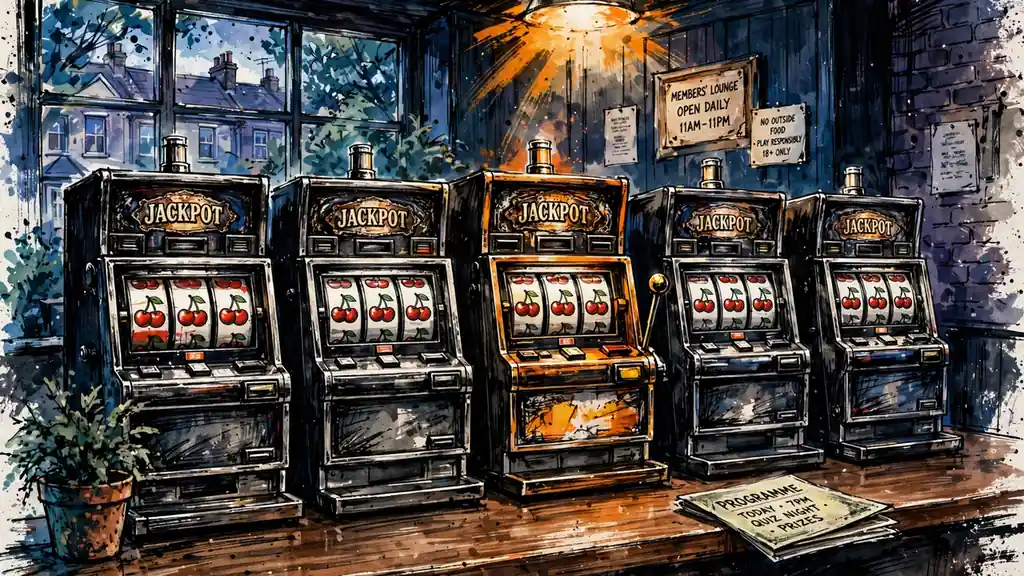
The guide explains reel layouts, paylines, bonus rounds and volatility, while distinguishing free play from real-money sessions.
Five Reels, and What They Change
A reel is the vertical strip on which slot symbols appear. Put several reels side by side and the game begins to resemble the machine familiar from a casino floor: symbols move, stop, and form patterns across the visible arrangement. The number of reels is therefore not a decorative detail. It changes the shape of the game, the number of possible routes through it, and the way a winning combination is read.
A three-reel slot is the older, more compressed design. Its image is easy to grasp at a glance: a small group of symbols, a short line of movement, and a result that often feels almost immediate. The format belongs to the visual language of the classic fruit machine, where the machine’s identity rested on a modest set of symbols and a clean arrangement. There is little room for visual ceremony. The reels turn, settle, and deliver their answer.
Fruit Machine Slots UK: From Pub Cabinets to Online Reels
Five reel slots open the picture out. Two additional reels create a broader field in which symbols may meet in more places and in more varied arrangements. A result can stretch from the first reel to the last, rather than being contained within the compact geometry of a three-reel design. That extra space is the central change. Everything else follows from it: the appearance of the layout, the reading of combinations, and the possibility of applying a bet across all five reels.
This does not make one format automatically superior to the other. A three-reel game can feel direct and uncluttered, while a five-reel game can feel more layered. The difference is less a contest than a difference in grammar. One speaks in short phrases; the other has room for a longer sentence.
From a line to a wider field
The most useful way to understand five-reel slots is to look at how symbols are connected. A bet may be applied across all five reels, allowing the game to judge the symbols as a sequence that runs through the complete layout. The reels do not stand as five unrelated columns. They belong to one arrangement, and the arrangement gives the spin its meaning.
That wider field also changes the visual rhythm. On three reels, the eye tends to search for a familiar trio or a simple alignment. On five reels, attention moves across the whole screen. A symbol on the first reel may acquire significance only after later reels stop. The result arrives in stages, even when the spin itself is brief.
This is why five-reel games often appear more elaborate than their older counterparts. The extra reels provide space for themes, symbols and patterns to develop across the screen. A game can present a setting, a cast of characters or a visual story without abandoning the basic act of matching symbols. The decoration is new; the underlying ritual is old.
Best RTP Casino Slots in the UK: What RTP Means
There is also a change in how the outcome is perceived. In a three-reel game, a near-match can look plainly unsuccessful because the possible arrangement is so compact. In a five-reel game, the eye has more positions to inspect. A winning pattern may occupy only part of the display, or it may travel through the reels in a way that is not obvious until the game highlights it. The broader design makes the result less like a single stamp and more like a small diagram.
The classic machine, enlarged
Classic five reel slots occupy an interesting middle ground. They borrow the visual restraint of traditional machines while using the broader structure associated with modern online play. Fruit, bars, bells and sevens can sit on five reels just as comfortably as more elaborate symbols. The theme need not determine the format.
That distinction matters because “classic” describes a style rather than a reel count. A game may look old-fashioned and still use five reels. Equally, a three-reel design may be presented with polished graphics and contemporary sound. The reels establish the architecture; the artwork establishes the period and mood.
For 5 reel slots online, the change from physical cabinet to screen is mostly a change of setting, not of basic vocabulary. The reels remain columns, symbols remain the visible material, and the spin remains the brief event around which the game is organised. The screen can make the layout larger or more animated, but the player is still watching symbols settle into relation with one another.
This helps explain why five-reel casino slots have become such a recognisable category. They are spacious enough to support a variety of visual ideas but familiar enough to retain the outline of a machine. They can look theatrical without becoming difficult to identify as slots.
Five-reel slots provide more space for themes, symbols, and patterns to develop across the screen compared to traditional three-reel machines.
What the extra reels do not change
Five reels do not turn a slot into a different kind of gambling game. The result is still determined by the game’s programmed rules, and the presence of more symbols on screen does not create a skill-based way to control the outcome. The wider layout changes what can be displayed and how a combination can be formed; it does not make the spin something that can be steered by timing or judgement.
Nor does the phrase “best five reel slots” describe a single mechanical standard. It may refer to a preference for a classic appearance, a particular theme, a spacious layout or a simple reading of the reels. Those are matters of design and taste, not proof that one format has defeated another.
Three reels offer compression. Five reels offer expansion. The difference is visible before any feature, promotion or playing mode enters the picture. Five reels give the slot more room to arrange its symbols, and that room is the real change.
Free Spins, Real Money Left Out
Free online play gives five-reel slots a harmless first setting: the reels turn, symbols settle, and the screen records wins, but no money changes hands. The balance is fictional. It cannot be withdrawn, and the displayed result creates no entitlement to a payout. That distinction matters because the familiar appearance of a casino game can make a simulation look more consequential than it is.
A five-reel slot can apply one bet across all five reels. In a free version, that bet is only a notional unit used by the game to calculate its results. It demonstrates how a stake might be distributed across the layout without becoming a financial transaction. The reels still have their order, the paylines still connect symbols, and the result still follows the game’s programmed rules. What is absent is the wager.
Video Slots in the UK: How the Games Work
What “free” means online
The phrase “play free 5 reel slots online” covers a simple arrangement: the game runs in a browser without requiring a cash balance. Some pages describe these as free online five-reel slot games; others use the older image of free five-reel slot machines. The terminology changes, while the central condition remains the same. No real stake is placed and no winnings are paid.
“No deposit” describes the absence of a funding requirement, not a promise of cash or a bonus balance. A no-registration version may open immediately, while another free game may ask for an account before loading. Neither arrangement turns the session into gambling for money. Registration can affect access to a website, but it does not transform fictional credits into withdrawable funds.
The same caution applies to “no download”. A browser-based game may work without installing software on a computer or phone. That is a technical description, not a financial one. A game can be played without a download, without a deposit, or without registration, yet still remain entirely separate from real-money play. Three different conveniences are often folded into one small label.
This is where advertising language becomes slippery. “Free spins” can mean spins supplied inside a demonstration game, or it can refer to a bonus feature encountered during the simulated session. In either case, the word “free” does not make the result redeemable. A screen may count a win, add symbols to a virtual balance, or unlock another sequence of spins; those events belong to the simulation.
Attention
Free play is a simulation with fictional credits and does not represent a financial transaction or a promise of future winnings.
Learning the rhythm without a cash balance
Free play is useful for observing how a five-reel layout behaves. The reels can be followed from left to right, and the effect of a bet applied across the full set of reels becomes easier to see when money is not competing for attention. A player can notice how symbols form combinations, how the game announces a result, and how the balance changes inside the fictional accounting system.
That accounting system is theatre with arithmetic. It has to look coherent for the game to make sense, but it does not represent a bank account. A large virtual win does not establish a pattern that will transfer to a paid session. Nor does a sequence of empty results prove that the next spin is somehow owed a success. The demonstration shows the interface and the rules; it does not create a personal forecast.
This makes free play different from a trial of financial performance. It can show how a five-reel slot presents its reels and winning combinations, but it cannot show what a particular session would cost. The absence of a stake removes the very pressure that gives real-money gambling its economic character. The screen may be busy. The purse is not.
Bonus features without a cash prize
Free five-reel slots with bonus features can still offer plenty of movement. A demonstration game may announce a special round, display extra spins, or attach a multiplier to the fictional wins recorded during play. These features are part of the game’s design and can be inspected without a deposit. They remain simulated events, however, and the final total remains imaginary.
Highest RTP Slots in the UK: How Returns Work
That separation is particularly important when a page presents “free bonus slots” beside paid casino games. Similar graphics, identical symbols and the same five-reel arrangement can make the two versions appear interchangeable. They are not. One is a model of a gambling game; the other involves a wager and a possible payout. The visual experience may overlap, but the legal and financial meaning does not.
A free session therefore works best as an encounter with the format rather than as a substitute for a cash game. It lets the five reels occupy the screen, lets the fictional balance rise and fall, and leaves the real money where it began. A modest arrangement, but an honest one.
The Machine Behind the Game
A 5 reel slot game is often pictured as a row of moving windows, but the visible reels are only the most theatrical part of the machine. Behind them sits a set of rules deciding which symbols may appear, how combinations are recognised and how the stake is translated into a possible return. The artwork gives the machine its period costume. The mathematical structure does the actual work.
Five reels create a broad canvas. Symbols can be repeated across several columns, and winning arrangements can be read through the width of the display rather than along a single central path. This is why a 5 reel slot machine tends to feel more like a small system than a simple fruit machine. There are more places for symbols to meet, more ways for a design to distribute its returns, and more visual information for the eye to process while the reels settle.
The machine does not need to be physically large. A digital game can reproduce the appearance of mechanical reels while operating through software. Its visible movement is presentation; the underlying design is a collection of symbols, reel positions, winning routes and payout rules. The distinction matters because a polished interface can make a modest structure look elaborate, while a plain-looking game may contain a carefully balanced one.
The machine’s structure
The visible reels are only the theatrical part; the mathematical structure and rules determine how symbols and stakes work.
Behind the artwork lies a system of reel positions, winning routes, and payout rules that define the game’s actual mechanics.
The low-volatility construction
Low-volatility titles are built around a particular temperament. They distribute returns through many smaller wins rather than relying mainly on rare, substantial prizes. In practical terms, the machine is designed to make winning combinations part of the regular rhythm of play, while keeping the individual return comparatively restrained. It is less a succession of dramatic events than a steady drip from a carefully arranged tap.
A common low-volatility design uses five reels and at least twenty-five paylines. That does not mean every game presents its lines in the same way, nor that every symbol has the same role. The lines form the routes by which neighbouring reels can produce recognised combinations. Their presence gives the machine several chances to register a win within one spin, rather than making the entire result depend on one narrow arrangement.
This structure also affects the visual language of the game. High-value symbols may be rarer and more emphatic, while ordinary symbols carry much of the everyday activity. The machine’s identity is therefore not found in its theme alone. A jungle, a city, a baroque palace and a collection of lucky sevens can share an underlying architecture. Change the pictures, and much of the mechanism remains standing.
There is a certain honesty in that repetition. Slot design has always borrowed its clothing from elsewhere: fruit machines borrow from grocers’ windows, western games from cinema, mythology from the old illustrated book. The machine is an organiser of symbols before it is a storyteller.
Reels, symbols and routes
The five columns are usually read together. A symbol appearing on one reel has significance because it may meet matching symbols on later reels along one of the game’s authorised routes. Some arrangements place weight on symbols landing from left to right; others use a broader pattern. The exact presentation belongs to the individual game, but the principle is stable: reels supply the positions, while the payline structure defines which positions can form a recognised result.
That separation is useful when examining 5-reel slot machines. The reel window is what the eye sees, but paylines are the machine’s grammar. Symbols are nouns, the lines are syntax, and the paytable is the dictionary nobody reads until money is involved. A visually generous display may still have a narrow mathematical purpose; a restrained display may connect its symbols through many permitted routes.
Low-volatility games commonly use fixed jackpot amounts rather than progressive pools. A fixed jackpot is part of the game’s own payout design: its value does not depend on a shared prize accumulating elsewhere. A progressive pool, by contrast, is presented as something that can grow over time. The distinction changes the character of the machine. One offers a defined prize within a contained structure; the other makes the prize appear to belong partly to a wider stream of play.
The fixed approach suits the low-volatility temperament. The machine can concentrate on distributing smaller returns through its ordinary combinations while reserving defined prizes for particular outcomes. It does not need to advertise a constantly swelling figure to give the game a sense of shape. The architecture is already busy enough.
What remains when the decoration is removed
A 5 reel slot machine is therefore best understood as a layered object. The first layer is the cabinet of the imagination: reels, symbols, sounds and animation. Beneath it sit the paytable and the winning routes. Beneath those are the rules governing how the game allocates outcomes across its different features. Low volatility is not a mood added by the graphics; it is the result of that allocation.
The machine’s architecture
Low volatility is a result of how outcomes are allocated, not just a visual mood.
This also explains why a free 5 reel slot game or a 5 reel slot demo can look almost identical to a paid version without being the same kind of session. The display may show the same five reels, symbols and lines, but appearance does not determine whether money is being staked or whether any payout exists. The machine’s visual shell can travel between modes with remarkable ease. The mathematics, the stake and the consequence do not travel so casually.
The most characteristic low-volatility construction remains recognisable: five reels, a substantial set of paylines, fixed rather than progressive jackpot amounts, and bonus elements built around multipliers applied to accumulated wins. The last of these belongs to the game’s wider feature design, but it also reveals the machine’s preference for aggregation. Wins are gathered, then given a chance to be enlarged according to the rules. Nothing is accidental in the mechanism, even when the screen performs surprise with great enthusiasm.
For anyone comparing 5 reel slot games UK players may encounter, the useful distinction is not the theme painted over the reels. It is the machine underneath: how widely it allows symbols to connect, how it distributes ordinary returns, and whether its prizes are fixed within the game or tied to a growing pool. The decoration changes nightly. The architecture is more stubborn.
Bonus Rounds and the Shape of a Win
A bonus round changes the texture of a 5 reel slot game. The ordinary spin has a familiar rhythm: symbols settle, winning combinations are counted, and the reels return to their starting position. A feature interrupts that routine. It may open a separate screen, alter the value of later wins, or keep the accumulated result in view while the game adds something to it. The appeal is not merely the possibility of a larger result. It is the brief sense that the machine has acquired another set of rules.
In low-volatility games, bonus rounds are commonly built around multipliers applied to accumulated wins. A sequence of winning combinations can therefore become the material for a feature rather than a series of isolated payments. The multiplier does not change the fact that the game has a mathematical house edge; it changes how a particular winning sequence is expressed. A modest win may be gathered, carried into the feature, and then increased according to the game’s rules. Or the feature may arrive after a qualifying combination and give the existing result a different shape.
This is why descriptions of 5 reel slots with bonus features often sound more dramatic than descriptions of the base game. The reels themselves may remain unchanged, while the counting system becomes more generous for a limited passage of play. The distinction matters. A multiplier is not a promise that every spin will produce a return, and a bonus round is not a separate source of value. Both are programmed parts of the same game, with their conditions and outcomes determined by its design.
Low-volatility titles are also associated with fixed jackpot amounts rather than progressive pools. That gives the jackpot a defined shape: its value does not depend on a shared fund growing across players or sessions. Alongside twenty-five or more paylines, this structure helps explain why some five-reel games present many modest events and then reserve a more conspicuous moment for a feature. It is a carefully arranged procession, not a sudden escape from the machine’s mathematics.
Real-Money Play
- Verify your age before depositing
- Set financial limits before your first deposit
- Use regulated operators with a UK Gambling Commission licence
Free Play
- Use it to observe the layout and rhythm
- Treat it as an interactive demonstration
- Do not mistake virtual wins for real-world patterns
The word “free” creates a small linguistic trap. Free 5 reel bonus slots may refer to a feature that awards spins without an additional stake inside a game, not necessarily to a session in which real money is absent. The label alone says little about the setting. A bonus feature belongs to the game; free play belongs to the mode in which the game is being used. Those are separate ideas, although casino copy often places them side by side until they look like one.
Bonuses also have a lifespan outside the reels. A specialist review gives a typical duration of 48 hours for bonuses, a time condition rather than a game mechanic. Such a period may determine when an offer must be used, while the feature inside the slot may last only for its programmed sequence. The two clocks should not be confused. One belongs to the promotion; the other belongs to the game.
For real-money play, this distinction becomes especially important. A feature can lengthen the emotional arc of a session without changing the underlying expectation of the game. The interruption feels substantial. The arithmetic remains quiet.
Free Play as a Separate Kind of Session
Free play is not a cheaper version of gambling. It is a different activity using the same visual language: reels turn, symbols settle, winning combinations may trigger sounds or animations, and a balance on the screen can rise or fall. That balance is simulated. The money is fake, and no payout is awarded.
This distinction matters because the appearance of a 5 reel slot game can be remarkably persuasive. A play-money balance resembles a gambling account, while the spin button behaves as though something consequential is about to happen. Yet nothing leaves a bank account and nothing can be withdrawn. The session is closer to an interactive demonstration than to a financial transaction.
What the session contains
A free-play version normally reproduces the central rhythm of the game:
- a stake is selected from the available on-screen options;
- a bet can be applied across all five reels;
- the reels spin and display symbols;
- wins and losses are added to the simulated balance;
- the balance can be reset or the session can simply end.
The figures shown inside the game are therefore counters, not funds. A large balance does not represent profit, and an empty balance does not create a debt. The software is presenting an account of fictional events.
That makes this mode useful for noticing how a game behaves without confusing observation with a money decision. The arrangement of the reels becomes easier to follow. The payline display, symbols and win animations can be examined at leisure. A session can also reveal how quickly the screen fills with small rewards or how often nothing appears, although those impressions belong only to that particular run and do not predict a future result.
Why the separation matters
Real-money play attaches an external consequence to every selected stake. Free play removes that consequence while leaving much of the ceremony intact. The contrast is revealing: the flashing graphics and celebratory sounds remain, but the supposed balance has no value beyond the screen.
This is also why simulated results should not be treated as evidence of a reliable winning pattern. A run of favourable spins changes the display, not the underlying mathematics. Likewise, a poor run has no financial meaning. The mode offers familiarity with the format, not a promise about what paid play would produce.
Free play can be paused, abandoned or restarted without a cash transfer. That quiet freedom is its defining feature. It permits contact with the form of a 5 reel slot game while keeping the transaction absent — a rehearsal with no wages attached.
In the UK, the maximum stake on an online slot game cycle is £5 for adults aged twenty-five and over, and £2 for those aged eighteen to twenty-four.
Real-Money Play Under British Rules
Real-money 5 reel slots occupy a more formal world than their free-play counterparts. In a simulated game, the stake is fictional and no payout follows a winning combination. Once money is deposited and a spin can produce a withdrawal, the activity becomes remote gambling and enters the British licensing system.
The central institution is the UK Gambling Commission. It regulates commercial gambling in Great Britain, including online casinos, and remains the sole regulator for commercial gambling there. Its reach is not determined by the location of the computer systems running a game. A remote operator offering gambling to consumers in Great Britain falls within the regulatory framework even when important equipment is located elsewhere.
This produces a distinction that is easy to miss on a casino interface. The five reels are a piece of game design; the permission to offer them for money is a matter of licensing. An operator needs a Gambling Commission operating licence, while people performing regulated roles may need personal licences. The Commission therefore licenses both the businesses that provide gambling services and the individuals who operate within that system. Paperwork, in other words, sits behind the coloured symbols.
For customers aged twenty-five and over, the maximum stake on an online slot game cycle is £5. For those aged eighteen to twenty-four, it is £2. The £5 limit for all adults aged twenty-five and over took effect on 9 April 2025. These limits apply to online slots, not to every casino game: roulette and blackjack are outside this particular slot-stake rule.
Real-money play also requires more than choosing a title and pressing spin. Operators must verify age before allowing a customer to deposit funds into a gambling account. Remote operators must ask new customers to set a financial limit before the first deposit and provide account-level controls for changing such limits. Online slot autoplay is banned in Britain, and at least 2.5 seconds must pass from the beginning of one game cycle before another can start. The pause is modest, but it is deliberate: the machine is not permitted to become invisible through sheer speed.
Payment rules form another boundary. UK-licensed casinos cannot accept credit cards for gambling, including credit-card funding routed through a money service business. A wallet cannot be used where its funds come from a credit card for gambling either. Licensed operators must provide an internal complaints process and access to an approved Alternative Dispute Resolution service, alongside responsible-gambling tools such as self-exclusion.
So, when a title is described as one of the best real-money 5 reel slots, the phrase concerns the game, not a special legal category. How to play 5 reel slots for money is inseparable from where the game is offered, who holds the licence and which safeguards surround the transaction. The reels may be old-fashioned. The regulation is not.
Paylines Across Five Reels
A payline is the route by which symbols are assessed after a spin. On a five-reel game, that route can run across the full reel set, linking positions from the first reel to the fifth. The visible arrangement may look like a simple row, but paylines can also travel through different vertical positions, creating patterns that step, dip or rise across the screen.
The important distinction is between reels and lines. Five reels describe the width of the machine; paylines describe the winning routes laid over that width. A single bet can therefore be applied across all five reels, while the game checks the selected lines for matching symbols. The reels provide the columns. The paylines provide the logic.
Paylines
The authorised routes through the reels that define which symbol arrangements constitute a winning combination.
How line coverage changes the screen
A game with a modest number of active lines leaves more symbol positions outside the bet. A broader set of lines covers more possible connections, making the display feel busier even though the underlying reels remain the same. This is why a five-reel slot machine’s paylines deserve attention before the artwork or sound: they determine how much of each spin is being evaluated.
Low-volatility games are commonly built around five reels and at least twenty-five paylines. Their design tends to distribute returns through repeated smaller combinations rather than relying on rare, dramatic outcomes. In that setting, multiple lines help create a steady succession of assessed patterns. A win may appear on one route while neighbouring symbols form nothing useful on another. The screen can be crowded with near-matches; the mathematics is less sentimental.
The stake is connected to line coverage through the game’s betting controls. A player may be able to choose how many lines are active or alter the amount assigned to them, depending on the title. Those controls should be read as part of the game’s structure, not as a promise that adding lines improves the result. More covered routes change the bet and the number of combinations being considered; they do not remove the house edge.
Free versions and line practice
Free online versions of 5 reel slot machines generally reproduce the same visual arrangement of reels and paylines, allowing the line patterns to be inspected without treating the session as real-money gambling. Such play can make the difference between a five-reel layout and a five-reel line system easier to see. It does not turn simulated combinations into payouts.
Low-volatility titles may also pair their line structure with fixed jackpot amounts rather than progressive pools. The jackpot is then a defined feature of the game, not a prize that grows through a shared network. Even here, paylines remain the central map: every result is interpreted through the routes laid across those five reels.
Five-Reel Slots in Online Casinos
An online casino is not simply a website with a digital version of a machine. It is a remote gambling business, and its relationship with the player is shaped by the jurisdiction in which the gambling is offered. For five-reel games, the setting matters because the same visual product may appear in markets governed by very different rules.
In Great Britain, remote gambling directed at consumers falls under the oversight of the UK Gambling Commission. This remains the case even when the servers, software, or other essential equipment are located elsewhere. The physical whereabouts of the machinery do not provide a convenient escape hatch from British supervision. Geography, in this matter, is less powerful than the customer-facing service.
A legitimate online casino serving British players must therefore operate under the relevant Gambling Commission authorisation. That framework covers the business offering the game, rather than changing the underlying five-reel format. The reels, symbols, paylines and other design elements belong to the game; licensing belongs to the operator and the market in which it accepts customers. Keeping those two layers separate makes the arrangement easier to understand.
The online-casino setting also affects how access is organised. A regulated operator must verify age before allowing a customer to deposit money into a gambling account. It must provide account-level financial-limit controls, and a new customer must be prompted to set a limit before the first deposit. Credit cards cannot be used for gambling, including through certain payment services that route credit-card funds into a gambling transaction.
Summary
- Licensed operators must provide responsible-gambling tools like self-exclusion.
- Free play is a separate, simulated activity with no financial consequence.
- The legality of an online casino depends on its authorisation and regulatory compliance.
These requirements are not decorative notices placed around a game window. They describe the conditions under which the casino may offer remote gambling at all. Licensed operators must also provide responsible-gambling tools, including self-exclusion, and make an internal complaints route available alongside access to an approved Alternative Dispute Resolution service. The game may occupy the centre of the screen, but the surrounding obligations are part of the product.
Free online five-reel games sit outside this particular money flow when they are genuinely simulated: no deposit is made, no stake is placed, and no cash payout is awarded. Their presence on a site does not by itself turn the site into a real-money casino session. The distinction is plain, although online interfaces have never been especially gifted at plainness.
For a real-money game, the relevant question is not only whether five reels appear on screen. It is whether the operator is authorised to provide remote gambling to customers in Great Britain and whether the account, payment and player-protection arrangements fit that regulated setting. That is the online casino around the game.
A Five-Reel Slot, Without the Sales Pitch
A 5 reel slot is built around five vertical reels set side by side. Each reel displays symbols, and a spin produces a new arrangement across the visible playing area. The essential point is not the decoration, theme or soundtrack. It is the way a stake is connected to the reels.
A bet can be applied across all five reels. Winning combinations are then assessed according to the game’s own paytable and line arrangement. Some games require matching symbols to appear in a particular sequence; others allow features such as ways to win or adjacent-symbol patterns. Those details belong to the individual game, not to the five-reel format itself.
The five-reel layout gives a slot more room to arrange symbols than a compact three-reel machine. That extra space can support longer combinations and a greater variety of visual patterns. It also makes the result feel more like a small moving tableau than a row of isolated wheels. The old mechanical image survives, although the modern version is software running inside an online game.
The word “slot” can make the format sound simpler than it is. The reels are only the visible surface. Behind them sit the paytable, the available lines, the rules for qualifying combinations and the calculation of the stake. None of these turns a game into a strategy exercise; they describe how the game accepts a bet and evaluates a spin.
In plain terms, a five-reel slot is a game in which one wager may cover all five reels, with the outcome judged by the arrangement that appears. That is the format stripped of its costume.
Features, Volatility and the Pace of Play
The features of 5 reel slot games are not limited to visible symbols or decorative themes. They also include the underlying rhythm of returns: how often winning combinations appear and how sharply their size can vary. That rhythm is commonly described as volatility.
Low-volatility slots spread their returns across a larger number of smaller wins. The result is a steadier sequence, although “steadier” should not be confused with profitable. Across most titles, winning combinations in this category typically appear every three to six spins on average. That is a description of frequency, not a promise about the result of any particular session.
High-volatility slots take the opposite shape. Winning combinations arrive less often, while individual returns can be larger. Long stretches without a win therefore form part of the intended pace rather than evidence that the machine is waiting to correct itself. Slot software has no memory in that human sense; a quiet sequence does not make the next spin more likely to pay.
This distinction changes how the game feels. Low volatility can make a session appear active because smaller returns interrupt the losing spins more regularly. High volatility creates a more uneven landscape, with anticipation accumulating between winning combinations. Neither pattern changes the mathematical character of gambling: a game with a positive house edge still carries a negative expectation over enough sessions, whether losses arrive gradually or in conspicuous gaps.
The most conspicuous feature, then, may be the interval between events. A bright interface can disguise it, but the pace remains the central design choice. Slim wins, wide pauses.