

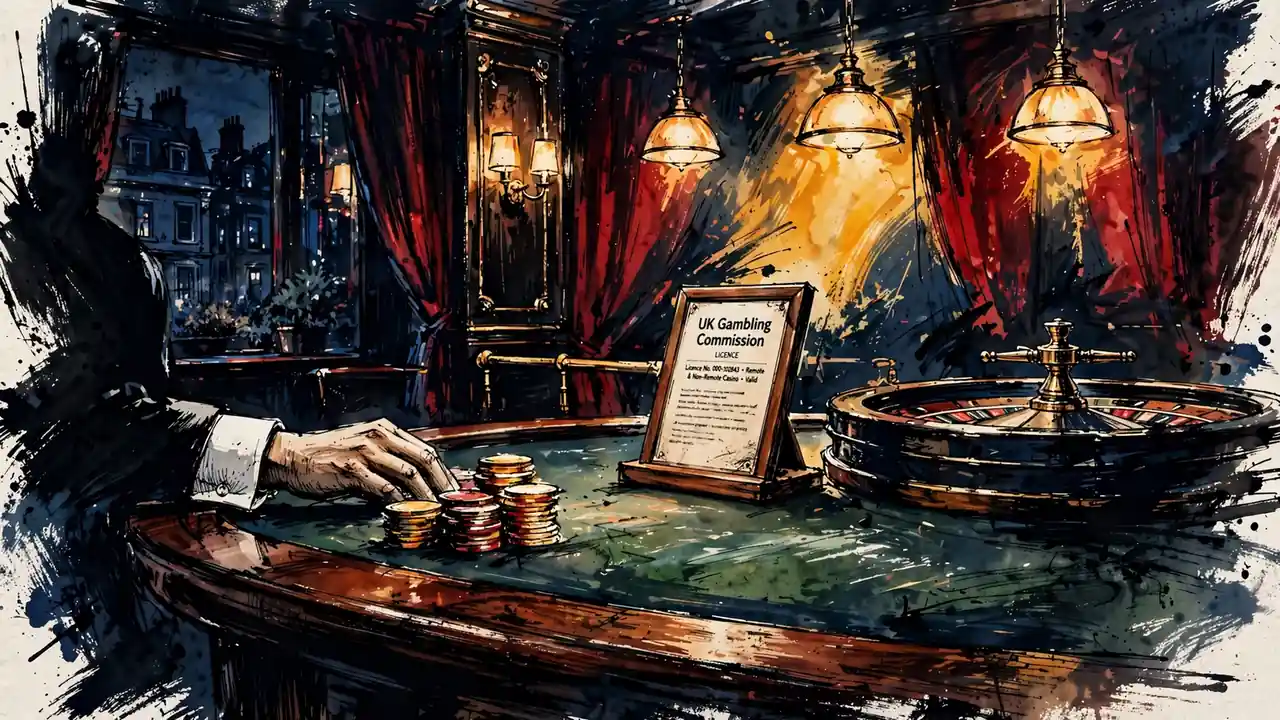
A guide to licensing, live-game formats, demo play and the terms that shape Crazy Time at UK-facing casinos.
The Licence Behind the Casino Window
A casino website can make its entrance look almost theatrical: polished branding, bright tables, a promise of immediate action. Behind that window, however, sits a less glamorous requirement. A remote operator serving customers in Great Britain must hold the relevant licence from the UK Gambling Commission. The location of the company, its servers or other key equipment does not remove that obligation. What matters is that gambling is being offered to people in the British market.
That principle applies whether the casino presents traditional tables, live-dealer games or a branded game-show title such as Crazy Time. The game’s appearance does not create a separate legal category for the operator. A site presenting Crazy Time for real-money play remains an online casino and falls within the system governing remote gambling.
The UK Gambling Commission is the regulator for commercial gambling in Great Britain and also oversees online casinos. It is the sole body with that role across England, Scotland and Wales. Northern Ireland has a separate legal framework, which is one reason that “UK” is not always a sufficiently precise word when licensing is discussed. For a casino serving customers in Great Britain, the relevant question is whether the business is authorised under the British system.
What the licence actually concerns
The Commission grants operating licences to businesses. It also issues personal licences to individuals whose work in the gambling industry requires that level of authorisation. These are different responsibilities: one concerns the company providing the gambling service, while the other concerns people in regulated roles.
A licence is therefore not decorative wording in a website footer. It is the legal basis on which the operator can offer remote gambling to British customers. A casino that displays a logo without providing a verifiable licence number leaves the important part of the claim unfinished. The number should be checked against the UK Gambling Commission’s public register before an account is funded.
That check should establish that:
- the operator’s name corresponds with the business named on the register;
- the licence covers remote gambling rather than an unrelated activity;
- the website or trading brand is connected with the licensed entity;
- the licence is current when the check is made.
The register is more useful than a badge selected for visual reassurance. A badge can be copied, moved or left behind after a business changes its position. A public regulatory record is designed for verification.
The difference between a British casino and an offshore one
A casino may be based elsewhere and still need British authorisation if it offers gambling to consumers in Great Britain. Conversely, an offshore licence is not a substitute for a UK Gambling Commission licence. Offshore operators sit outside the UKGC regulatory system, even when their websites are easy to reach from Britain.
That distinction matters for Crazy Time casinos just as it does for any other online casino. A familiar game name says nothing about the legal status of the platform displaying it. The provider of a game and the operator accepting the customer’s wager are not automatically the same business. The operator carries the responsibility for complying with the rules of the market in which it solicits and accepts play.
Access alone proves little. The internet is generous with doors.
Protections attached to licensed play
The licensing system is also expressed through practical safeguards, not only through paperwork. Before allowing a customer to deposit funds, an operator must verify that person’s age. Online gambling in Britain is legal for adults aged 18 and over where the operator holds the appropriate UK Gambling Commission licence.
New customers must be prompted to set a financial limit before making their first deposit. Account-level controls must remain accessible afterwards, so that limits are not merely a ceremonial question shown once and forgotten. UKGC-licensed casinos must also provide responsible-gambling tools, including self-exclusion.
These measures do not turn gambling into a risk-free activity. They create points at which spending can be considered and restricted. The sensible boundary remains plain: gambling should be limited to money that can be afforded to lose.
Payment rules form another part of the protection. UK-licensed casinos cannot accept credit cards for gambling. The restriction also covers credit-card funding routed through a money-service business, and a wallet cannot be used where its funds are themselves drawn from a credit card for gambling. A payment method appearing in a cashier does not override those requirements.
DO
- Check the operator’s name against the UK Gambling Commission’s public register
- Verify that the licence covers remote gambling
- Ensure the website or trading brand is connected to the licensed entity
DON’T
- Rely on a visual badge or logo without a verifiable licence number
- Fund an account before checking the licence status
Licensed operators must offer an internal complaints procedure. If a complaint is not resolved through that route, customers must have access to an approved Alternative Dispute Resolution service. This gives a dispute somewhere more formal to go than an unanswered message to a general support address.
The operator must also contribute to the Research, Education and Treatment levy. That obligation belongs to the regulated market rather than to the individual game, but it shows the broader bargain behind the licence: permission to operate is accompanied by duties towards safer gambling and public oversight.
For someone looking for a casino carrying Crazy Time, the first assessment is therefore not the colour of the lobby or the prominence of the game tile. It is the operator’s identity, its licence number and the protections visible around the account. The game may draw attention to the window. The licence determines whether the window belongs to a lawful British-facing casino at all.
Live Casino, Made for the Screen
A live casino is not simply a digital shelf of games. It is a broadcast arrangement: a real table, studio or game-show set is placed in front of a camera, while software carries the image, sound and player interface to an online account. The result sits somewhere between gambling product and television format. The screen is not merely displaying an outcome; it is supplying the room around it.
Crazy Time belongs to that presenter-led side of online casino entertainment. Its identity is therefore tied to live delivery rather than to the quiet, solitary rhythm associated with many computer-generated casino games. The visual setting, the host’s presence and the timing of the broadcast all help define the experience. A player is not looking at a static illustration of a casino. The player is watching a programmed show unfold in a studio environment.
Deal or No Deal Casino UK: Slot Features Explained
That distinction matters when the phrase “Crazy Time online casino” is used loosely. It can suggest a conventional casino game that happens to be available through a website, but the online version is better understood as a live stream with an interactive gambling layer. The video occupies the centre of the screen; controls and account information sit around it. The arrangement is designed for a browser or mobile display, where the atmosphere of a physical venue must be compressed into an interface.
From casino floor to online window
The history of live casino in Britain shows how this format became part of the ordinary online catalogue. Grosvenor first presented its live casino games in 2013, with card and casino offerings such as Blackjack, Texas Hold’em and Roulette. That early mixture is revealing: live online gambling did not begin as a single new genre, but as an attempt to transmit familiar table games while preserving something of their social setting.
Presenter-led game shows extend the same idea in a more theatrical direction. The table is no longer the only visual anchor. The host, studio design, pacing and on-screen presentation become part of the product. Crazy Time is consequently encountered not just as a name in a casino menu but as an event made for a camera. Its appeal, where it exists, comes partly from this change of scale: the online casino borrows the grammar of television, while the account interface retains the practical function of a gambling platform.
Crash Casino Games in the UK: How They Work
There is an odd reversal here. Traditional casinos often tried to make the outside world disappear: heavy doors, controlled lighting and a carefully staged sense of elsewhere. Live online casinos do the opposite. They bring the set into the home and make the camera the doorway. The casino becomes less a place than a continuous picture.
What the online format changes
A streamed game can offer a stronger sense of occasion than a purely automated display. The presenter gives the sequence a human rhythm, even though the digital interface remains essential. Camera angles, studio graphics and the visible progression of the show make the session feel less like pressing a button in isolation. They also make the boundaries of the format more apparent: a broadcast has a schedule, a studio has a set, and the player is observing an organised production rather than entering an unrestricted physical room.
The online setting also changes the social character of casino play. Several people may be connected to the same live table, but they remain separated by screens and accounts. The shared atmosphere is simulated through the broadcast and interface rather than created by bodies gathered around one table. This is neither quite solitary play nor the sociability of a traditional casino. It is a mediated middle ground.
For a UK audience, the phrase “online casino with Crazy Time” should therefore be read as a description of format, not as a promise of a particular atmosphere or service. Availability, presentation and account conditions belong to the individual operator and should not be inferred from the game’s televised appearance. The game itself may look expansive, but the surrounding website still determines how the online session is framed.
Casino Games: Slots, Live Tables and Game Formats
The distinction between watching and wagering can also become blurred. A polished studio, a host’s patter and the pace of a broadcast can make gambling resemble entertainment programming. It remains gambling nevertheless. Money can be lost, and the visual energy of the show does not alter that fact. Only funds that can be afforded to lose should be used, with the session treated as paid gambling rather than free viewing.
Crazy Time is thus best placed within the screen-native branch of the online casino: a live production adapted for remote participation. Its defining setting is not a brick building or a silent software reel, but the moving image of a hosted show. The casino window has become a television set. The wager remains.
Choosing a Casino Without a ‘Best’ List
A “best” Crazy Time casino sounds like a helpful shortcut, but it is a weak way to assess a gambling service. A ranking would need current, comparable evidence about licensing, account controls, payments, complaints and the game’s availability. Without that evidence, calling one site the best is decoration rather than guidance.
Live Casino UK: How to Assess Tables and Terms
The first check is the operator’s position in Great Britain. Remote operators serving consumers in Great Britain must hold the relevant UK Gambling Commission licence. The licence number should be checked on the Commission’s public register before an account is funded, rather than relying on a badge, logo or statement on a casino’s own page. The register is the useful part; the badge is merely theatre.
Account controls before the first wager
A UK-licensed casino must verify a customer’s age before allowing deposits. That is not an optional courtesy or a feature reserved for suspicious accounts. The same account-opening process should also make a financial limit available before the first deposit, with account-level controls that remain accessible afterwards.
Those controls matter more than a colourful welcome banner. A casino offering Crazy Time should make it possible to review or change limits, use self-exclusion tools and find responsible-gambling information without having to search through promotional pages. Self-exclusion is a serious interruption to gambling, not another button competing with a bonus.
The practical standard is simple: the account should show what has been set, what restrictions apply and how support can be reached. Any service that makes deposits prominent while hiding limits deserves a less romantic assessment.
Payments are part of the test
Payment methods reveal whether the casino is operating within the British framework. UK-licensed casinos cannot accept credit cards for gambling. The restriction also covers credit-card funding routed through a money service business, and a wallet cannot be used where its funds come from a credit card for gambling.
That makes a payment page worth reading before any money is moved. A casino may display many deposit logos, but the relevant question is whether the method is permitted for gambling in the account’s circumstances. Deposit and withdrawal conditions should also be read as account terms, not treated as an afterthought to the advertised game.
Casino Dice Games in the UK: Wagers and Rules
No payment route changes the underlying risk. Money used for wagering should be money that can be lost without affecting essentials, bills or obligations.
Complaints, records and game information
A credible UK-licensed operator must provide an internal complaints process and access to an approved Alternative Dispute Resolution service. The complaint route should therefore be visible in the terms, help pages or account area. It is a useful distinction between a regulated service and a page that merely borrows the language of legitimacy.
Terms should also identify how account activity is recorded. References to Crazy Time results need careful reading: a result is an outcome of a particular game round, not evidence that a casino is better, safer or more likely to produce a favourable run. Past results do not create a strategy, and a list of recent outcomes should not be presented as a prediction tool.
The same restraint applies to Crazy Time bonuses. A promotional offer can affect the conditions attached to an account, but it does not establish that the casino is the best place to play. Wagering requirements, eligible games, withdrawal restrictions and expiry conditions belong in the small print, where enthusiasm loses its shine.
A sensible comparison therefore has no podium. It has a checklist: a verifiable UK Gambling Commission licence, age verification, visible financial limits, lawful payment methods, responsible-gambling controls and a clear complaints route. Crazy Time can then be considered as one offering within that regulated account, without confusing a promotion, a result history or a confident adjective with evidence.
Where Crazy Time Sits in the Live Casino
A live casino is not one game stretched across a screen. It is a catalogue, and the catalogue has its own social order. Card tables tend to form its traditional centre: blackjack, roulette and poker variants carry the history of the physical casino with them. Alongside them sit newer presenter-led formats, designed less like a quiet table in a gaming room and more like a televised event.
Blackjack
Traditional card games that carry the history of the physical casino.
Roulette
Table games with established vocabulary and wheel-based structures.
Texas Hold’em
Card games that retain their particular social ritual.
Crazy Time belongs in that second area of the catalogue. It is a live casino game-show title, associated with a prominent wheel-based presentation rather than with the familiar vocabulary of a blackjack hand or a roulette layout. That distinction matters when deciding what kind of experience it represents. It is not simply another name for roulette, nor should the word “casino” turn every live title into a conventional table game. The setting is shared; the format is not.
From casino tables to live catalogues
The move from physical casino games to live online tables did not erase the old categories. It carried them into a new room. Grosvenor, for instance, first introduced its live casino offering in 2013. Its selection included Blackjack, Texas Hold’em and Roulette — three recognisable examples of how a live catalogue was initially anchored in established card and casino games.
That history explains why a modern live-casino lobby can feel like a small museum with a television studio attached. Roulette retains its wheel and table vocabulary. Blackjack retains the dealer, cards and hand-based structure. Texas Hold’em carries the language of poker and its particular social ritual. These games make the live format legible because their origins are already familiar.
Game-show titles occupy a different shelf. Their appeal lies in presentation, ceremony and the feeling of joining a hosted broadcast. Crazy Time is therefore best understood beside the table games, not as a replacement for them. The contrast is part of the catalogue’s design: one title offers the recognisable discipline of a card table, another offers a more theatrical wheel-centred setting.
Mines Casino Game in the UK: How It Works
What “where to play” really describes
The question of where to play Crazy Time is often treated as though it concerns a single destination. In practice, it describes a place within a wider casino menu. A suitable live-casino lobby would set the title among other live offerings, allowing it to be compared with roulette, blackjack and related game-show products without pretending that all of them work in the same way.
That broader view is more useful than calling a casino “top” merely because it displays the title. The presence of Crazy Time says something about the range of a live catalogue, but not everything about the operator behind it. A lobby may be extensive, narrowly focused, traditional or heavily oriented towards game-show presentation. The title is one entry in that arrangement, not a certificate of quality.
It also explains why “Crazy Time wheel casino” and “Crazy Time wheel game” are natural descriptions, even when the surrounding catalogue contains ordinary tables. The wheel identifies the visual and presentational family readers are looking for. The word “casino” identifies the setting in which that family appears. Neither term makes the title a roulette table.
A place beside, not inside, the classics
Crazy Time sits at the intersection of casino tradition and broadcast entertainment. Its surroundings may include the old institutions of live gambling — Blackjack, Texas Hold’em and Roulette — while its own identity belongs to the newer game-show side of the lobby. That is the useful distinction when considering a UK live-casino catalogue: not whether every title shares one set of rules, but whether the selection reflects more than one idea of what a casino can look like.
Any real-money play remains a leisure expense, and only money that can be afforded to lose should be used.
Attention Only money that can be afforded to lose should be used for gambling.
Strategy Meets the Limits of the Category
The phrase “Crazy Time strategy” suggests that a repeatable method might turn a televised casino format into a puzzle with a dependable solution. That expectation needs trimming. A strategy can organise decisions around a gambling session, but it cannot guarantee an outcome. It may set a planned wager, define a stopping point or prevent a series of losses from quietly becoming the purpose of the evening. It cannot make an uncertain result obedient.
That distinction matters because searches often place Crazy Time beside online slots. The label can create a false legal shortcut: if a page calls the product a slot, it does not follow that the rules for online slots automatically govern it. Category names used in menus, reviews or casual conversation are not a substitute for the regulatory classification of the game.
A specialist review describes the Great Britain slot stake framework as allowing a maximum of £5 in a game cycle for players aged 25 and over, and £2 for those aged 18 to 24. The same type of source states that the slot limits do not extend to roulette or blackjack. Those figures therefore belong to the slot category described in that material; they must not simply be transferred to Crazy Time because both products appear in an online casino.
The same caution applies to timing and automation. Great Britain’s requirements for online slots include a minimum interval of 2.5 seconds between the start of one game cycle and the beginning of the next, and autoplay for online slots is banned. Those are rules for the relevant category, not universal instructions for every live casino product. Treating them as a description of Crazy Time would turn a regulatory distinction into a guess.
Chicken Road Game Casino UK: What the Name Means
A practical approach to a live casino game is consequently narrower than many “systems” imply. A player can decide in advance what amount is affordable to lose, keep the stake consistent with that decision and stop when the planned session ends. Chasing losses is not a strategy in the useful sense; it is a way of allowing the previous result to dictate the next financial decision. The only safe budget is money that can disappear without interfering with ordinary commitments.
Trackers raise a different issue. A Crazy Time tracker may record previous rounds, dates or selected outcomes, but a record is not evidence that the next result has become predictable. Historical data can describe what has happened; it cannot create control over what happens next. The word “tracker” also says nothing about the accuracy, independence or privacy of a particular tool. Any service that asks for account credentials, payment details or access to a casino account deserves particular suspicion.
The history of casino strategy is full of devices designed to make chance look more negotiable than it is. Ledgers, progressions and elaborate staking charts give uncertainty a respectable filing system. Their appearance of order is not the same as predictive power. Crazy Time does not acquire a reliable winning method merely because a chart has been given a name.
The sensible boundary is therefore plain: strategy may govern personal limits and record-keeping, while it cannot promise control over the game. Any amount wagered should be money the player can afford to lose.
Crazy Time in the Live Game-Show Line-up
Crazy Time belongs to the part of online casino culture that borrows the language of television: a studio setting, a presenter-led session and a game designed to be watched as well as played. That makes it different in tone from a conventional digital table. The screen is not merely a surface on which symbols appear; it is arranged as a small show, with the casino placed inside a familiar broadcast grammar.
Progressive Jackpot Slots: How the Prizes Grow
For people looking for Crazy Time in a UK casino, the important distinction is therefore between the game’s name and its presentation. “Crazy Time casino” can describe the title itself, while “Crazy Time live casino” points towards the streamed, hosted version. The wording changes, but the subject remains a game-show-style product within a live casino environment.
That environment has a history of its own. Grosvenor introduced its live casino offering in 2013, with a selection that included Blackjack, Texas Hold’em and Roulette. These were recognisable casino forms transferred to a live setting, retaining the vocabulary of the traditional table while adding a visible dealer and a broadcast-like atmosphere. Crazy Time sits in a later, more theatrical branch of that development: not a replacement for the established table games, but another way of arranging attention around a casino product.
The contrast is useful. Blackjack, Roulette and Texas Hold’em carry long-established identities. Their names already tell a visitor what kind of casino territory lies ahead, even before the table opens. Crazy Time announces something less restrained. Its title signals spectacle, and the game-show format places the presenter and the studio at the centre of the experience rather than treating them as background decoration.
Other named live offerings help show the range of this wider line-up:
- Crazy Time — a live casino game-show title.
- Dream Catcher — a live casino game-show title.
- Common Draw — a named casino product.
- Infinite Blackjack — a live blackjack offering.
- Lightning Roulette — a live roulette offering.
This is not a ranking. A catalogue is not a league table, however enthusiastically a page may dress it up. Each title represents a different expectation of what a live casino can be: a familiar card game, a roulette table, or a more overtly televisual production.
For a UK audience, the phrase “casino live Crazy Time” can consequently refer to more than a particular title on a menu. It points to a social arrangement in which the game is hosted, observed and consumed as an event. The appeal is partly in the shared visual rhythm: a studio, a presenter, the anticipation of the next stage. The casino becomes less like a silent machine in a private corner and more like a small public performance, even when watched alone.
That performance should not be confused with a promise of results. The show can shape the mood, but it does not turn chance into a skill or make a wager harmless. Any real-money play belongs within the ordinary discipline of gambling: only money that can be afforded to lose should be used. Spectacle remains spectacle.
Free Play and the Question of What It Offers
“Free” can describe several different things in casino advertising, and they are not interchangeable. It may mean a practice version with no cash stake, a promotional offer attached to an account, or free spins on a slot. Crazy Time is a live casino game-show product, so language about free spins should not automatically be treated as a description of the game itself.
No particular free mode or free-spin offer can be assumed for Crazy Time. Availability depends on the casino, the way its lobby presents the game and the terms attached to any promotion. A page that places the game under a “free casino games” heading may be referring to a demonstration environment, while another may be using “free” as part of a general promotional message. The label is not a rulebook.
A review of a UK-facing offer therefore has to separate three questions:
- Is the game accessible without a real-money wager?
- Is the offer connected to Crazy Time itself, or to another casino product?
- What conditions apply before any promotional value can be used or withdrawn?
The third question is where attractive wording tends to become administrative prose. A free-spin promotion may concern slots rather than a live game-show table. A bonus may require account registration or other conditions. None of that establishes that Crazy Time has a permanent free-play version, and a casino review should not present a temporary promotion as a built-in feature.
There is also a difference between a harmless preview and a real gambling account. Operators must verify age before allowing deposits, and remote gambling businesses serving Great Britain must operate under the relevant Gambling Commission licensing framework. A “free” button does not turn an unverified or unsuitable site into a safe one. Licence details should still be checked on the UK Gambling Commission’s public register before depositing.
Free access can be useful for understanding how a casino labels its products, but it says little about the quality or suitability of real-money play. Any later wager remains a wager, even when it follows a promotional screen. Money should be limited to what can be afforded to lose. No slogan improves that arithmetic.
Bonuses, Deposits and the Small Print
A search for a Crazy Time casino bonus can mean several different things: a welcome offer for a new account, an incentive attached to a deposit, or a promotion that happens to mention the game. Those are conditions of the casino account, not properties of Crazy Time itself. The game does not automatically bring a no-deposit bonus, free balance or special payout arrangement with it.
The same distinction matters for claims about Crazy Time payouts. A casino may describe how withdrawals are processed, which verification checks apply and which payment methods it supports, but those details belong to the operator. They should be read alongside the promotion’s eligibility rules, excluded games, expiry wording and any restrictions on withdrawing bonus-related funds. Attractive headline language has never been famous for carrying the whole contract.
Classic Slots Online in the UK: How They Work
Funding an account in Great Britain also has firm boundaries. A licensed casino cannot accept a credit card for gambling, including credit-card funding routed through a money service business. A wallet cannot be used for gambling where its balance comes from a credit card. The available payment route therefore matters more than a banner promising a generous casino bonus.
Before the first deposit, a remote operator must prompt a new customer to set a financial limit. Account-level controls must remain accessible afterwards, rather than disappearing beneath the promotional furniture. Age verification is required before deposits are allowed, and responsible-gambling tools must include self-exclusion. GAMSTOP is the national self-exclusion programme commonly associated with this protection.
That makes talk of a “not on GamStop” casino especially important to treat as a change in safeguards, not as a bonus category. A site outside the UK regulatory system does not provide the same UK-licensed framework. A promotion cannot repair that gap.
Any decision about depositing should therefore begin with the account conditions: payment exclusions, limit settings, verification, withdrawal terms and the complaints route. UKGC licensees must provide an internal complaints process and access to an approved Alternative Dispute Resolution service. The licence number should be checked on the UK Gambling Commission’s public register before money is deposited.
Bonuses are optional. Losses are real. Only money affordable to lose should be used for gambling.
Rules, Multipliers and What Can Be Stated
Crazy Time rules belong to the individual game, not to the general rulebook for online casinos. That distinction matters because the UK Gambling Commission regulates the operator and the remote gambling activity, while the game’s own information explains how a round is conducted, what selections are available and how an outcome is settled.
A reliable rules panel should therefore be the starting point for any account of Crazy Time. It should identify the available wager choices, explain when wagering closes, describe how the result is determined and show how any winning return is calculated. If a game includes bonus features, those features should be explained separately rather than folded into a vague promise of “big scores”. Casino language has never suffered from a shortage of adjectives.
The same restraint applies to multipliers. A multiplier is meaningful only when its trigger, value and application are stated together. A figure without those conditions does not explain the game; it merely decorates the page. No particular multiplier value, bonus outcome or winning score should be presented for Crazy Time without a current, game-specific rules display to support it.
“Scores” can also mislead. In a live casino setting, the relevant information may concern a settled wager and its return rather than a sporting-style score. Any account of Crazy Time live casino results should make that distinction clear and avoid treating an outcome label as evidence of a strategy or future result.
A trusted Crazy Time casino in the UK is not established by confident wording about rules. The operator still needs a current UK Gambling Commission operating licence, whose number should be checked on the Commission’s public register before funds are deposited. Rules, multiplier explanations and displayed outcomes should then agree with the game information available inside the licensed service. Wager only what can be afforded to lose.
A Demo Before Real-Money Play
A Crazy Time demo is generally understood as a practice version of the game, not a bonus, free-spin offer or promise of cash play. That distinction matters. A page may use “demo” to describe a simulated interface, a preview of the live-casino presentation, or simply an information page about the product. The label alone establishes very little.
Before treating a version as a genuine practice mode, several points need checking:
- whether the game can be opened without depositing or wagering;
- whether the display is a simulation or a live stream;
- whether the rules and available features match the real-money version;
- whether any outcome has monetary value, or is only for familiarisation;
- whether registration, age checks or other account conditions still apply.
The last point is easily overlooked. “Free” does not automatically mean “unrestricted”, and a demo should not be treated as evidence that a particular casino is authorised to offer real-money gambling in Great Britain. Any move from practice to real play belongs behind the operator’s licensing, payment and account safeguards.
The phrase “demo slot” can also misdescribe Crazy Time. A search label does not decide the game’s legal or technical category, and slot-specific rules should not be applied merely because a page uses the word “slot”. A practice screen is useful only for seeing how the presentation works; it cannot establish future outcomes or make wagering safer by itself.
If no clearly identified demo is available, the honest position is simple: the availability needs confirmation from the relevant operator or game page. No invented button will improve the experience. Any real-money play should remain within what can be afforded to lose.
Are online casino games licensed and regulated?
Yes, online casino operators offering gambling to consumers in Great Britain must hold the relevant UK Gambling Commission licence. The Commission regulates the operator and its gambling activity.
Is LuckyPays licensed by the UK Gambling Commission?
The Commission’s public register dated 26 September 2026 does not list LuckyPays under its brand or stated domain, luckypays.io, so a UKGC licence for LuckyPays is not verified there.
What are the online slot stake limits in Great Britain?
The maximum stake is £5 per game cycle for adults aged 25 and over, and £2 for adults aged 18 to 24. These limits do not apply to roulette or blackjack.