

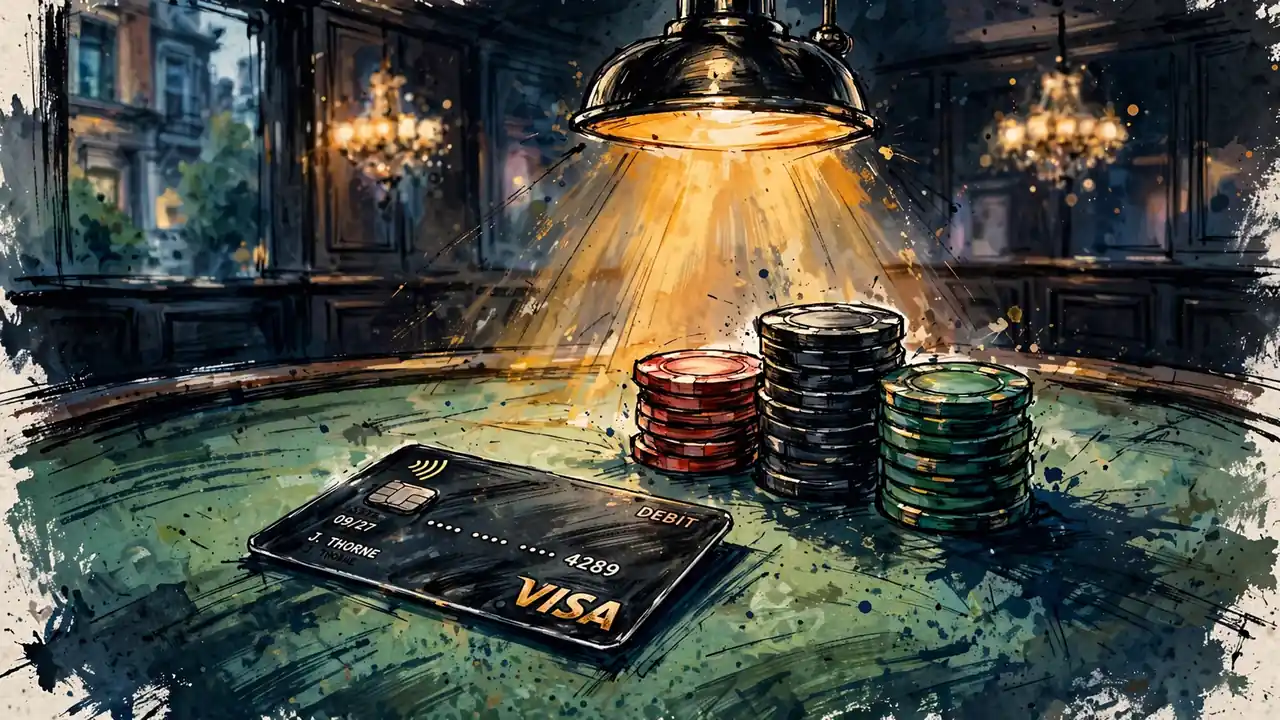
Visa may appear in a casino cashier, but acceptance depends on the operator, processor and card product, while withdrawals can follow a different route.
Visa’s Place in the UK Casino Cashier
Visa has a familiar place in the British casino cashier. UK casinos commonly accept debit cards issued on the Visa network, alongside Mastercard, so a Visa debit card remains a recognisable way to fund a gambling account. That does not make Visa a universal passport into every cashier, however. The logo on the card is only one part of the arrangement; the casino, the payment processor and the particular card product all have a say.
This distinction matters because “Visa accepted” is often used as if it described a complete payment service. It does not. It describes a payment rail that may appear among the cashier’s available choices. The actual question is narrower and more practical: does that casino currently display Visa for the relevant account, and does the particular Visa card qualify for the transaction?
In Britain, the important word is debit. UK-licensed casinos cannot accept credit-card payments for gambling, and remote gambling operators cannot get around that rule by accepting credit-card funds through a money service business. A Visa debit card therefore belongs to a different category from a Visa credit card. The familiar blue-and-gold branding does not erase the distinction between the underlying products. Banking labels are less glamorous than casino advertising, but they decide the outcome.
Casinos That Accept AstroPay in the UK: What to Check
That is why casinos that accept Visa in the UK should be understood as casinos accepting eligible Visa debit payments, not as places accepting every card carrying the Visa name. A debit card may be issued by a bank, building society or another financial provider, and the product can have conditions affecting where and how it is used. The cashier is the relevant checkpoint. A general payment logo is not a promise about every card bearing it.
A specialist review of UK casino payment options lists Visa and Mastercard among the methods offered by the sites it examines. That is useful as an indication of the payment landscape, but availability changes and card-product eligibility is not fixed by a review page. The live cashier remains the decisive place to confirm whether Visa is present for a particular account. A small piece of interface, rather than a grand claim in a banner, has the final word.
Casino Payments: Deposit and Withdrawal Methods
The same principle applies to the phrase all Visa casinos in the UK. No permanent directory can turn a changing cashier into a permanent fact. A remote gambling licensee may alter its payment partners, remove a card method, or present different options according to the account and the card product. The result is a category, not a sealed club: casinos displaying Visa debit as an available method at the time of checking.
This also explains why lists described as the best Visa casinos, the best casino sites for Visa deposits, or the best new Visa casinos should be treated carefully. “Best” is not a property supplied by the Visa network. It may refer to a reviewer’s judgement, a casino’s wider features, or simply the fact that a Visa button appears in the cashier. Payment acceptance alone says nothing about the quality of the casino, its games, its customer service or its wider terms. A payment method is plumbing. Plumbing can be essential without being a recommendation.
Casinos That Accept Wirecard in the UK: What to Check
Nor does Visa acceptance create a special class of games. A casino does not become a “Visa games casino” because its cashier accepts a Visa debit card. The card concerns the movement of funds into the gambling account; it does not turn one game into a Visa game or make every part of the casino experience identical across devices. The payment method and the entertainment offered are adjacent facts, not the same fact.
The label “Visa casino bonus” requires similar restraint. A Visa deposit may be accepted without every promotion applying to it. Whether a payment method qualifies for a particular offer belongs to the promotion’s own conditions, not to the Visa logo. Acceptance and promotional eligibility are separate questions, even when a casino places them close together on the same page. The cashier may welcome the deposit while the promotional terms remain indifferent.
There is a quiet historical reason for this careful language. Cards have long been a conventional bridge between personal banking and online commerce, and casino cashiers adopted the same visual vocabulary: familiar networks, familiar fields, familiar confirmation screens. Yet gambling regulation has drawn a firm boundary around credit. In the British market, a Visa debit card may occupy the ordinary card slot, while a Visa credit card cannot be treated as an equivalent substitute.
Attention UK-licensed casinos cannot accept credit-card payments for gambling. Only Visa debit cards are permitted.
So, are Visa casinos still available in the UK in 2026? Visa debit acceptance remains a common feature of UK casino cashiers, but the sensible meaning of that statement is limited. It does not identify every site, every account or every card. The current cashier and the product type decide whether the payment route is genuinely available.
That is the whole distinction. The logo opens the conversation; the cashier settles it.
A Deposit Is Not the Same as a Withdrawal
A Visa deposit and a Visa withdrawal may appear to belong to the same transaction, but they travel in opposite directions and meet different controls. The deposit moves money into the casino account; the payout begins only after a withdrawal request has been made, reviewed and approved. A familiar logo does not make the two stages mirror images.
A Visa debit deposit can be instant. The balance may become available while the cashier is still a fairly simple doorway: the card details are checked, the payment is authorised and the account is credited. That is the practical appeal of depositing via Visa at UK casinos. It should not be confused with credit-card gambling, which UK-licensed casinos cannot accept. The relevant route is a permitted debit-card payment, subject to the card product and the cashier’s current settings.
Casinos That Accept WebMoney in the UK: What’s Verified
The exit is more deliberate. A withdrawal may wait for the casino’s internal approval before it is sent onwards, and the first request can take longer while KYC checks are completed. This point is also made in specialist affiliate reviews, whose descriptions should be treated as time-sensitive rather than as a permanent promise about every casino. The casino may ask for identity or payment evidence even when the original deposit was accepted without ceremony.
That difference explains why a card deposit can be instant while the corresponding payout takes several business days. The delay is not necessarily a fault with Visa. It can arise before the payment provider receives the instruction, during account verification, or while the casino checks whether the withdrawal follows its payment and anti-fraud controls. A “fast withdrawal” label therefore describes a possible payment route, not a guaranteed timetable.
UK anti-money laundering controls commonly point payouts back to the original payment source. In practice, the account used for the Visa deposit matters: a withdrawal may be directed to that card where the cashier supports card payouts, or the casino may set out another approved route after checking ownership. The important principle is that funds should not casually move to an unrelated person’s card or account.
This is why “direct Visa withdrawal” needs careful reading. Visa can be the card network behind a deposit and, where enabled, part of the payout process, but acceptance of Visa for deposits does not by itself prove that Visa withdrawals are available. The cashier’s withdrawal screen and the operator’s payment terms establish the route.
The payment journey has two clocks: authorisation at the front, and scrutiny at the back. The second is slower by design.
Withdrawal delays can occur due to casino verification or bank processing times, even if the initial deposit was instant.
When the Cashier Offers More Than a Card
A casino cashier is less a single door than a small transport system. Visa may be the familiar entrance, but it is not the only route by which money reaches an online gambling account. UK-facing cashiers can also display open banking services, ordinary bank transfers, electronic wallets and prepaid vouchers. Their presence does not make them interchangeable. Each carries its own direction of travel, account requirements and relationship with promotions.
That distinction matters because the label “payment method” can conceal several different functions. A method may be designed for deposits, withdrawals or both. It may move money directly from a bank account, hold a balance separately or rely on a voucher purchased in advance. The cashier’s icons are therefore not a complete explanation. They are more like a railway map: useful, but not a timetable.
Open banking and bank transfers
Open banking connects the casino payment page with a bank account, allowing a deposit to be authorised through the bank rather than by entering card details. A bank transfer follows a more traditional route, with funds sent from the account to the gambling account using the information supplied by the remote gambling licensee.
A specialist affiliate review describes open banking and bank transfers as capable of providing instant deposits and fast withdrawals at many sites. That is a description of availability, not a promise applying to every cashier. The actual route depends on whether the casino supports the relevant service and whether the customer’s bank is compatible with it.
Casinos That Accept Solana in the UK: What’s Verified
The two methods can also feel different even when both begin with a bank account. Open banking is presented inside the cashier as a connected payment flow. A bank transfer may require separate banking steps and more attention to the recipient details. Delivery can also be affected by bank processing conditions, including cut-off times, weekends and currency conversion. A fast-looking button does not abolish the banking system behind it.
Their usefulness is therefore broader than a card’s deposit role only when the individual cashier confirms what is enabled on both sides of the transaction. A method shown under “deposit” should not automatically be treated as a withdrawal route. Money has a stubborn habit of following the menu rather than the customer’s assumptions.
Electronic wallets
Electronic wallets place an additional account between the bank and the casino. PayPal is associated with speed and convenience, according to a specialist affiliate review, and the same type of source notes that it may be left out of bonus eligibility. That makes PayPal a clear example of why a successful deposit does not settle every question about a payment method.
Skrill and Neteller are also available at some sites. A specialist affiliate review says that these wallets are often excluded from promotions. The wording is important: availability and promotional treatment can change from one cashier to another. A wallet can be displayed as a working deposit option while a particular offer excludes deposits made through it.
Wallets can be useful where a customer prefers not to expose card details to each separate merchant, but they introduce another account whose ownership and verification may matter. The wallet must be permitted for gambling transactions, and it must not be funded with a credit card where that would route prohibited credit-card payments into gambling. A convenient layer cannot be used to disguise the source beneath it.
DO
- Use a Visa debit card for fast deposits
- Check the cashier for specific withdrawal methods
- Ensure the cardholder’s name matches the casino account
DON’T
- Use a Visa credit card for gambling
- Assume a deposit method is also a withdrawal method
- Expect instant payouts every time
PayPal, open banking services and debit cards connected to fast payout systems are described by a specialist affiliate review as being among the quickest withdrawal methods. The observation concerns a category of methods, not a fixed result at every casino. The remote gambling licensee still has to approve the transaction and apply its own controls.
Prepaid vouchers
Paysafecard belongs to a different family. It is a prepaid voucher used for deposits only. The money is loaded onto the voucher before it reaches the casino, so it does not serve as a general two-way payment channel. That makes it unlike a bank account or wallet, where the method may form part of a wider deposit-and-payout arrangement.
A voucher can appeal to people who want to separate the amount available for gambling from their main banking account. Yet its deposit-only nature changes what happens afterwards: it cannot simply be assumed to receive a casino payout. The cashier may need another permitted route for any withdrawal, together with the checks attached to that route.
This is also why a long list of logos should not be mistaken for a ranking. A casino displaying Visa, PayPal, Skrill, Neteller, open banking and Paysafecard is not declaring one universal winner. It is presenting several tools with different jobs. The sensible comparison is functional: which methods accept deposits, which support withdrawals, whether the account is held in pounds, and whether the chosen route is included in the relevant promotion.
The cashier remains the final authority
Payment pages change. A method available at one UK casino may be absent at another, and an option shown in an information page may not appear after login, account verification or location checks. Some UK-licensed casinos also accept Apple Pay for deposits, adding another route without making it a substitute for every other method.
Casinos That Accept USDC in the UK: Payment Checks
The broad landscape is therefore more useful than a simple list of “best” casino payment methods. Open banking and bank transfers connect directly with banking services; wallets hold an intermediate balance; prepaid vouchers are deposit-only; card-linked systems occupy their own place in the cashier. The practical difference lies in what each method can do, not in how prominently its logo is displayed.
Before a transaction, the cashier should be read as a set of permissions: deposit, withdrawal, promotion and account compatibility. Those permissions may not align. That is the whole plot.
Visa on Slots: The Payment Route, Not the Game
Visa is a payment method, not a slot category. It does not describe a reel design, a software provider, a jackpot feature or a special class of online slots. When people speak of “Visa slots” or slots that accept Visa in the UK, they generally mean a casino account funded with a Visa debit card, followed by access to the games available on that account.
That distinction matters because the cashier and the game lobby are separate parts of the same service. Visa appears in the payment area, where funds are added to an account. The slot lobby is where games are displayed and played. A title does not become a “Visa slot” because Visa was used to fund the balance, and Visa does not alter its rules, design or mathematical operation.
Visa and online slot access
UK casinos commonly accept debit cards, including Visa and Mastercard. That makes Visa a familiar route into a casino’s online games, but it is not a universal pass. Acceptance depends on the particular remote gambling licensee, the cashier shown to the account holder and the type of card being presented.
Payment Method vs Game Type
Visa is a payment method used to fund your account, not a specific category or type of slot game.
A specialist review of casino sites reports that Visa and Mastercard appear among the listed payment methods on the sites it examined. That is useful as an indication of what may be offered, not as a permanent cashier rule. The current UK availability of Visa, together with eligibility for the specific card product, needs to be checked in the casino cashier.
This is why two casinos can present similar slot pages while offering different payment choices. One may display Visa clearly; another may show a different selection after registration, location checks or account checks. The game catalogue does not settle the payment question. The cashier does.
The same principle applies to phrases such as “pay by Visa slots” and “online slots using Visa”. They describe the route to the account rather than a special game family. Searching for a slot with Visa in its name would confuse the means of payment with the thing being purchased: rather like calling a book a “contactless novel” because it was bought by card.
Mobile casinos are not a separate Visa network
A mobile casino may present its cashier through a mobile browser or an app-like interface, but Visa remains a card option within the account’s payment section. The small screen changes the presentation, not the meaning of the payment method. Mobile access therefore does not guarantee that Visa will be available, nor does a desktop listing prove that the same option will appear in every mobile flow.
Casinos That Accept Citadel in the UK: What to Check
“Free Visa slots” is a different misunderstanding. Free-play modes do not require a Visa payment simply because the same casino also offers card-funded play. Visa belongs to the account-funding side of the service; free games belong to the play-format side. The two can sit on the same page without being the same product.
The sensible reading of “Visa online slots UK” is therefore straightforward: UK online slots accessed through a casino account for which Visa is an available payment route. The slot remains a slot. The card remains a card. Different jobs.
Real-Money Slot Play and the Slower Exit
A Visa-funded balance is simply money held in a casino account for real-money play. Visa does not turn a slot into a special product, and it does not alter how a spin works. The card is involved at the cashier; the game is governed by the casino’s slot rules and the balance available for staking.
That distinction matters because searches for Visa slots in the UK can suggest that Visa itself is attached to a particular machine, app or game catalogue. It is not. A casino site may accept a Visa debit card for funding while offering its games through a separate desktop or mobile interface. The payment method opens the route to the balance; it does not determine which slots appear there.
The same applies to playing slots for money with Visa. The card deposit may arrive in the account quickly, allowing the balance to be used once the casino has accepted the transaction and any required account checks are complete. The experience can therefore feel immediate: a payment confirmation, a refreshed balance and real-money play in one short sequence. The exit is a different piece of machinery.
Summary
A Visa deposit is typically instant, while withdrawals require additional verification and may take several business days.
A specialist review describes the contrast plainly: a card deposit can be instant, whereas a payout may take several business days. That is not a promise attached to every Visa cashier. It is a useful reminder that a successful deposit says little about the timing of a withdrawal. The casino must receive and assess the withdrawal request, and the payment route must be available for the return of funds.
The internal approval stage is particularly important when a balance has been used for slot play. The withdrawal is not merely the reverse of the deposit button. The casino may need to confirm that the account is fully verified before releasing the money. A specialist review also identifies account verification and the casino’s own approval process as factors that determine withdrawal speed. The card can be fast on the way in and slow on the way out. The old banking asymmetry survives online.
This is why phrases such as “Visa slots games” or “slots that accept Visa” need translating into more precise language. The relevant question is whether the casino’s cashier accepts the card for deposits, whether the account can be used for real-money play, and what withdrawal process applies afterwards. A Visa-funded balance can support play without guaranteeing an equally rapid payout.
“Free” and “real money” describe different arrangements. Free play does not establish that a Visa deposit is required, while real-money play concerns the balance being risked and any resulting withdrawal. A page promising both without explaining the cashier would be selling a mood rather than describing a payment journey.
For a Visa slots app or mobile casino site, the principle remains unchanged: mobile access may alter the screen, not the financial sequence. Deposit first, play from the credited balance, then wait for the casino’s approval before the payout moves. The card is the entrance. It is not the departure lounge.
Casinos that accept Giropay in the UK
Bonuses Do Not Always Follow the Payment
A successful deposit and an eligible bonus are two separate events. The cashier may accept a payment, credit the account and leave the promotional conditions entirely untouched. Money has entered the account; that does not mean a welcome offer, slots promotion or bonus code has been activated.
This distinction matters particularly when a casino presents several payment routes side by side. Visa may appear among the available deposit methods, while the promotion has its own conditions about which payment methods qualify. The presence of a Visa button is therefore not proof that a Visa deposit will trigger every offer shown on the site. The cashier answers one question: whether the transaction can be made. The promotional terms answer another: whether that transaction counts.
A visa casino welcome bonus in the UK should consequently be read as an offer with payment conditions, not as a natural consequence of using Visa. The same applies to promotions described as a Visa slots bonus or a bonus code for slots. The wording may refer to a payment method, a particular campaign, or merely the wider casino service. Only the terms attached to that promotion establish its scope.
Popular alternatives create an additional wrinkle. A specialist affiliate review reports that PayPal can be favoured for speed and convenience yet excluded from bonus eligibility. The same type of review reports that Skrill and Neteller are available at some sites but are often left outside promotional offers. Those observations are not a permanent rule for every remote gambling licensee; payment policies change, and the offer itself remains decisive. Still, they illustrate the awkward little gap between a working cashier and a qualifying deposit.
Warning A successful deposit does not guarantee eligibility for all promotional bonuses or offers.
A deposit made through Skrill or Neteller can therefore succeed without producing the expected promotional credit. PayPal belongs in the same category of method that requires careful reading rather than assumption. The issue is not whether the payment route is useful. It is whether the particular offer recognises it.
“No bonus” can be a payment condition, not a payment failure.
The sensible order is to inspect the promotion’s eligibility wording before making the deposit, then check whether any code must be entered and whether the offer is limited to a specified payment method. A site accepting Visa for real-money play is not thereby promising a no-deposit offer, a welcome bonus, or a qualifying slots promotion. Acceptance is operational; eligibility is contractual.
Minimum Deposits, Limits and the Cost of Moving Money
A Visa cashier does not have one universal entry price. The minimum deposit is set by the casino and may change with the selected payment method. A specialist affiliate review places the starting point for many casino deposits at £10–£20, but that is a reported range, not a rule for every UK cashier. The amount shown beside Visa at the moment of payment is the operative figure.
That matters when a search for a £5 Visa deposit casino produces neat-looking lists. A low figure cannot be assumed merely because Visa appears among the payment logos. The cashier may attach a different minimum to Visa, and the card product must also be eligible for gambling payments. The practical distinction is simple: Visa acceptance answers whether the route is available; the cashier answers how little can be deposited through it.
Casinos That Accept Interac in the UK: What to Check
The casino’s minimum is not the same thing as a customer’s financial limit. UK remote gambling operators must prompt a new customer to set a financial limit before the first deposit. Account-level controls must remain accessible afterwards. This is a personal control on gambling expenditure, not a promise that every payment method will accept a deposit of that size. One figure belongs to the cashier; the other belongs to the account’s spending controls.
Transaction ceilings can also differ according to the payment method and the account’s status. A Visa deposit made through a mobile cashier is therefore subject to the same need for checking the displayed terms as a desktop payment. “Instant” describes the movement of the deposit request, not an exemption from limits or account controls.
The amount leaving the bank account may not end with the casino’s displayed deposit. A specialist review identifies several possible cost layers: a casino charge, a payment-provider fee, an issuer or bank fee, an exchange-rate spread and a network fee. Not every transaction carries each one, but a visible flat charge is not the whole arithmetic. Currency conversion deserves particular attention: the spread built into the rate can alter the final cost without appearing as a separate fee.
Small print, large consequences.
Alternatives When Visa Is Not Available
Visa is still an active payment method in the UK, but a cashier can omit it, reject a particular card product, or offer a different route that better fits its own payment system. The sensible replacement is therefore not a universal “best” option. It is the method shown as available for the account, in the currency required, and with the intended transaction function clearly stated.
Open Banking
Allows direct authorisation through your bank account.
E-wallets
Services like PayPal, Skrill, or Neteller hold an intermediate balance.
Prepaid Vouchers
Deposit-only methods like Paysafecard.
Open banking is one practical substitute. A specialist review describes open-banking services and bank transfers as capable of supporting instant deposits and fast withdrawals at many sites. That wording matters: availability and performance belong to the individual cashier, not to the label alone. A bank transfer may also be affected by the banking process surrounding it, so the payment page remains the final authority.
E-wallets provide another route where the casino supports them. Skrill and Neteller appear at some sites, although a specialist review notes that both are often excluded from promotions. That makes them useful as payment tools without making them automatically suitable for every offer. PayPal is also popular for speed and convenience, but an affiliate review of casino payments has reported that it may be excluded from bonus eligibility. The payment can work while the promotion does not. A small but expensive distinction.
Some alternatives are narrower by design. Paysafecard is a prepaid voucher and is deposit-only, so it cannot be treated as a complete replacement where withdrawals are part of the plan. It may suit a controlled way of funding an account, but it does not create a matching payout route.
Jeton has not disappeared entirely: a specialist review records it as remaining at a handful of UK online casinos in 2026. That is a limited availability point, not a ranking. Apple Pay is accepted for deposits by some UKGC-licensed casinos, while the cashier must still confirm whether the method supports the required transaction. The same caution applies to any wallet or bank-based option.
The practical shortlist is therefore simple: open banking, a bank transfer, a supported e-wallet, or a deposit-only voucher. Availability decides the winner. Not fashion.
UKash Casinos in the UK: What Current Evidence Shows
Payment Ownership and the Paper Trail
A casino cashier is not merely a doorway through which money passes. It is also a record of who supplied that money, where it came from and where it is expected to return. That is why the neatest arrangement for a Visa casino account is generally one in which the account details and the payment method belong to the same customer.
The name on the gambling account should correspond with the name associated with the Visa debit card. The same principle applies to other payment routes: a bank account, e-wallet or alternative service should be held by the person whose casino account is being funded. When those basic details agree, a transaction has fewer reasons to pause for questions about ownership. Administrative neatness is not glamorous, but it is remarkably useful.
This does not mean that every payment made with a matching card will pass without review. Remote gambling licensees still have duties around identity, source of funds and anti-money laundering controls. A card payment can therefore be recognised as belonging to the right customer while the wider account remains subject to KYC checks. Payment ownership is one part of the paper trail, not a substitute for it.
The cleanest pattern is often a single named account used consistently for both deposits and withdrawals. In practical terms, that means opening the casino account in the customer’s own details, funding it with a personally held Visa debit card and selecting the same account when funds are returned. A regular path is easier to understand than a procession of cards, wallets and bank accounts with different names attached.
Final Points
- Match your payment method name to your casino account name for smoother transactions
- The casino cashier is the final authority on available methods and limits
- Always check the specific terms for bonus eligibility before depositing
There is a quiet social history behind this caution. Financial systems were built to distinguish the owner of an account from the person attempting to move its contents; gambling regulation inherited that suspicion and made it more explicit. The concern is not limited to casinos. Banks, payment providers and other financial services also treat unexplained third-party money as something requiring attention. The cashier is simply where that institutional suspicion becomes visible to the player.
Returning money to the original payment source is a common anti-fraud and anti-money-laundering control. It helps prevent a gambling account from becoming a convenient route for moving somebody else’s funds, disguising ownership or turning a deposit into an unexplained transfer. Closed-loop rules can therefore make the journey back resemble the journey in, at least where the payment method supports that route.
A different arrangement may still be possible, but it should not be mistaken for a frictionless one. If a casino cannot return funds to the original Visa card, it may request another withdrawal route or ask for additional verification before releasing the money. Alternatives can involve further checks because the operator must establish that the receiving account also belongs to the appropriate customer.
The same logic explains why a payment method appearing in a cashier does not, by itself, settle every ownership question. A Visa logo says that the card network is supported; it does not prove that a particular card may be used for a particular account, nor that a payout can be sent wherever the customer prefers. The operator’s payment terms and account review still govern the transaction.
For anyone comparing casinos accepting Visa debit cards in the UK, ownership is therefore more important than a colourful list of logos. The sensible distinction is between a method that is technically displayed and a method that can be used cleanly from deposit through withdrawal. A personally held Visa debit card, matching account information and a consistent payment history leave less for the cashier to investigate.
Paperwork remains paperwork. But matching names give it less to complain about.
Casinos That Accept Instadebit in the UK
Visa Payments at Casinos Outside GamStop
The phrase “casinos outside GamStop” describes a claimed relationship with a self-exclusion scheme, not a payment category. Visa belongs to the cashier. A site may display Visa among its deposit methods, yet that does not establish that it is outside GamStop, nor does a claimed GamStop position prove that Visa will be accepted.
Those questions have to be kept apart. A payment logo can indicate what the cashier is designed to handle; it says nothing about the operator’s regulatory status or its participation in a self-exclusion system. Card availability can also depend on the specific site and card product. The cashier is the relevant place to confirm whether Visa is currently listed.
There is a more important distinction behind the fashionable wording. Remote gambling operators selling into Great Britain must hold a UK Gambling Commission licence, wherever the business is based. Offshore casinos operate outside that UKGC system and do not hold a UKGC licence. A site described as “not on GamStop” should therefore not be treated as an alternative form of a UK-licensed casino. The label is not a licence, a safety mark or proof of lawful service to British customers.
UK-licensed casinos must provide responsible-gambling measures, including self-exclusion, and remote gambling licensees must offer account-level financial-limit controls. The regulatory framework is not decorative paperwork; it is the machinery intended to make restrictions function. Remove the machinery, and the slogan becomes rather less impressive.
Visa deposits at casinos outside GamStop are consequently a claim requiring separate checking, not a conclusion drawn from a search label. Any operator serving Great Britain as a legal remote gambling business must hold the relevant UKGC licence, while advertising offshore or unlicensed casinos to the British market is restricted. A player does not incur a fine or criminal prosecution merely for playing at an offshore casino, but the absence of UKGC oversight changes the protections surrounding the account.
“Visa accepted” and “outside GamStop” are therefore two unrelated statements. Neither authenticates the other.
What is the fastest withdrawal method for UK casinos?
PayPal, open banking services and debit cards linked to fast payout systems are generally among the quickest options. Actual speed also depends on the casino’s approval process and whether your account is verified.
Are Visa and Mastercard deposits definitely debit cards?
No. UK-licensed casinos can accept eligible Visa or Mastercard debit cards, but credit-card gambling is banned, and the card’s product type must be checked.
What is the current minimum deposit?
The minimum deposit usually starts at £10–£20, depending on the payment method.
Are fast casino withdrawals guaranteed?
No. Withdrawal speed depends on the casino’s internal approval process and whether your account is fully verified.
Why must withdrawals return to the deposit method?
Returning funds to the original payment source is a common anti-fraud and anti-money-laundering control. Using another route may require additional verification.