

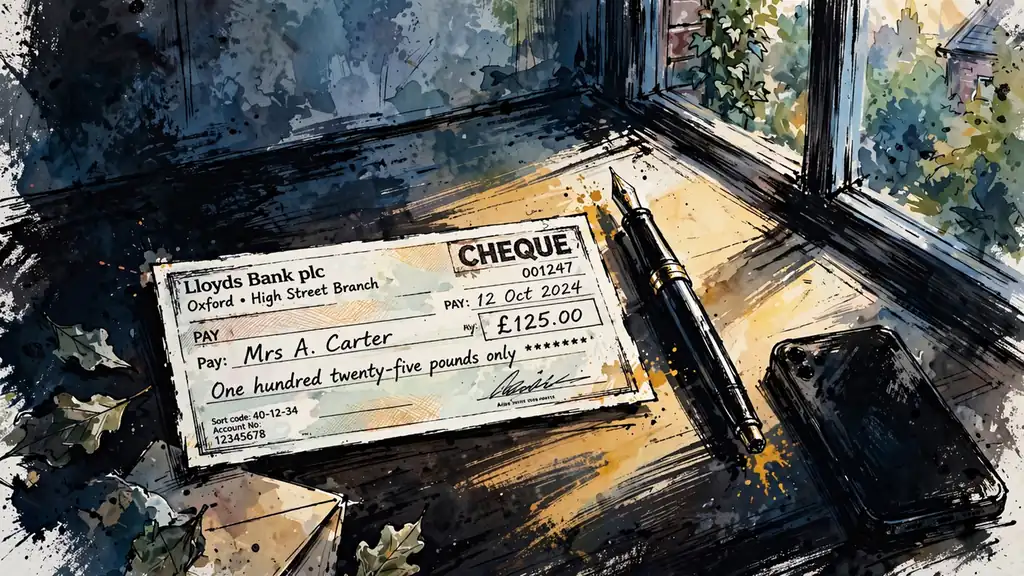
A Boku cashier option is mobile billing, not evidence that an operator accepts paper bank cheques.
A cheque is not the payment method in the evidence
A bank cheque and Boku belong to entirely different payment traditions. One is a paper instruction connected with a bank account; the other is a Pay by Phone service linked to a mobile account. Treating them as interchangeable turns a narrow question about cheque deposits into a broader, and misleading, question about ways of funding a casino account.
That distinction matters because many pages discussing UK casino payments use the language of “alternative methods” rather loosely. A reference to mobile billing may sit beside references to cards, e-wallets, bank transfers and older payment instruments, creating the impression that every method in the same paragraph is available at the cashier. It is not. A casino accepting Boku has not thereby accepted a bank cheque. A casino accepting Pay by Phone has not announced that its banking department will process paper cheques.
For searches concerning online casinos that accept bank cheques in the UK, the relevant word is therefore cheque, not merely “alternative”, “offline” or “bank-based”. The payment route must be named precisely. Boku does not satisfy that description.
Casinos That Accept MuchBetter in the UK
The distinction is also historical. Cheques belong to the banking system: the payer authorises a transfer from an account, and the recipient or its bank handles the instrument. Boku belongs to the mobile-payment system: the casino payment is associated with the customer’s phone service rather than presented as a paper banking instrument. The two routes may appear in the same discussion because both sit outside the familiar debit-card checkout, but that is where the resemblance ends.
A payment label can be a surprisingly poor guide to what happens behind it. “Bank” may describe the account ultimately used; “mobile” may describe the billing channel; “wallet” may describe an intermediary. None of those labels answers the practical question of whether a casino cashier accepts a physical cheque. That requires an explicit cheque option or a clearly stated cheque-deposit policy. Without that precision, a list of supposed top UK casinos accepting cheques risks offering Boku sites instead: relevant to mobile funding, irrelevant to the requested banking instrument.
Casinos That Accept Neteller in the UK: How It Works
Boku itself has not disappeared because the Gambling Commission introduced a rule banning it by name. No such specific prohibition was introduced. Instead, individual casino operators have withdrawn the method because of compliance risk. That difference is important. A regulatory ban would describe a single market-wide decision; operators removing a payment route describes a series of commercial decisions made under regulatory pressure and operational caution. The result can look similar at the cashier, where a once-familiar button simply vanishes, but the cause is not the same.
A small number of UK Gambling Commission-licensed casinos still accept Boku deposits, although the number has been declining since 2023. Nor does the continued presence of Boku establish that a casino accepts deposits by post, over a branch counter or through any other cheque-handling arrangement.
This is more than a technical distinction. Payment methods carry different trails of responsibility. A mobile charge is handled through the mobile-payment arrangement; a cheque invokes a bank instrument, account processing and the casino’s own acceptance policy. An operator may decide that one route fits its controls while another does not. The existence of one says nothing automatic about the other.
UKash Casinos in the UK: What Current Evidence Shows
The phrase “casinos that accept bank cheques” can therefore be understood only literally. It calls for operators that expressly handle cheque deposits, not casinos that accept Boku, Fonix, an e-wallet funded by a phone service or some vaguely described offline payment. Substituting one for another may make a list look fuller, but it answers a different question.
The cleanest description of the current Boku position is consequently modest: some UK-licensed casinos continue to offer Boku, and the group has become smaller since 2023. The cleanest description of cheque acceptance is narrower still: Boku examples are not cheque examples. A mobile bill is not a bank cheque.
Why Boku has become harder to find
Boku once fitted neatly into the idea of a casino deposit made through a mobile phone. There was no need for a card or bank account: the payment was attached to the mobile account instead. That simplicity helped make Boku visible among British gambling payment options. It also made the method unusually dependent on decisions taken outside the casino itself.
Since 2023, many operators have been moving away from Boku, replacing it with services like Fonix or Siru Mobile.
Since 2023, operators have been moving away from Boku. A specialist review reports that some casinos replaced it with Fonix or Siru Mobile, while others removed Pay by Phone options altogether. This is a change in the payment landscape rather than a named prohibition imposed by the Gambling Commission. No specific UK Gambling Commission rule was introduced to ban Boku by name. Instead, individual operators have withdrawn it in response to compliance risk.
That distinction matters. A payment method can disappear from a casino cashier without having been declared unlawful across the market. Commercial operators make their own decisions about which services to retain, and a method that once appeared familiar can become difficult to locate even when the brand itself still exists. The result is a shrinking and uneven Boku market: one operator may retain it, another may present a different mobile-payment service, and a third may offer no phone-based deposit route at all.
The change also explains why older lists of British casinos accepting Boku can be misleading. A list assembled when Boku was more widely available may continue to circulate after individual cashiers have changed. The operator’s payment page is therefore more useful than a static label attached to an old recommendation. Payment menus are not monuments.
There is also a difference between a casino accepting Pay by Phone and accepting Boku specifically. Fonix and Siru Mobile belong to the same broad family of mobile-based payment services, but they are not alternative names for Boku. When Boku has been removed, the replacement may look similar from a distance while using a different provider and a different route through the cashier. A search for British casinos that accept cheques can therefore become tangled with pages describing mobile payments, even though those are separate subjects and separate payment arrangements.
Pay by Phone services
Fonix and Siru Mobile belong to the same broad family of mobile-based payment services, but they are not alternative names for Boku.
The shift towards Fonix and Siru Mobile shows that the decline of Boku has not necessarily meant the complete disappearance of phone-based deposits. It has instead produced a more fragmented market. Some operators have changed provider; some have stopped offering the facility. The word “mobile” can conceal that difference, which is unhelpful when the payment method determines how a deposit is authorised and charged.
The surviving references to Boku should be read as time-sensitive rather than permanent. A specialist review identifies BoyleSports as having added Boku to its cashier as a UK payment option. That is a concrete example of the method being available at an operator, but it does not establish that every casino named in older material still offers the same route. Nor does it turn Boku into a general answer for bank-cheque casinos in the UK. The two payment categories should not be merged simply because both may appear in articles about casino deposits.
The practical pattern is consequently narrow:
- Boku remains present at a small number of UKGC-licensed casinos.
- Some operators have substituted Fonix or Siru Mobile.
- Some casinos have removed Pay by Phone deposits entirely.
- Availability can change at the operator level without a UK-wide ban on Boku.
This narrowing reflects the caution surrounding payment services connected to gambling, not a single event that closed the market overnight. Operators have been reassessing the services they are willing to keep, while players are left with a cashier that may offer fewer familiar choices than an older page suggests. For anyone comparing payment routes in 2026, the important question is not whether Boku appeared in a historical list, but whether the named operator currently displays it as an available deposit option.
Operators and the few direct-Boku sites
The names attached to Boku are not the names of a permanent payment network. They describe a particular moment in the changing cashier menus of UK-facing gambling operators, where a mobile-billing option may appear, disappear, or be replaced without changing the casino’s wider identity. A casino can remain familiar while its payment shelf quietly alters.
A specialist review reported Boku deposits at the following operators:
- BoyleSports
- Sun Bingo
- William Hill
- Sky Vegas
- PlayOJO
- Genting Casino
- Betfred
- Lottoland
- bwin
- 888 Casino
That is a list of operators associated with Boku, not a promise that every cashier still displays it. Payment methods are operational features rather than permanent badges. They depend on what the operator offers at the time of registration and deposit, and the Boku presence described in this group has to be treated as time-sensitive. The distinction matters especially for searches for an online casino that accepts bank cheques in the UK: these names belong to the Boku discussion, not to a confirmed list of cheque-paying casinos.
BoyleSports has a particularly clear place in the account. A specialist review described the operator as having added Boku to its cashier as a UK payment option. That makes BoyleSports a concrete example of an operator linking a recognised betting and gaming brand with mobile-billed deposits. It does not turn Boku into a bank-cheque facility, nor does it establish that the option remains visible indefinitely. The cashier decides the practical answer.
The larger group should therefore be read as a set of reported Boku examples:
- Sun Bingo appears among the bingo operators associated with the payment method.
- William Hill and Betfred represent established names in betting and gaming.
- Sky Vegas, PlayOJO, and Genting Casino are listed in the same Boku context.
- Lottoland, bwin, and 888 Casino complete the broader set described by the specialist review.
The grouping is useful because it shows that Boku was not confined to one narrow type of gambling business. It was attached to bingo brands, betting operators and online casino names. Yet the breadth of the old list should not be mistaken for the breadth of the present market. A payment method may have once been available across several recognisable brands and still become difficult to locate as operators revise their systems.
The smaller direct-Boku group
Alongside the broader operator list, a specialist review identified a smaller surviving group of direct-Boku sites. Jackpot Mobile Casino and Peachy Games were named among them. The phrase “direct Boku” is significant: it separates a casino showing Boku itself from a site associated with another mobile-payment arrangement or with a route that merely begins on a phone.
That distinction prevents a common muddle. A page may use the language of phone payments broadly, while the cashier presents a different provider. The operator may still accept a mobile-funded transaction, but that does not make the method Boku. Nor does a casino’s support for Boku say anything about bank-cheque deposits. A cheque is a banking instrument; Boku is a mobile-billing route. Similar convenience claims cannot erase the difference in the payment rails.
Important Distinction
Jackpot Mobile Casino and Peachy Games are part of a smaller group of sites directly connected with Boku.
Jackpot Mobile Casino and Peachy Games consequently belong to the narrow direct-Boku category described in the specialist review, while the larger ten-name group belongs to the wider set of operators reported to accept Boku deposits. The categories overlap in subject but not in weight. One is a broad collection of reported operator examples; the other is a smaller identification of sites presented as directly connected with Boku.
For anyone comparing casino payment pages, the useful question is not which brand sounds most established. It is whether the cashier explicitly names Boku at the point when a deposit is being made. Brand familiarity is not evidence of a particular payment option. Neither is a page that mentions mobile payments without naming the provider.
The market has made a tidy list untidy. That is its most accurate feature.
How a Boku deposit reaches the cashier
A Boku deposit begins in the casino cashier, not in a bank account and not with a paper instrument. The payment route is built around the mobile number attached to the account. Once Boku appears among the available deposit methods, the transaction follows a short chain: choose the method, enter the amount, provide the phone number and approve the request by text message.
Casino Payments: Deposit and Withdrawal Methods · Casinos That Accept WebMoney in the UK: What’s Verified
The cashier normally presents Boku alongside the other deposit options. Selecting it opens the payment form, where the amount is entered and the mobile number is supplied. The number matters because Boku does not draw money from a separate card or bank balance. It identifies the mobile account that will carry the charge.
A verification message then arrives by SMS. The message contains a code used to confirm that the person making the deposit has access to the stated phone. Entering that code authorises the payment. Without this step, the cashier cannot complete the Boku transaction. A mobile number alone is not the payment.
The financial effect depends on the type of mobile plan. For a customer with a monthly contract, the Boku charge is passed to the mobile network operator and appears on the phone bill. The casino receives the deposit through the payment service, while the cost is collected as part of the mobile account’s billing cycle. The arrangement resembles adding a purchase to an existing household bill, although the purchase itself takes place in the casino cashier.
For a PAYG customer, there is no later monthly invoice to settle. The amount is taken from the available prepaid phone balance instead. If that balance cannot cover the requested payment, the transaction is declined. In that sense, PAYG turns the phone into a small spending account: useful for a deposit, but constrained by whatever credit remains on the handset.
Boku Payment Process
Step 1: Selection
Choose Boku from the available deposit options in the casino cashier.
Step 2: Details
Enter the deposit amount and provide your mobile phone number.
Step 3: Verification
Receive a verification code via SMS and enter it to authorise the payment.
The route is therefore different from a card payment even though both begin with a form on the casino website. A card asks for card details and sends the transaction through a card network. Boku asks for a mobile identity and sends the charge through the network operator. The casino cashier is only the visible front end of that arrangement.
One reported account of Boku’s payment rules says deposits are offered only in amounts divisible by ten, with £10, £20 and £30 given as examples. That detail comes from a specialist review rather than a universal rule that can be applied to every cashier. Payment interfaces change, and the available denominations can depend on the operator and the mobile network. It is therefore a feature to inspect in the live cashier, not a promise about every Boku-enabled account.
The transaction can be summarised without turning it into a financial puzzle:
- Boku is selected in the casino’s deposit cashier.
- The deposit amount is entered.
- The mobile number is added.
- An SMS verification code is received.
- The code is entered to approve the charge.
- The amount is billed to a monthly mobile account or deducted from PAYG credit.
Boku does not require a card or a bank account for this deposit route. The phone performs both the identification and the billing function. That explains its appeal, but also its particular boundaries: the transaction belongs to the mobile account from the moment the SMS confirmation is accepted.
Small deposits, with limits set beyond the casino
Boku is designed around relatively small deposits, and its ceiling is not determined by the casino alone. The payment passes through the mobile network, so the network operator’s rules can be as important as the cashier settings displayed by the gambling business. A casino may show Boku as available while the phone account imposes a lower practical limit.
A specialist review describes the UK Boku ceiling as £30 for one transaction, while noting that some casinos or mobile networks may permit £40 or £50. Those higher figures should be treated as conditional, not as a standard available everywhere. The amount displayed at one operator therefore cannot be assumed to apply across all casinos accepting Pay by Phone.
UK Casino Bank Transfers: How Boku Differs
There is also a direct disagreement over the smaller figures. One account describes Boku as limited to approximately £10 per transaction and £30 per day at network level. Another version gives £30 per day but specifies no separate per-transaction cap. These are not interchangeable descriptions: one sets both a transaction ceiling and a daily ceiling, while the other identifies only the daily limit. The difference matters when several deposits are planned, and it makes a single universal schedule difficult to state honestly.
A specialist review also attributes the daily restriction to the mobile operator rather than the casino. That arrangement places the limit outside the gambling cashier. The casino can decide whether Boku appears among its payment options, but the network can still reject a transaction once its own daily threshold has been reached. A failed deposit may therefore reflect the phone account rather than a problem with the casino account.
PAYG users face an additional ceiling: the available prepaid balance. A Boku deposit charged against PAYG credit cannot exceed what remains on the phone. If the balance is insufficient, the payment is declined. The stated casino limit may consequently be higher than the amount that can actually be deposited at that moment.
This makes PAYG credit a practical spending boundary, not merely a billing detail. Monthly-billed customers have the charge placed on the mobile bill, whereas PAYG customers draw down the balance already held on the account. In both cases, the mobile operator remains part of the payment chain.
Deposit Limits
Attention Boku deposits are subject to limits set by the mobile network operator, which may be lower than the casino’s displayed limits.
The result is a set of limits layered one over another: a figure associated with Boku, a possible casino or network variation, a daily network threshold, and, for PAYG accounts, the remaining balance. The neat number in a payment guide can conceal a less tidy arrangement. Small by design.
Pay by mobile is not a withdrawal route
Boku’s usefulness stops at the casino cashier’s deposit side. It can move money into a gambling account, but it cannot carry winnings back out. A player who funds an account through Boku therefore needs a different, separately supported withdrawal method before treating the payment option as practical.
This is an important distinction in discussions of the best bank-cheque casinos in the UK, because a payment method can appear in a deposit menu without offering a complete journey for casino funds. Boku is not a bank account, a card, or a holding account for winnings. It is a route for charging the mobile account connected with the transaction. The return journey belongs to another system.
The withdrawal method must be registered with the casino and accepted for payouts. Depending on the operator, that may be a debit card, an e-wallet, or a bank transfer. The relevant choice is made at the casino rather than through Boku. UK-licensed casinos also cannot accept credit cards for gambling, so a credit card cannot simply be substituted as a general solution.
Casinos That Accept E-Cheques in the UK: What to Check
There is a slightly curious workaround described in specialist casino reviews: Boku may be used to fund Neteller, after which Neteller can be used at casinos that accept it. That does not turn Boku itself into a withdrawal route. It only places another payment service between the mobile charge and the casino account. Any later payout would still depend on Neteller and the receiving casino’s own rules.
The arrangement resembles a one-way door. Money can pass in through the mobile network, while winnings must leave through an approved channel that the operator can verify. This can matter when comparing bank-cheque online casinos in the UK: even where a casino advertises several deposit choices, the withdrawal menu may be narrower, and a cheque-based expectation should not be inferred from a mobile-payment option.
Boku’s deposit-only status also means that the initial payment decision should be made alongside the withdrawal arrangements, not before them. A casino account funded through Pay by Phone still requires a usable payout method, and the operator may need to confirm ownership or other account details before releasing funds.
No return ticket.
No Withdrawals
Boku is a deposit-only method and cannot be used to withdraw winnings from a casino account.
Boku, Fonix and Siru Mobile are not interchangeable
A casino cashier can show several phone-based payment labels without offering the same payment route. Boku, Fonix and Siru Mobile all belong to the wider Pay by Phone family, but they are separate services. Treating the names as synonyms makes the cashier look clearer than it is.
Boku is the specific service associated with charging a deposit to a mobile bill or deducting it from available PAYG credit. Fonix is a different mobile top-up service, while Siru Mobile is another provider in the same broad category. The distinction matters because a casino accepting Fonix is not automatically a casino accepting Boku. Nor does a Siru Mobile option turn into a Boku option merely because both use a phone number.
The mobile networks named in connection with Pay by Phone and Fonix are EE, O2, Vodafone and Three. Network support, however, does not make every casino cashier identical. The operator decides which provider appears among its deposit methods, and that choice can change independently of the networks carrying the charge.
A specialist review identified the following division between the services:
- MrQ and Duelz accept Fonix.
- Mr Vegas and Videoslots accept Siru Mobile.
Those examples demonstrate why the payment label must be read precisely. A casino listed as accepting Fonix should not be described as a direct-Boku casino, and one showing Siru Mobile should not be presented as offering Boku simply because both belong to Pay by Phone. The names are close in purpose, not interchangeable in operation.
That distinction also keeps cheque terminology from drifting into the wrong place. A bank cheque is a banking instrument; Boku, Fonix and Siru Mobile are mobile-payment services. None of these labels, on its own, describes an online casino deposit by bank cheque. A cashier offering one of the phone-based options is offering a charge routed through a mobile account or mobile service, not a cheque deposit.
The difference is practical as well as linguistic. A list of online casinos that accept bank-cheque deposits cannot be assembled by collecting operators that show Boku, Fonix or Siru Mobile. Those are alternative Pay by Phone routes, each requiring its own confirmation at the cashier. Similar appearance, different plumbing.
Bonus terms can change the value of a mobile deposit
A payment method can alter the value of a casino promotion even when the cashier accepts the deposit. Pay by Phone deposits are not automatically treated in the same way as card, bank-transfer or e-wallet payments. Bonus eligibility is set by the operator, so the promotional terms matter as much as the payment button itself.
Casinos That Accept eChecks in the UK: What to Check
A specialist review reports that Boku deposits generally come without a promotion designed specifically for that method. The same review found no Boku-related deposit restrictions on the platforms it assessed. That is useful context, but it is not a permanent rule for every UK casino. Payment arrangements and promotional pages can change, and a welcome offer may still exclude Pay by Phone funding in its small print.
Another specialist review identifies MrQ, Duelz, Mr Vegas and Videoslots as operators where pay-by-phone deposits qualify for bonus eligibility. That does not turn every promotion at those brands into a Boku offer. It means the payment route was reported as acceptable for the relevant bonus conditions. The exact wording remains decisive.
Welcome offers often combine a deposit match with wagering requirements. One specialist review describes a common structure as a 100% match on a deposit of up to £100, with winnings from the bonus subject to a 35x wagering requirement. The same type of review gives expiry periods of 30 days for bonus funds and 72 hours for bonus spins. These are examples of terms reported in promotional material, not universal conditions for casinos accepting cheques in the UK or for mobile deposits.
The distinction is easy to miss. A cashier may accept Boku while the bonus page excludes it; another operator may count the deposit but apply a separate rule to the bonus balance. A casino’s welcome offer therefore needs to be read alongside its payment terms, rather than treated as a reward attached to every funding method.
Summary of Boku
- Boku is a mobile-billing service, not a banking instrument.
- It is intended for deposits, not for withdrawals.
- Availability is time-sensitive and varies by operator.
For anyone comparing casinos accepting bank cheques in the UK, this promotional evidence should not be mistaken for proof that cheque deposits qualify for bonuses. It concerns Pay by Phone and Boku only. The method and the offer remain separate questions. Almost bureaucratic, but money often is.
Licence checks matter more than a payment label
A payment badge in a casino cashier is not a regulatory credential. That distinction matters when the proposed funding route is a bank cheque, a Pay by Phone service, or any other label presented as a convenient alternative. The relevant question is whether the operator is permitted to offer remote gambling to customers in Great Britain.
The UK Gambling Commission oversees gambling activity in the country, including online casino operations. For remote gambling supplied to people in Great Britain, its authority applies even when the equipment running the service is located elsewhere. Geography, in other words, does not provide an escape hatch for an operator selling into this market. The server may be abroad; the regulatory obligation is not.
For commercial gambling in Great Britain, the Gambling Commission is the single licensing authority. Its work is divided between two types of permission. An operating licence belongs to the business conducting the gambling activity. A personal licence applies to individuals whose roles involve operating or managing that activity. These are not decorative certificates placed beside a list of payment methods. They identify who is accountable for the service.
That makes a proposed UK casino deposit by cheque a secondary question until the operator itself has been established as legitimate. A cashier may display a cheque-related option, or describe its banking arrangements in broad terms, without that description proving the site can lawfully offer online gambling to British customers. The payment label says what the operator claims to accept. The licence addresses whether the operator may conduct the underlying business.
Casinos That Accept Neosurf in the UK: Payment Guide
A proper check therefore starts with the UK Gambling Commission’s public register and the operator’s current licence details. The name on the casino website should correspond with the licensed business, rather than merely resembling it. This is particularly important where a service is operated from outside Great Britain: overseas location does not remove the requirement for the relevant British authorisation when the business serves consumers there.
The same principle applies to searches for deposit by cheque at online casinos. Payment terminology can change; licensing status is the more serious constant. A neat cashier, a familiar brand and an attractive funding promise remain just presentation until the regulatory identity behind them has been checked. A label is not a licence.
What can be confirmed about cheque payments
A bank cheque is a paper-based payment instrument. It is not the same as Pay by Phone, and it should not be grouped with Boku simply because both may appear in discussions about alternatives to cards or bank transfers.
Casinos That Accept Ethereum in the UK
That means no casino can responsibly be presented here as a confirmed destination for a cheque deposit. A casino may display payment options that resemble traditional banking, but a bank transfer, debit card payment and cheque are separate methods, with separate processing arrangements.
Boku belongs to a different category altogether. It is a mobile billing service: the charge is passed to a mobile network account or deducted from prepaid credit. A small number of UK-licensed casinos still accept Boku deposits, although that group has been contracting since 2023. This does not make those operators cheque casinos, nor does it turn a mobile payment into a bank-based deposit route.
The distinction matters because a payment label can suggest more certainty than it deserves. “Banking options” is a broad heading; it does not prove that a cashier accepts a paper cheque, whether crossed or otherwise. Any operator claiming to support this method would need to state it expressly in its current cashier and payment terms.
Separate categories, separate claims.
What are the deposit limits at pay-by-mobile casinos?
Limits depend on the payment and mobile-network arrangements. Boku’s standard limit is £30 per transaction, while network-level limits may be about £10 per transaction and £30 per day; PAYG deposits are also capped by the remaining phone balance.
What is the standard Boku deposit limit in the UK?
The standard limit is £30 per transaction, though some casinos or network operators may allow £40 or £50. Network-level limits may be lower, at about £10 per transaction and £30 per day.
Are Boku deposits eligible for casino bonuses?
Bonus eligibility varies by operator. Some casinos accept pay-by-phone deposits for bonus eligibility, but Boku deposits generally do not come with specific bonuses.
What is the best alternative to Boku for casino deposits?
There is no single best alternative for every casino. Fonix and Siru Mobile are pay-by-phone options offered by some operators, while Neteller can be funded with Boku and then used at casinos that accept Neteller.
Why might a Boku deposit be declined?
A deposit may exceed the applicable transaction or daily limit. PAYG users also cannot deposit more than their remaining phone credit.