

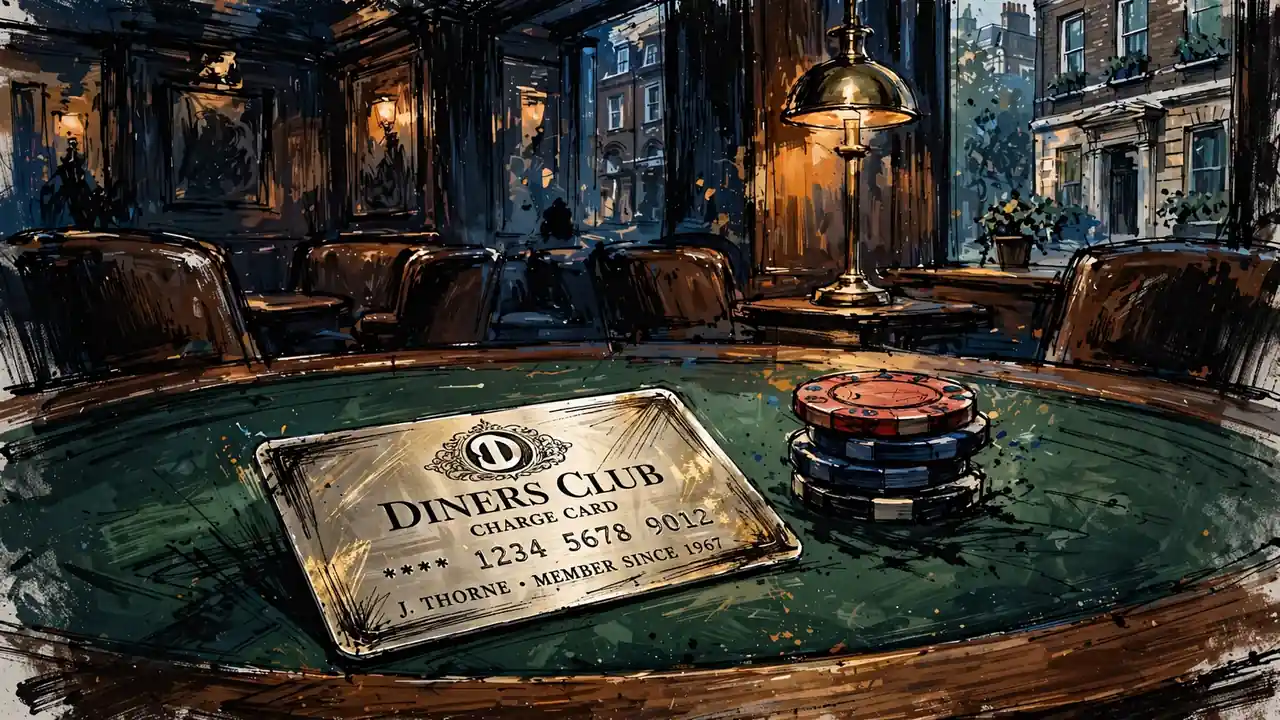
Card availability depends on the casino’s payment provider and card product, while deposits and withdrawals may follow different rules.
The Diners Club Question: Card Acceptance Is Not a Given
Diners Club occupies an awkward place in the vocabulary of casino payments. A search for UK casinos that accept Diners Club may sound like a straightforward request for a list, yet the word “card” conceals several separate questions. Does the casino accept card payments at all? Does its payment provider process Diners Club? Is the particular Diners Club product a debit, charge or credit product? Is it available to customers in the United Kingdom? And, if the cashier displays the logo, does that mean deposits, withdrawals, or only one of the two?
Those questions cannot be answered by pointing to the presence of Visa or Mastercard. UK casinos commonly display those brands among their payment methods, especially for debit cards. That establishes a general card route, not acceptance of every card carrying a different network mark. Diners Club is a separate payment scheme, and a cashier listing Visa and Mastercard does not silently include it. A logo is not a constitutional amendment.
This distinction matters because payment pages and card products do not always line up neatly. A remote gambling licensee may support a payment processor that handles one card network but not another. The processor may accept a particular product in one country and reject it in another. A card issuer may also apply its own restrictions. Consequently, a page describing “card deposits” is too broad to prove that a Diners Club transaction will be authorised.
A specialist review can record Visa and Mastercard among the methods shown on the sites it examines, while still leaving current availability and the eligibility of individual card products to be checked in the casino cashier. That is the useful boundary: such a review can indicate what a site has listed, but it cannot turn a general card reference into verified Diners Club support. Payment menus change, providers are replaced and a method visible on an information page may not appear for every account.
Casinos That Accept Dogecoin in the UK: What to Check · Casinos That Accept Revolut in the UK: How to Check
The word “accept” needs similar care. It might mean that a Diners Club card can be used to fund an account. It might mean that the casino can send a payout back to that card. It might mean only that the card is recognised at the first stage of a transaction, before the issuer or payment provider declines it. Deposit acceptance and payout support are not interchangeable claims, so a statement about one should not be stretched to cover the other.
There is also a specifically British reason not to treat the question as an ordinary card-shopping exercise. On 14 April 2020, the regulator prohibited credit-card gambling, and that prohibition remains in force. UK-licensed casinos cannot take credit-card payments for gambling. Remote gambling licensees also cannot accept a wallet payment when that wallet permits credit-card funds to be used for gambling. The rule therefore reaches beyond the plastic card placed in front of a screen; the funding route matters as well.
Casinos That Accept Citadel in the UK: What to Check
Diners Club products are not all necessarily identical in how they are issued or classified. The relevant issue is not the prestige of the brand or the fact that it resembles a familiar payment card, but whether the proposed transaction would amount to a prohibited credit-card payment for gambling. A casino cannot treat a Diners Club label as an exemption from the British rule. Nor can a customer infer legality from the fact that a card works for an unrelated purchase.
This is why searches for the “best” Diners Club casino, or for every UK casino with that option, invite more certainty than the payment evidence can bear. A reliable answer would need to identify a UK-facing, UKGC-licensed casino, show Diners Club in the live cashier for the relevant account and establish what role the method plays. A broad list of card brands does not perform those checks. An old description may be accurate historically and useless today.
The same caution applies when the search is framed around Android casinos. The handset or operating system changes the way the cashier is displayed, not the underlying payment permission. A mobile page may expose the same card form as a desktop site, but Android compatibility does not demonstrate Diners Club processing. Nor does a search combining Diners Club with Bitcoin establish a shared payment route: these are distinct methods, and a reference to one says nothing about the other.
Credit Card Ban
UK-licensed casinos cannot accept credit-card payments for gambling. This prohibition includes funds coming from certain wallets that permit credit-card use.
The proper conclusion is narrow but important. Visa and Mastercard listings show that card payments may be part of a casino’s cashier, particularly through debit cards. They do not verify Diners Club acceptance. For a Diners Club transaction, the decisive information is the current cashier, the exact card product, the customer’s account and the restrictions imposed by the UK credit-card gambling ban. Until those points align, “card accepted” remains a general description, not a promise made to Diners Club.
Deposits and the Alternatives Listed by UK Casinos
When a Diners Club route is not shown in a casino cashier, the practical question becomes broader: which other payment methods are available for a deposit, and what kind of account does each method create? UK casino cashiers tend to present several families of options rather than one universal card solution. The list may include debit cards, electronic wallets, prepaid vouchers and bank-based services, with the final selection depending on the individual operator.
The card section is often the most familiar. Visa and Mastercard debit cards are commonly accepted by UK casinos, but a card logo alone does not settle every detail. The cashier determines whether the particular card product can be used, and the card must not be a credit-card route for gambling. UK remote gambling operators cannot accept credit-card payments, including arrangements in which a money service business passes on credit-card funds. The same restriction applies where a wallet permits credit-card money to be used for gambling.
That leaves the debit-card label important, but not magical. A Diners Club card should not be treated as interchangeable with Visa or Mastercard simply because all are payment cards. The brand, product type and cashier configuration still matter. In practical terms, the alternatives to a Diners Club deposit are more likely to be found among the methods explicitly displayed by the casino than inferred from a general payment logo.
Casinos That Accept Interac in the UK: What to Check · Zimpler at UK Casinos: Checking Cashier Availability
Electronic wallets
PayPal is one of the better-known alternatives for a casino deposit. A specialist review presents it as attractive because of its speed and convenience, though the same type of source notes that a PayPal deposit may not qualify for a promotion. That is a separate question from whether the deposit itself is accepted: the cashier and the promotion terms perform different jobs, and confusing them is how a payment method acquires a reputation it did not ask for.
Skrill and Neteller also appear at some UK casino sites. A specialist review describes both as common choices in this part of the market and points out that promotions may exclude them. Skrill is also described in current market coverage as one of the more frequently listed deposit methods at UK-friendly casino sites in 2026. Availability still belongs to the individual cashier, rather than to the name of the wallet in the abstract.
Wallets can be convenient because the casino receives a payment instruction from the wallet rather than the full underlying bank-card arrangement. Yet the credit-card rule follows the money. A wallet that allows credit-card funds to be used for gambling cannot be used as a way around the prohibition. The payment method may look different on the screen; the regulatory treatment does not become different with it.
Prepaid vouchers
Paysafecard belongs to another category. It is a prepaid voucher intended for deposits only, so it should not be presented as a complete substitute for a method that also handles payouts. Its role is narrower: funds are loaded through the voucher and credited to the gambling account, while the voucher itself is not a withdrawal channel.
Prepaid Vouchers
Paysafecard is a one-way funding tool intended for deposits only and cannot be used as a withdrawal channel.
That distinction matters because a cashier label can conceal a practical limitation. “Available for deposits” does not mean “available for every movement of money”. Prepaid instruments are therefore best understood as one-way funding tools. They may suit a person who wants to avoid entering card details at the casino, but they do not provide the same payment path as a debit card or an electronic wallet.
Open banking and bank transfers
Bank-based payment methods occupy a different place in the cashier. Open banking services and bank transfers can support instant deposits and fast withdrawals at many sites, according to a specialist review. That description belongs to the type of service and not to every casino carrying a bank icon, so the individual cashier remains decisive.
Open banking generally connects the payment to a bank account through an authorised banking flow, while a bank transfer uses the account-to-account route more directly. Both are distinct from a Diners Club card deposit. They also tend to make the relationship between the gambling account and the bank account more visible, which can be useful when payment ownership needs to be clear.
The familiar bank-transfer label should not be mistaken for a promise of identical timing everywhere. The service offered by the casino, the banking route and the account arrangement all shape what happens after the payment instruction is submitted. A method can therefore be listed as a deposit alternative without carrying the same experience as a card, wallet or voucher.
Reading the cashier as a live list
The deposit page is the useful point of comparison. It shows which methods the casino has enabled, whether the route is deposit-only, and whether a card or wallet category is subject to a separate condition. Visa and Mastercard may be listed across casino payment pages, while the current availability of a particular card product still belongs to the cashier rather than to the logo.
Casinos That Accept iDEAL in the UK: Payment Guide
A casino may also show more than one wallet or bank option, but that does not make the methods interchangeable. PayPal, Skrill, Neteller, Paysafecard and bank-based services each have their own function. Some are designed for deposits and withdrawals, some may be deposit-only, and some may be accepted for funding while being left outside promotional eligibility.
The sensible comparison is therefore not a hunt for a universal “best” substitute. It is a matter of matching the available route with its purpose: debit card for a card-based deposit, wallet for an electronic-wallet route, Paysafecard for prepaid funding, or open banking and bank transfer for a bank-linked payment. The cashier supplies the final word. Dry, but useful.
Real-Money Slots and the Payment Route Behind Them
A real-money slot session begins before the reels appear. It begins in the cashier, where an account must be funded through a payment route that the casino actually supports. The game may be available on a desktop page or a mobile interface, but neither the title of the game nor the appearance of an app establishes that a particular card can be used to pay for it.
This is the small distinction hidden inside phrases such as “Diners Club slots” or “Diners Club casino sites”. Slots do not normally belong to the payment card. A card, wallet or bank route funds the gambling account; the account then provides access to the casino games made available by the remote gambling licensee. The payment method is the entrance ticket, not a special variety of machine.
Funding Your Account
Step 1: Open Account
The player opens an account with a remote gambling licensee serving the British market.
Step 2: Check Cashier
The player views the cashier to see which payment routes are available for that specific account.
Step 3: Verify Eligibility
The selected route is checked for card or funding eligibility.
Step 4: Deposit
A successful deposit places funds into the gambling balance.
Step 5: Play
The available real-money slots can then be played.
That makes the search for a suitable route more practical than the search for a supposedly special slot category. A casino may advertise real-money slots while showing a cashier whose available methods differ by country, account, currency or card product. The label on a payment brand is therefore only the beginning of the check. The cashier is where the current position becomes visible.
What the cashier can establish
A specialist review of the supplied casino pages lists Visa and Mastercard among the payment brands, but those references are not a permanent promise that every British customer can use every card carrying either logo. Availability can change, and eligibility may depend on the particular card product. The live cashier is the relevant place to confirm whether the route is offered to the account in question.
This matters especially when a card is being considered as an alternative to Diners Club. A familiar logo does not automatically mean that a transaction will be approved, nor does a deposit method described on an older page prove that it remains active. A payment option has to be present for the account and accepted for gambling transactions under the applicable rules. The machinery is less romantic than the reels, but more decisive.
Credit-card payments for gambling cannot be accepted by UK-licensed casinos. That restriction also covers credit-card funding sent through a money service business, and a wallet cannot be used for gambling where it permits credit-card funds to be used in that way. A card carrying a recognised network mark must therefore still be considered in light of how it is funded and classified. Branding is not regulation.
For real-money play, the sequence is consequently straightforward:
- The account is opened with a remote gambling licensee serving the British market.
- The cashier displays the payment routes available to that account.
- The selected route is checked for its card or funding eligibility.
- A successful deposit places funds in the gambling balance.
- Only then can the available real-money slots be played.
This sequence does not confirm Diners Club acceptance, and it does not turn a mention of Visa or Mastercard into a universal alternative. It simply separates the game from the financial route that makes play possible.
Mobile access changes the screen, not the principle
A mobile casino interface may make the cashier and the slot lobby fit a smaller screen, but it does not create a new payment entitlement. A supposed Diners Club slots app would still depend on the underlying casino account and the methods displayed there. Likewise, a page presenting slot machines for real money cannot be treated as evidence that a particular card is supported.
The useful question is not whether a game is described as a card-funded slot. It is whether the account has a permitted, available deposit route and whether that route is eligible for the intended transaction. Once that point is settled, the slots are simply games played from the funded balance. The card remains a card. The slot remains a slot.
Essential Principle
The card remains a card and the slot remains a slot; the payment method is merely the entrance ticket.
Withdrawals, Verification and the Original Payment Source
A casino withdrawal is not simply a deposit travelling backwards. Once funds leave the gambling account, the operator must establish where they are going and whether the account holder is entitled to receive them. This is why searches for Diners Club casinos with fast payouts often describe two separate stages: the casino’s own approval and the payment provider’s delivery of the money.
UK anti-money laundering controls generally point towards returning a payout to the method used to fund the account. This is the practical meaning of the closed-loop approach. A deposit made with a Diners Club card, where such a route is available, would therefore not automatically create a free choice of withdrawal destination. The cashier may instead direct funds back to the original payment source, subject to the operator’s rules and the provider’s capabilities.
That distinction matters because a method can appear attractive at the deposit stage while being less straightforward for withdrawals. A card may be suitable for adding funds but not necessarily for receiving a payout. The presence of a card logo in a cashier is not, by itself, evidence that the same card product supports both directions. A Diners Club casino deposit and withdrawal arrangement must be checked as a complete payment route, not inferred from the deposit screen.
Why the first payout can take longer
The first withdrawal often brings the account’s paperwork into view. KYC may involve confirming identity, age, address, ownership of the payment method and other account details. Until that review is complete, the request may remain in the casino’s internal queue rather than moving to the payment provider.
A specialist review describes withdrawal timing as including this operator-side approval, with an initial payout potentially taking longer while verification is completed. That is a description of a process, not a fixed promise. Another specialist review links payout speed to two moving parts: the casino’s approval procedure and whether the account has been fully verified.
The order is therefore important:
- the player requests the withdrawal;
- the casino checks the account and transaction;
- the operator approves or queries the request;
- the payment route delivers the funds.
A delay at any earlier stage affects the final arrival time. “Instant withdrawal” is consequently a slippery label. Even where a provider can move money quickly, the casino may still need to complete its review first.
Matching the account to the payment route
The cleanest arrangement is a payment route registered to the same person as the gambling account, with matching ownership information. That consistency can prevent avoidable questions about who deposited the money and who should receive it. It does not remove the possibility of KYC, but it avoids turning a basic ownership mismatch into an additional obstacle.
This is particularly relevant when a search refers to the best Diners Club casino site in the UK, low deposits or real-money play. Those descriptions say little about the exit route. A site may advertise a deposit option while applying separate conditions to withdrawals, or require another verification step before approving the first payout. The payment method’s name is only one part of the arrangement.
Diners Club casino withdrawal times in the UK should therefore be treated as account- and operator-dependent rather than assumed from the speed of the initial transaction. A successful deposit confirms that money entered the account; it does not establish that a payout will leave it by the same route, at the same speed, or without further checks.
The cashier tells only half the story.
Withdrawal Process
Withdrawals are not simply deposits travelling backwards and involve several stages of verification.
UK anti-money laundering controls often require returning a payout to the original method used to fund the account.
Can Diners Club Be Used for an Online Casino Deposit?
The short answer is that Diners Club cannot be treated as a confirmed deposit option at UK online casinos. A cashier may display familiar card brands while leaving Diners Club absent, unsupported or subject to the particular card product and issuing bank. The distinction matters: a casino accepting cards in general has not thereby accepted every card scheme.
There is also a legal complication behind the plastic. Remote gambling operators in Britain cannot accept credit-card payments for gambling, including credit-card funding routed through a money service business. Diners Club cards are not one uniform product in every market, so the card’s status and the transaction route would matter. A card bearing the right logo is not a permission slip.
A specialist review of casino payment arrangements lists Visa and Mastercard among the card methods found on the sites it examined. That is useful as an indication of the card brands encountered there, but it does not establish Diners Club acceptance. Nor does it settle whether a particular Visa or Mastercard product remains eligible at a given casino. Payment menus are less like permanent architecture than shop displays: they change, and the cashier is where the current version is shown.
What the cashier can establish
For anyone asking whether Diners Club is still available for online casinos in the UK, the practical test is narrow:
- the Diners Club logo or name should appear in the deposit cashier;
- the card product must be permitted for gambling transactions;
- the casino must accept the payment route for the account’s jurisdiction and currency;
- the transaction must comply with the ban on credit-card payments for gambling.
If Diners Club is not listed, entering the card details into another card category is not a workaround. A failed payment can be irritating; a payment made through an unsuitable route can create a more serious ownership or compliance question. Gambling systems are fond of categories, even when customers are not.
The same principle applies to the account itself. Account information and payment details belonging to the same customer reduce the chance that basic ownership checks create avoidable friction around a transaction. A matching name is therefore more than tidy administration: it helps explain who is funding the gambling account and why the funds belong there.
That does not turn a Diners Club deposit into a guaranteed route, and it does not establish that the same card will be available for withdrawals. A deposit method and a payout method are separate questions. The presence of a card button at the cashier proves only that a deposit request may be submitted under the displayed conditions; it is not evidence of support for every later movement of money.
The sensible reading of “Diners Club online casinos” is consequently modest. It describes a payment-method possibility to be checked, not a verified class of UK casinos or real-money slots. No ranking of top Diners Club sites follows from a card logo, and no particular casino can be presented as confirmed on that basis alone.
Bonuses and the Payment Methods That May Miss Out
A payment method and a promotion are separate parts of a casino account. Seeing a method in the cashier does not mean that a deposit made with it will qualify for free spins, bonus funds or another introductory offer. The promotion’s terms decide that point, and those terms can distinguish between payment services even when the deposit itself is accepted.
Bonus Eligibility
Attention A deposit method appearing in the cashier does not guarantee that it will qualify for specific promotions or free spins.
PayPal illustrates the awkwardness neatly. A specialist review describes PayPal as valued for speed and convenience, while also noting that it may be excluded from bonus eligibility. That is not a permanent rule for every remote gambling licencee or every promotion. It is a reminder that the attractive route through the cashier may not be the route recognised by the bonus system.
Skrill and Neteller create a similar division. Both are available at some sites, and a specialist review says that they are often excluded from promotions. “Often” belongs to that review, not to a universal rule. A particular offer may include one wallet, exclude both, or impose a separate condition. The only reliable wording is the wording attached to the promotion being considered.
This matters to searches for Diners Club casinos offering free spins without a deposit, no-wagering rewards or a bonus code for slots. A phrase linking Diners Club with an offer does not establish three separate things:
- that a casino accepts Diners Club;
- that a Diners Club deposit qualifies for a promotion;
- that the promotion is available without a deposit or without wagering conditions.
Nor does it establish that a card-related offer applies to real-money slots. A payment brand is not a game category, and a bonus label is not evidence that the payment route has been accepted. Marketing has always enjoyed letting nouns stand in for proof.
The distinction is particularly important for no-deposit claims. Such an offer, if presented, would need its own eligibility terms: whether a deposit is required, which customers qualify, which payment methods are excluded and what restrictions apply to any resulting balance. Diners Club cannot be assumed to unlock free spins merely because a page places the words together. No Diners Club free-spins, no-deposit or bonus-code offer should be treated as established without current terms from the relevant casino.
The same caution applies when a promotion is described as “Diners Club slots” or as a route to playing slots for real money. The payment method concerns funding; the promotion concerns eligibility; the games concern what can be played after funds or bonus credit are available. These are related stages, not interchangeable promises.
Casinos That Accept E-Cheques in the UK: What to Check
Before a promotion is accepted, the cashier and its terms need to be read together. The method shown for a deposit may be unavailable for the offer, while a wallet named in promotional material may still carry exclusions. A small line in the conditions can decide whether the reward exists at all.
What ‘Diners Club Slots’ Can—and Cannot—Mean
“Diners Club slots” sounds like a category of casino game, but payment cards do not create a separate type of slot. The phrase normally joins two unrelated ideas: a casino cashier and the games available after money has been placed in an account. The slot does not know whether the deposit came from Diners Club, another card, a wallet or a bank-based service. A payment label is not a game feature.
The same distinction matters when a bonus is attached to the phrase. A “Diners Club slots bonus” would refer to a promotion connected with a payment method, not to free spins built into a special family of games. Promotional eligibility is a separate set of terms, and a payment route may be treated differently from another route. The word “Diners” in a headline therefore proves very little. Marketing has always enjoyed making the cashier sound more glamorous than it is.
Slot Categories
"Diners Club slots" is not a technical game category; it simply describes games played after a specific funding method is used.
There is also a legal reason for caution around any card-related casino wording in Britain. The regulator prohibited credit-card gambling on 14 April 2020, and that position has not been loosened. A Diners Club product cannot be treated as a route for credit-card payments for gambling merely because its name appears in a casino description. The nature of the card and the payment arrangement matter more than the brand printed on it.
“Diners Club slots not on GamStop” is a different construction again. “Not on GamStop” describes the operator’s relationship with the self-exclusion scheme; it does not describe the card, the slot or a special payment gateway. It should not be read as a recommendation or as proof that a casino is suitable for customers in Britain. Remote gambling licensees selling into the British market require a Gambling Commission licence, while offshore casinos sit outside that regulatory system.
Finally, searches asking why Diners Club “closed” in the UK should not be turned into a definite story about a withdrawal, ban or corporate decision. A payment option can disappear from a cashier for reasons that are not visible in a short description, and the name alone does not explain the change. One thing is clear: the credit-card gambling prohibition remains part of the British framework. The rest needs operator-specific confirmation.
Mobile Play and the Difference Between a Fast Deposit and a Fast Payout
Mobile casino play can make payment speed look simpler than it is. A cashier that opens quickly on a phone may still show only the methods enabled for that particular account, currency and operator. The appearance of a Diners Club option cannot be assumed merely because a site offers mobile slots or accepts other cards.
Casinos That Accept USDC in the UK: Payment Checks
This distinction matters for searches about Diners Club debit cards and fast withdrawals. The card brand, the account type and the casino’s own payment arrangements are separate questions. A mobile-friendly site may provide a smooth route to the games without supporting Diners Club deposits, and mobile access does not turn a deposit method into a withdrawal method.
A card deposit can arrive instantly, while the corresponding payout may take several business days. The difference is structural rather than mysterious: depositing is an authorisation at the cashier, whereas withdrawing involves the casino’s payment workflow and, where necessary, the return of funds through an approved route. A bright button on a small screen cannot shorten that process. Technology has improved the shop window; it has not abolished the back office.
A specialist review identifies PayPal, open banking services and debit cards connected to fast payout systems among the quicker withdrawal routes. That is a time-sensitive description, not a permanent ranking. Availability still depends on the individual remote gambling licensee and the payment method displayed in its cashier. A method that appears on a mobile deposit screen therefore needs separate confirmation for withdrawals.
The same caution applies to mobile slots associated with Diners Club. The slots are accessed through the casino account, while the payment route is determined by the cashier. If Diners Club is not listed there, a mobile browser cannot supply it by implication. Nor does an instant card deposit promise an instant payout: the two speeds belong to different stages of the transaction.
Do
- Check the live cashier for current availability
- Verify the specific card product type
- Ensure the account is fully verified
Don’t
- Assume a card logo includes all networks
- Treat deposit methods as automatic withdrawal methods
- Assume a method is eligible for bonuses
For mobile play, the useful comparison is therefore not “fast” against “slow”, but deposit authorisation against payout processing. One may be immediate; the other may take several business days. A small screen, large expectations.
No-Deposit Bonus Claims Need Separate Verification
A claim about the highest no-deposit bonus attached to a UK casino accepting a Diners Club deposit needs to be treated as a claim about two separate things. The promotional offer must exist on its own terms, and the payment method must be eligible under those terms. One does not establish the other.
A no-deposit promotion is not automatically available to every account, every customer or every cashier route. Its conditions may distinguish between payment methods, account status and the way an account has been funded. That makes a headline ranking fragile: an offer described as the largest may not apply to a customer whose preferred card or wallet is treated differently.
Diners Club therefore cannot be used as a shortcut to a bonus conclusion. A casino’s acceptance of a particular payment route, where offered, would not by itself prove eligibility for a no-deposit promotion. The promotion’s own rules would still govern the position. Fine print has a long memory.
PayPal illustrates the point from another direction. A specialist affiliate review describes PayPal as popular for speed and convenience while also noting that it may be left outside bonus eligibility. That is a statement about one payment service and a changing promotional condition, not a universal rule for every UK casino. The same caution applies when a page links a bonus claim with Diners Club.
The useful distinction is between:
- the existence of a no-deposit offer;
- the value or structure advertised for that offer;
- the customer conditions attached to it; and
- whether the selected payment method qualifies.
Those details can change independently. A promotion may be withdrawn, its terms amended, or its payment exclusions altered without changing the cashier’s list. Conversely, a payment option may appear in the cashier while a particular promotion excludes it.
For that reason, no single “highest” no-deposit bonus is named for Diners Club casino deposits in the UK. The responsible comparison is the individual offer’s current terms alongside its payment-method conditions, rather than a ranking built from a promotional headline.
Real-Money Play and the Limits Set Before Depositing
Real-money slots begin before the first spin. They begin with an account decision that has little to do with the name printed on a payment card and everything to do with how gambling is allowed to fit within a person’s finances. A search for real-money slots using Diners Club in the UK may therefore lead towards payment questions, but the account’s financial controls come first.
UK Gambling Commission rules require remote gambling operators to prompt a new customer to set a financial limit before the first deposit is made. The sequence matters. The limit is not an optional setting hidden somewhere after the balance has been funded; it belongs at the threshold between opening an account and beginning real-money play. Even an account intended for slots must pass through that pause.
Casinos That Accept Neosurf in the UK: Payment Guide
This requirement changes the character of the deposit screen. It is not merely a place for selecting a payment route or entering an amount. It is also where the account acquires a boundary. The boundary applies to the customer’s gambling finances, not to a particular card brand, so Diners Club does not create a separate path around it. A payment method cannot remove an account-level control required by the rules.
The controls do not disappear once the first deposit has been made. Remote operators must provide accessible tools within the account so that limits can be managed afterwards. Accessibility is important here: responsible gambling should not depend on finding an obscure help page or negotiating a complicated administrative route. The control is meant to remain part of the account’s ordinary structure.
That makes the limit more than a preliminary interruption. It is a small piece of regulation built into the architecture of real-money play, placed before the excitement rather than after it. The card may attract the search; the account limit governs the start.
Do UK casino withdrawals require verification?
Yes. UK casinos may complete verification before approving a first withdrawal, and payouts are generally returned to the original payment source.
Which payment methods are accepted in Great Britain?
UK casinos commonly accept Visa and Mastercard debit cards, and may also offer bank transfers, open banking, e-wallets and prepaid vouchers. The available methods vary by casino and should be checked in its cashier.
Are Visa and Mastercard deposits definitely debit cards?
No. The network logo alone does not confirm the card product; check that the specific card is a debit card in the casino cashier. UK casinos cannot accept credit-card payments for gambling.
Can I use a credit card at 333 Casino in Great Britain?
No. UK-licensed casinos cannot accept credit-card payments for gambling, and a Diners Club label does not exempt a transaction from that restriction.
What is the current minimum deposit?
Minimum deposits commonly start at £10–£20, depending on the payment method.